




-
TL;DR: Shield AI and Taiwan’s Thunder Tiger are teaming up to embed Hivemind autonomy software into unmanned systems, starting with surface vessels and expanding to coordinated air–sea fleets capable of operating with minimal human control. The partnership will progress through simulation, hardware integration, and live testing, aiming to demonstrate multi-agent, cross-domain autonomy in real-world conditions. Positioned to support Taiwan’s defense strategy, the effort focuses on enabling autonomous systems to act independently or collaboratively in contested environments, while strengthening Shield AI’s growing presence and partnerships in the region.
Partnership announced in Taiwan
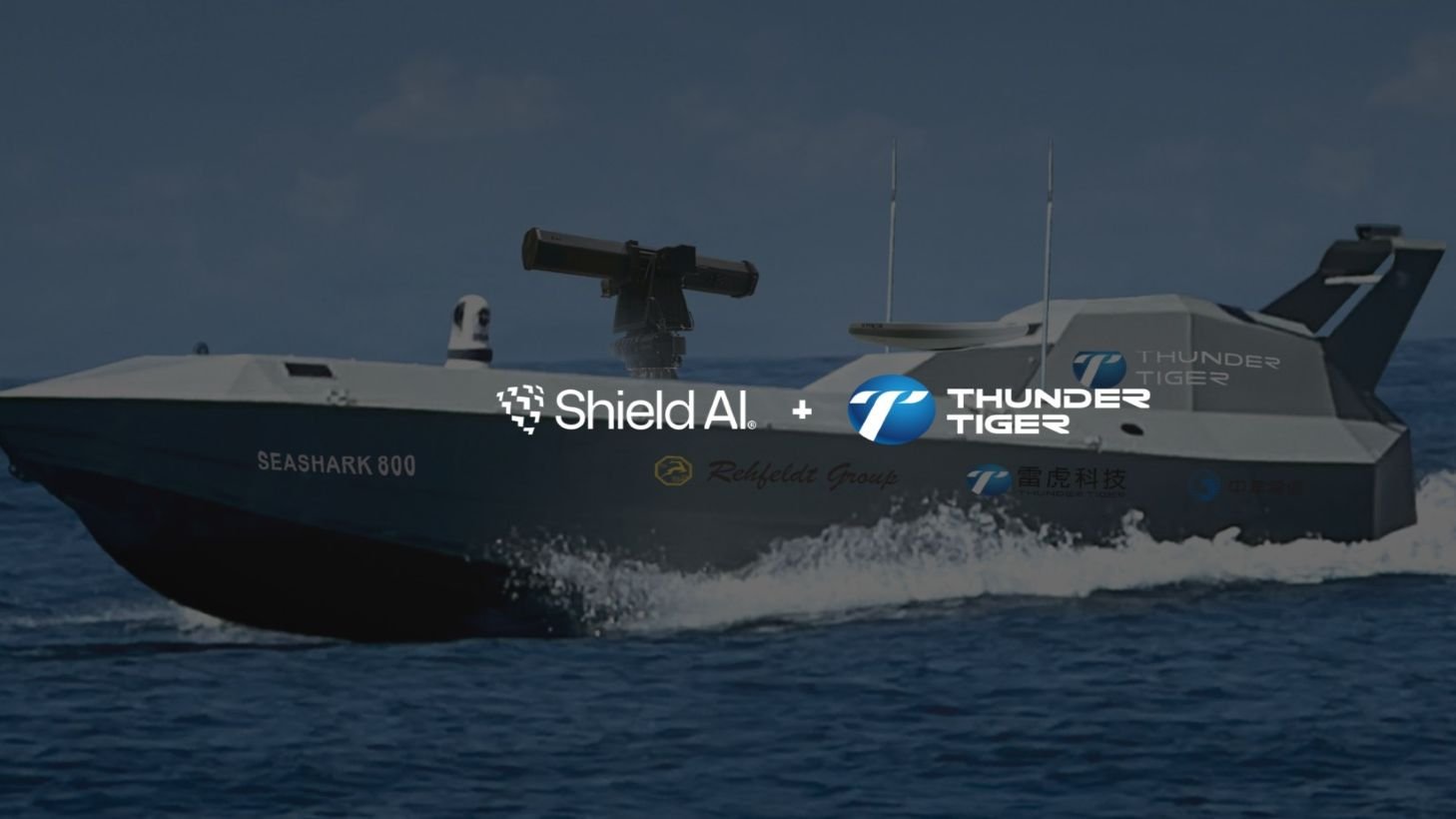
Shield AI and Thunder Tiger Corp. announced a memorandum of understanding on May 12, 2026, to integrate Shield AI’s Hivemind autonomy software into Thunder Tiger’s unmanned systems portfolio in Taiwan, starting with unmanned surface vessels.
The companies said the first milestone will place Hivemind as the AI pilot on a Thunder Tiger USV, with a live demonstration planned for this summer. The event is intended to show how autonomous maritime systems can navigate, respond, and conduct operational tasks at sea.
Initial scope and testing plan
Under the agreement, integration and testing will follow a phased process. The companies said this will include simulation-based testing, hardware-in-the-loop integration, and live vehicle testing.
The stated objective is to validate coordinated operation among multiple autonomous systems across Thunder Tiger’s platforms. That includes testing whether maritime and aerial systems can function as a mixed fleet and perform as a multi-agent team in operational conditions.
Focus on maritime and cross-domain autonomy
Hivemind is Shield AI’s core autonomy software and is designed to enable systems to sense, decide, and act without continuous human control. In this agreement, the software is intended for use across Thunder Tiger’s maritime and aerial unmanned systems, beginning with USVs.
Shield AI co-founder Brandon Tseng said the partnership is aimed at supporting Taiwan’s Ministry of National Defense with asymmetric capabilities and is part of the company’s broader strategy in Taiwan. He also said Hivemind has previously been integrated on dozens of platforms in multiple domains and that the Taiwan effort will support cross-domain, multi-agent teaming in contested environments.
Thunder Tiger board director and general manager Gene Su said the company’s systems are built for operational use cases ranging from coastal defense to broader multi-domain missions. He said integrating Hivemind is intended to add autonomous decision-making and improve the ability of individual platforms to operate independently or as part of a coordinated team.
Broader Taiwan presence
Shield AI said the agreement builds on its existing contracts and agreements in Taiwan related to AI-piloted unmanned systems and teaming. The company also pointed to its in-country presence, including an office in Taipei 101, as part of its effort to support the development, fielding, and sustainment of autonomous defense capabilities in partnership with local industry.
Company background
Shield AI, founded in 2015, develops autonomy software and aircraft, including Hivemind, V-BAT, and X-BAT. The company said it operates offices and facilities across the United States, Europe, the Middle East, and the Asia-Pacific region.
Thunder Tiger Corp., listed on the Taiwan Stock Exchange as 8033, manufactures unmanned aerial vehicles, unmanned surface vessels, and related systems. Its products are used in defense, inspection, disaster response, and other mission-focused applications.
The release also noted that Thunder Tiger’s FPV platforms have been approved under the U.S. Department of Defense Blue UAS program, a designation tied to cybersecurity, supply chain integrity, and non-PRC sourcing requirements used in allied procurement.
Recommended Comments