




-
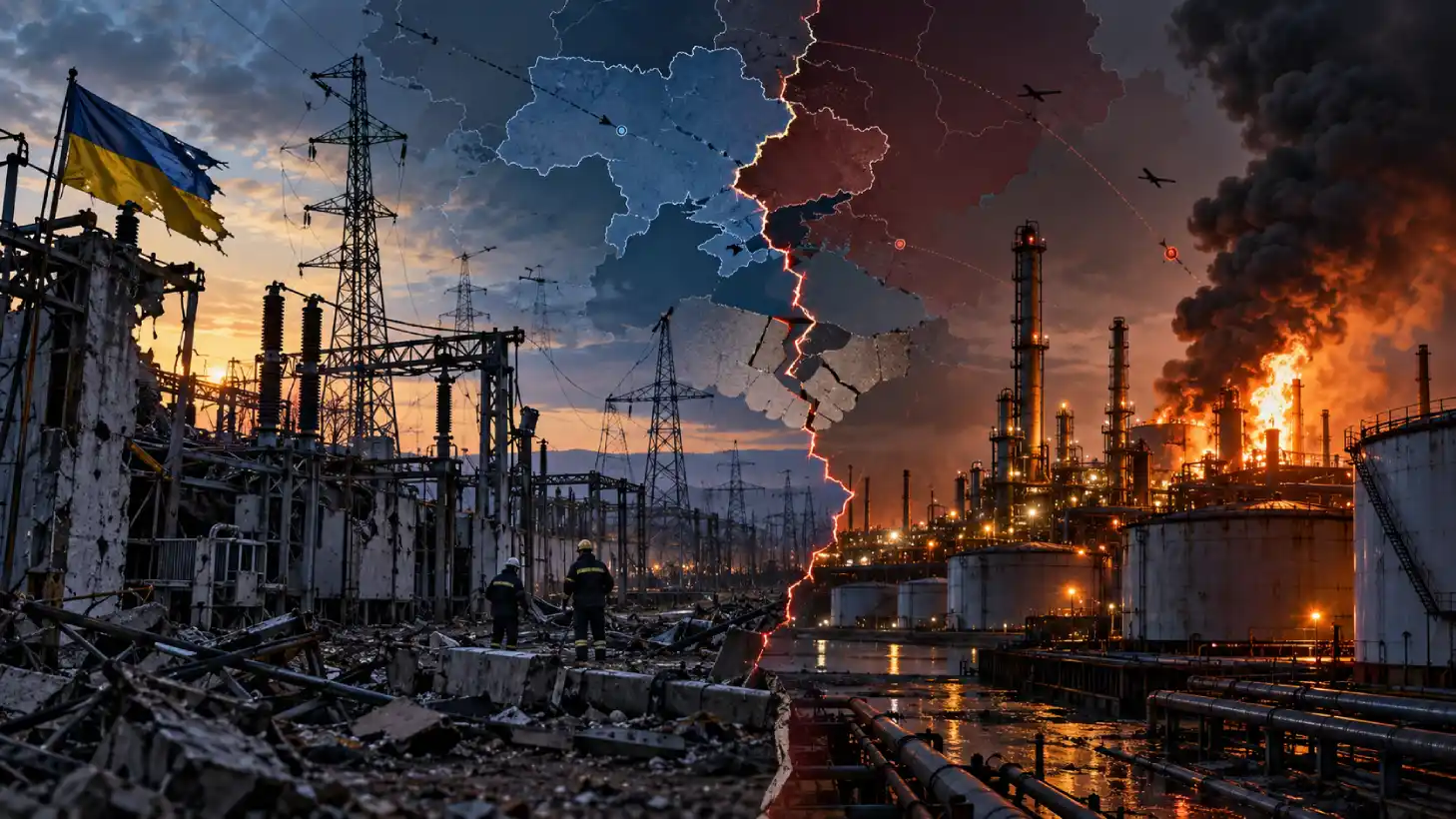
TL;DR: TL;DR: On October 11, 2026, U.S. President Donald Trump announced that Russia and Ukraine had agreed to an immediate ceasefire covering energy infrastructure. However, neither government independently confirmed a finalized agreement. Ukraine expressed support for a reciprocal halt and temporarily suspended strikes on Russian refineries, while Moscow continued discussing the proposed arrangement and Russian attacks on Ukrainian energy facilities persisted. On October 15, Ukraine resumed refinery strikes. The evidence supports a failed diplomatic initiative, not a successfully established and maintained bilateral energy ceasefire.
What Was the October 2026 Energy Ceasefire?
On October 11, 2026, U.S. President Donald Trump announced that Russia and Ukraine had agreed to immediately suspend attacks on one another's energy infrastructure. The announcement came amid increasing tensions between Washington and Kyiv, continuing Russian strikes on Ukrainian power facilities, and Ukrainian attacks on Russian oil refineries.
Trump announced the agreement on Truth Social, stating:
"Effective immediately, there is an ENERGY CEASEFIRE in the War between Russia and Ukraine. Both parties have agreed. Do not break it!"
The declaration suggested that both governments had accepted a mutual restriction on attacks against energy-related targets. However, neither Kyiv nor Moscow immediately confirmed that a finalized agreement existed.
Ukrainian President Volodymyr Zelenskyy initially expressed surprise at the announcement, while the Kremlin provided no immediate confirmation. Both governments subsequently discussed the possibility of an energy ceasefire, but their public statements did not establish that they had agreed to the same operational terms.
This distinction is central to understanding the controversy. A government announcing that an agreement has been reached does not, by itself, demonstrate that all participating governments have accepted its terms.
The October declaration was also not intended to end the broader war. An energy ceasefire would restrict a particular category of military operations while potentially allowing other fighting to continue.
Did Russia and Ukraine Actually Agree to a Ceasefire?
The available public evidence does not establish that Russia and Ukraine finalized a mutually accepted, operational energy ceasefire before the initiative collapsed.
Three distinct positions emerged following Trump's announcement.
The United States: Trump publicly declared that both countries had agreed to immediately halt attacks on energy infrastructure. His administration presented the arrangement as an effort to reduce attacks and ease international energy-market pressures.
Ukraine: Zelenskyy stated that Ukraine supported a reciprocal energy ceasefire and was willing to suspend attacks on Russian oil refineries if Russia stopped attacking Ukrainian energy infrastructure. However, Kyiv maintained that it was still awaiting details from Washington.
Russia: The Kremlin acknowledged ongoing discussions about a possible energy ceasefire but did not publicly confirm that an agreement with finalized terms had entered into force.
On October 13, Kremlin spokesperson Dmitry Peskov told reporters that discussions were continuing but offered no additional information. Russia's government did not identify the parties involved in those discussions or clarify which facilities would be protected.
(Reuters — October 11; Reuters — October 13)
By October 15, Reuters reported that the Kremlin had acknowledged the scope of the proposed energy ceasefire had never been determined and that work had continued to define it.
This was a substantial unresolved issue. Without an agreed definition of protected targets, duration, commencement, and compliance expectations, it becomes difficult to determine whether an attack constitutes a violation of the proposed arrangement.
A ceasefire does not necessarily require a publicly released written treaty. Governments can establish operational agreements through other diplomatic or military channels. However, an undisclosed understanding cannot be assumed merely because one participant announces it.
The most defensible conclusion is that negotiations and a temporary restraint in Ukrainian refinery strikes occurred, but a fully defined and mutually confirmed energy ceasefire was not publicly established.
Did Ukraine Reject the Proposed Energy Ceasefire?
No. The documented statements from Ukraine's leadership show support for a reciprocal cessation of attacks on energy infrastructure.
Following Trump's announcement, Zelenskyy stated that Ukraine supported the ceasefire, emphasized the need for Russian participation, and said Kyiv was awaiting details from the American government.
On October 12, Ukraine's presidential office reiterated that Kyiv was prepared to participate in an energy ceasefire and had previously proposed similar arrangements.
Ukraine's condition was straightforward: a halt to Ukrainian strikes on Russian energy facilities should be matched by a halt to Russian attacks on Ukrainian infrastructure.
(Office of the President of Ukraine — October 12; Reuters — October 11)
Importantly, this was not merely a verbal expression of support.
According to Reuters, Ukraine temporarily suspended strikes against Russian refineries following the American announcement. On October 12, Zelenskyy stated that Ukrainian forces had not attacked Russian refineries overnight.
The suspension was intended to demonstrate Kyiv's willingness to participate in an energy ceasefire.
Russian officials subsequently disputed whether Ukraine had fully halted its refinery attacks. Those competing claims have not been independently resolved for every incident.
Nevertheless, portraying Ukraine's initial position as an outright rejection of the ceasefire contradicts its documented public support and the reported temporary suspension of refinery strikes.
(Reuters — October 12; Associated Press — October 15)
Did Russia Stop Attacking Ukrainian Energy Infrastructure?
Russian attacks on Ukraine continued following the October 11 announcement, including strikes that Ukrainian authorities identified as attacks against energy infrastructure.
On the day of the announcement, Ukrainian officials reported an attack on a combined heating and power facility in Kharkiv. Zelenskyy also described continued Russian drone and missile activity.
On October 12, Ukraine reported strikes against at least six energy-related targets, including a gas-production facility and a fuel station.
The reported attacks occurred while Ukraine was publicly supporting the proposed ceasefire and awaiting its detailed terms.
(Reuters — October 11; Reuters — October 12)
The situation continued to deteriorate over the following days.
Russian missile and drone strikes damaged Ukrainian infrastructure and disrupted electricity supplies for hundreds of thousands of residents.
By October 15, Ukrainian officials reported another large-scale Russian aerial assault, including attacks affecting critical infrastructure and civilian areas. The Associated Press reported that three people were killed and six injured in a prolonged drone attack on Ukraine's Kirovohrad region.
(Associated Press — October 15)
Russia has disputed Ukrainian accounts of some incidents. On October 13, for example, the Russian Defense Ministry stated that its forces had not targeted Ukrainian energy facilities during the preceding overnight attacks.
Independent reporting establishes that attacks and infrastructure damage continued during the proposed ceasefire period, but does not independently settle every disputed target, launch time, or allegation of responsibility.
Furthermore, calling an attack a formal ceasefire violation requires establishing that an applicable agreement existed and determining when its obligations began.
The evidence therefore supports two related but distinct findings: Russian attacks on Ukrainian energy infrastructure continued, and the proposed ceasefire never developed into a publicly verifiable, functioning bilateral arrangement.
(Reuters — October 13; Reuters — October 15)
October 15: Why Did the Energy Ceasefire Collapse?
By October 15, Ukraine had abandoned its temporary restraint on attacks against Russian refineries.
In an interview published by the Financial Times, Zelenskyy announced that the restriction on Ukrainian refinery strikes had ended.
That same day, Ukraine struck a Russian oil refinery in the Ryazan region southeast of Moscow. Regional Russian authorities reported that the attack caused a fire at the facility.
The refinery, operated by Rosneft, represents a significant component of Russia's domestic oil-processing capacity.
Ukraine presented the decision as a response to Russia's continuing strikes and the failure of the proposed reciprocal arrangement.
The Kremlin responded by accusing Ukraine of undermining American peace efforts. Russian officials also maintained that Ukraine had never completely stopped attacking Russian refineries.
These statements illustrate the competing positions: Kyiv argued that reciprocity had failed, while Moscow disputed Kyiv's claimed compliance.
The October 15 refinery attack itself was corroborated through reporting from both Russian officials and a Ukrainian official. However, the record of alleged violations preceding the attack remains contested.
(Associated Press — October 15)
The breakdown should not be mistaken for the collapse of an established, comprehensive peace agreement. It was the failure of a narrower initiative to limit attacks on energy infrastructure.
Why Were Energy Facilities Central to the Negotiations?
The proposed ceasefire involved two countries attacking different but strategically significant parts of one another's energy systems.
Russia has repeatedly targeted Ukraine's electricity-generation, transmission, heating, and other energy infrastructure. These attacks can disrupt civilian electricity and heating while also affecting industrial production, transportation, communications, and military logistics.
Ukraine, meanwhile, has used long-range drones and other weapons to attack Russian oil refineries and associated fuel infrastructure.
These attacks can reduce Russian refining capacity, disrupt fuel distribution, and increase the economic and logistical costs of sustaining military operations.
Both approaches can produce significant civilian consequences, although the military purposes and immediate effects of particular strikes differ.
(Reuters — October 12; Reuters — October 15)
The United States also had an important economic reason to pursue an agreement.
Global diesel prices had risen substantially amid disruptions linked to the ongoing conflict involving Iran and damage to Russian refining capacity.
Trump argued that Ukrainian attacks on Russian refineries were contributing to higher diesel prices affecting American truckers, farmers, and consumers.
On October 9, Trump announced a separate agreement with Russia to make additional Russian diesel available to international markets. The administration subsequently eased sanctions affecting Russian diesel exports.
The initial quantity announced was more than 300,000 metric tons, or approximately 2.25 million barrels.
Reuters noted that this amounted to less than one day's U.S. transportation-sector diesel consumption. Consequently, the announced supply was limited relative to the scale of international fuel demand.
(Reuters — October 12, Diesel Deal Explained)
The diesel agreement and proposed energy ceasefire were related diplomatically, but they were not the same arrangement.
The diesel deal concerned sanctions and fuel exports between Washington and Moscow. The proposed ceasefire concerned the military conduct of Russia and Ukraine.
Confusing these agreements can create the mistaken impression that Russia's acceptance of a diesel-export arrangement also demonstrated its acceptance of a finalized energy ceasefire.
It did not.
On October 15, Reuters reported that Russian diesel shipments had resumed, including a shipment bound for Morocco. That established movement under the fuel arrangement, not compliance with the proposed military ceasefire.
(Reuters — October 15, Russian Diesel Exports)
Are Attacks on Energy Infrastructure Legal Under International Law?
The legality of an attack on energy infrastructure cannot be determined solely by whether the target is an oil refinery, electrical substation, or generating station.
International humanitarian law distinguishes between civilian objects and military objectives.
Civilian infrastructure generally enjoys protection from deliberate attack. However, certain infrastructure may qualify as a military objective when its nature, location, purpose, or use makes an effective contribution to military action and its destruction, capture, or neutralization offers a definite military advantage under the circumstances.
Energy infrastructure can serve civilian and military functions simultaneously, making the determination particularly complex.
Even when an energy facility qualifies as a military objective, an attack must comply with the rules governing proportionality, distinction, and precautions.
(International Committee of the Red Cross — Protection of Energy Infrastructure)
The International Committee of the Red Cross emphasizes that the foreseeable civilian consequences of an attack must be considered.
Disabling electricity generation or transmission may also disrupt hospitals, water treatment, telecommunications, heating, food storage, and other essential services.
An attack intended solely to damage an opponent's economy or pressure its civilian population into supporting a political settlement does not automatically qualify as an attack against a lawful military objective.
Nuclear power plants and certain other installations receive additional protections because attacks can release dangerous forces and produce exceptionally severe consequences.
(ICRC — Energy Infrastructure and Humanitarian Law; ICRC — Additional Protocol I, Article 56)
Accordingly, neither Russian attacks on Ukrainian electrical infrastructure nor Ukrainian attacks on Russian refineries can be universally classified as lawful or unlawful without examining the particular target, military purpose, expected civilian harm, and circumstances of each operation.
A ceasefire would establish additional agreed restrictions on military conduct, but those restrictions must be distinguished from the underlying rules of international humanitarian law.
Does a Failed Energy Ceasefire Mean Peace Negotiations Have Ended?
No. An energy ceasefire is a limited confidence-building or de-escalation measure, not necessarily a comprehensive political settlement.
A full ceasefire would generally involve a broader halt to hostilities. An energy ceasefire would instead restrict attacks on specifically defined energy-related targets.
Similarly, negotiations about territorial control, security guarantees, sanctions, troop withdrawals, and a permanent peace settlement can continue even if a limited ceasefire proposal fails.
This distinction became important during the October discussions.
Zelenskyy separately proposed a 60-day comprehensive ceasefire that would allow Ukraine to organize presidential elections. The Kremlin rejected that temporary full-ceasefire proposal, saying it preferred to pursue a broader peace agreement.
That position should not be confused with Russia's separate statements that discussions concerning an energy ceasefire were ongoing.
(Reuters — October 12, Russian Response)
Support for negotiations also does not require unconditional acceptance of another government's proposed terms.
Either government may support diplomacy while disputing the territorial, political, military, or security provisions of an agreement.
Therefore, statements that Ukraine rejected peace simply because it would not unilaterally suspend its refinery strikes omit the distinction between negotiating an agreement and accepting an arrangement without reciprocal commitments.
Could Separate Humanitarian Energy Ceasefires Still Exist?
Yes. Limited local ceasefires can be negotiated independently of a broader energy agreement.
For example, the International Atomic Energy Agency has worked with Russia and Ukraine to establish temporary arrangements permitting repairs to electrical infrastructure supporting the Zaporizhzhia Nuclear Power Plant.
These arrangements are intended to protect repair personnel and maintain electrical supplies necessary for nuclear safety.
In an October 9 update, the IAEA confirmed ongoing efforts to arrange a localized ceasefire for repairs near the Zaporizhzhia Thermal Power Plant.
On October 15, Russia's state nuclear company Rosatom said that a truce had been established to facilitate those repairs.
Such a localized humanitarian arrangement would not establish that either country accepted the broader energy ceasefire announced by Trump.
(IAEA — October 9, 2026; Reuters — October 15)
How Can Claims About an Energy Ceasefire Be Verified?
Coverage of ceasefires often fails to distinguish diplomatic announcements from implementation.
Before concluding that a ceasefire exists, reporting should establish whether the relevant governments have confirmed their participation, what restrictions they accepted, and whether those restrictions have taken effect.
Several questions are particularly useful.
Question | Why it matters |
|---|---|
Did both governments confirm the agreement? | A third-party announcement alone does not establish mutual acceptance. |
When was the ceasefire supposed to begin? | The commencement time determines which incidents may qualify as violations. |
Which facilities were protected? | Oil refineries, fuel depots, power plants, and transmission networks may not all be covered. |
Was the commitment reciprocal? | A unilateral pause is different from a bilateral agreement. |
Was compliance independently monitored? | Battlefield allegations require corroboration wherever possible. |
Did the parties agree on how violations would be handled? | Monitoring and dispute-resolution procedures can help sustain an arrangement. |
A public written document is not always necessary for a valid ceasefire. Nevertheless, when no agreed terms have been disclosed, journalists should avoid asserting more certainty than the evidence supports.
The same standards apply to claims that a government violated, rejected, or abandoned a ceasefire.
A political statement may accurately describe what a leader wants to happen without proving that the other parties have agreed or that the situation on the ground has changed.
Final Assessment: What Happened to the October 2026 Energy Ceasefire?
The October 2026 energy ceasefire initiative failed to establish a functioning, publicly verifiable agreement between Russia and Ukraine.
The available evidence supports the following conclusions:
Trump announced that both governments had agreed to halt attacks on energy infrastructure, but neither government independently confirmed finalized terms at the time.
Ukraine publicly supported a reciprocal arrangement and temporarily suspended attacks on Russian oil refineries.
The Kremlin continued discussing the proposed ceasefire without publicly establishing its scope or confirming a fully operational agreement.
Russian attacks on Ukrainian energy infrastructure continued during the period.
On October 15, Ukraine resumed strikes against Russian refineries, ending its temporary restraint.
The public record also contains unresolved competing claims about compliance. These should not be treated as independently proven merely because they were made by either government.
The central misconception is that the American announcement established a completed and functioning ceasefire. The evidence instead documents a proposed arrangement, limited restraint by Ukraine, continuing attacks, unresolved terms, and an eventual breakdown.
Claims that Ukraine simply refused the ceasefire are contradicted by its documented support for a reciprocal arrangement. Claims that both governments had already reached and implemented a binding operational agreement are likewise unsupported by the publicly available record.
The broader lesson extends beyond this particular diplomatic episode: a ceasefire announcement is not the same as a verified ceasefire, and diplomatic commitments must be judged against the terms accepted by the parties and their conduct on the ground.
Editorial note: This resource reflects information available through October 15, 2026. Diplomatic negotiations and battlefield conditions can change. Future announcements should be evaluated independently rather than assumed to confirm the October 11 declaration.
There are no reviews to display.