



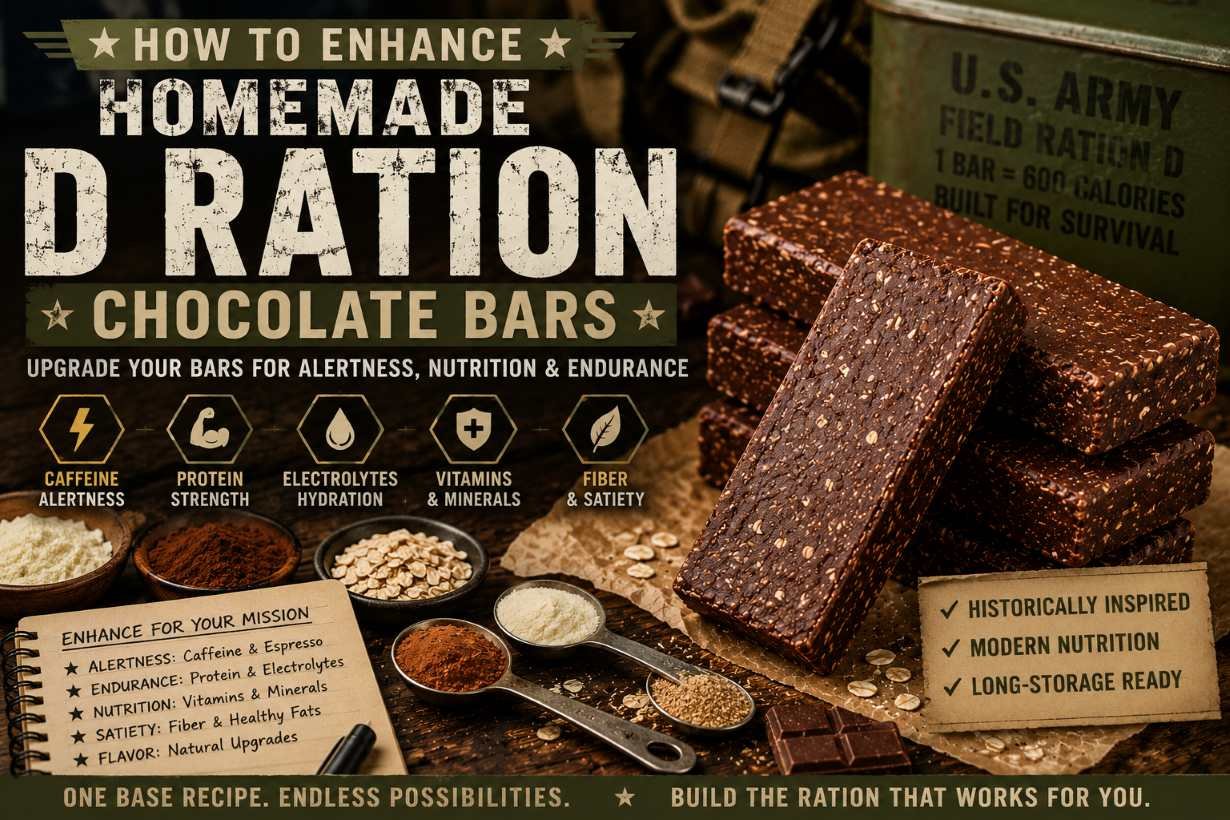

The original U.S. Army D Ration was not a candy bar. It was an emergency survival ration developed in the late 1930s to give soldiers a compact, durable, calorie-dense food source that could survive heat, rough handling, and long storage. It was intentionally hard, dense, and only mildly palatable because it was meant to be eaten when regular rations were unavailable.
That historical purpose is what makes the D Ration such an interesting recipe to recreate today. It was not designed around comfort. It was designed around function.
Modern home cooks, hikers, campers, reenactors, emergency preppers, and survival food enthusiasts often have different goals. You may want something historically inspired, but also more useful for long hikes, power outages, road trips, hunting camps, emergency bags, or long-storage meal kits. With modern ingredients, you can build on the D Ration concept by adding caffeine, electrolytes, protein, fiber, vitamins, and minerals.
This guide explains how to enhance homemade D Ration-style chocolate bars without replacing the base recipes themselves.
It is designed to work alongside two related recipes:
Historical WWII D Ration Chocolate Bar — a more authentic recreation based on the known ingredients and purpose of the original wartime ration.
Modern D Ration-Inspired Chocolate Bar — a more approachable version with better flavor, easier texture, and modern pantry ingredients.
The enhancements below can be applied to either version, though they make the most sense with the modern recipe. The historical version should remain mostly untouched if your goal is authenticity. If your goal is a practical emergency ration, then these upgrades can help turn a simple chocolate ration into a more complete long-storage meal enhancement.
Before You Begin
Start with one of your base D Ration-style recipes.
If you want the most historically faithful version, use the Historical WWII D Ration Chocolate Bar recipe. This version is harder, drier, less sweet, and more authentic to the wartime concept. Enhancements can be added to it, but every added ingredient pulls it farther away from the original experience.
If you want a practical ration bar for hiking, camping, emergency storage, or general use, start with the Modern D Ration-Inspired Chocolate Bar recipe. This version is easier to chew, easier to prepare, and better suited for fortification.
The basic rule is simple:
Add powdered enhancements to the dry ingredients before adding the wet ingredients.
This matters because many of the upgrades in this guide are powders: caffeine powder from crushed tablets, instant espresso, protein powder, vitamin and mineral premix, electrolyte powder, ground flaxseed, chia seed, or oat fiber. If these are added after the wet ingredients, they may clump, streak, or form concentrated pockets.
To enhance a batch properly:
Prepare the dry ingredients from your chosen base recipe.
Add any enhancement powders.
Whisk or stir thoroughly for several minutes.
Add the melted chocolate, cocoa butter, syrup, honey, or other wet ingredients.
Mix until a stiff dough or paste forms.
Compress firmly into molds or a lined pan.
Chill or set according to the base recipe.
Strong mixing is important. If you are adding vitamins, caffeine, or electrolytes, you do not want one bar receiving most of the added ingredient while another receives almost none.
Also remember that every enhancement changes texture and taste.
Protein powders and fiber powders can make the mixture drier. Electrolyte blends and vitamin premixes can add bitterness. Espresso powder can deepen the chocolate flavor. Caffeine tablets may add a slight medicinal edge if too much is used. If the mixture becomes too dry to press together, add warm water one teaspoon at a time, but use as little as possible. Extra moisture can reduce shelf life.
Enhancement Option 1: The Alertness Bar
The original D Ration did not contain caffeine. Soldiers relied on coffee, tea, or other ration items for stimulation. A modern version, however, can easily be adapted into an alertness bar.
This can be useful for:
Long hikes
Overnight camping
Long-distance driving
Emergency response
Hunting trips
Search and rescue work
Disaster preparedness
Bug-out bags
Power outage kits
The goal is not to create an overloaded energy product. The goal is controlled, moderate caffeine.
For most healthy adults, a useful target is:
50 mg caffeine per bar for mild alertness
75–100 mg caffeine per bar for a stronger effect
150–200 mg caffeine per bar only for people who already tolerate caffeine well
For a general homemade ration bar, 100 mg per bar is a practical upper target. It is roughly comparable to a normal cup of coffee.
Caffeine Source 1: Instant Espresso Powder
Instant espresso powder is the easiest and best-tasting caffeine source for chocolate ration bars.
It has several advantages:
It blends well with cocoa.
It improves chocolate flavor.
It is easy to mix into dry ingredients.
It does not require crushing tablets.
It feels like a natural part of the recipe.
To use it, add 2–3 tablespoons of instant espresso powder per batch.
Mix it into the dry ingredients before adding the wet ingredients.
The caffeine amount will vary depending on the brand, so check the label if exact dosing matters. Espresso powder usually provides a gentler caffeine boost than caffeine tablets unless a large amount is used. The caffeine dose is less predictable using this method unless the package clearly lists caffeine content.
Caffeine Source 2: Caffeine Tablets
Caffeine tablets are the best option when you want a more accurate dose.
Many commercial caffeine tablets contain 200 mg of caffeine each. That makes them easier to calculate than loose caffeine powder.
For example:
1 tablet at 200 mg divided across 4 bars = 50 mg per bar
1 tablet at 200 mg divided across 2 bars = 100 mg per bar
2 tablets at 200 mg each divided across 4 bars = 100 mg per bar
3 tablets at 200 mg each divided across 6 bars = 100 mg per bar
To use caffeine tablets:
Check the label for the caffeine amount per tablet.
Decide how many bars your batch will make.
Calculate the caffeine per bar before mixing.
Crush the tablets into a fine powder.
Add the powder to the dry ingredients.
Whisk thoroughly for even distribution.
You can crush tablets with a mortar and pestle, a pill crusher, or by sealing them in a plastic bag and pressing them with a rolling pin.
The powder should be as fine as possible. Large pieces can create bitter spots in the finished bar. Crushed tablets can have a slightly bitter or medicinal taste if not mixed well.
Avoid Pure Caffeine Powder
Pure caffeine powder is not recommended for homemade food projects.
The dose required for one serving is extremely small. A slight measuring mistake can create an unsafe amount of caffeine. Unless you have proper precision equipment and formulation experience, caffeine tablets or instant espresso powder are much safer options.
Not that it won't work, but you can also die from an overdose with ease.
Caffeine Safety Note
Caffeinated ration bars should be clearly labeled.
Do not give caffeinated bars to children. Pregnant individuals, people with heart conditions, people sensitive to caffeine, and those taking medications that interact with stimulants should avoid caffeinated versions unless cleared by a medical professional.
Also consider total daily caffeine intake. If someone eats two alertness bars and drinks coffee, they may consume far more caffeine than intended.
Enhancement Option 2: Protein Boost
The original D Ration was calorie-dense, but it was not a high-protein food by modern standards. Adding protein can make a D Ration-inspired bar more filling and more useful for hiking, camping, physical labor, or emergency preparedness.
Protein also helps shift the bar from a simple calorie block toward something closer to a meal supplement.
Good protein options include:
Whey protein isolate
Milk protein concentrate
Casein protein
Soy protein isolate
Pea protein isolate
For the best texture, use a plain or chocolate-flavored protein powder with minimal added sweeteners.
How Much Protein to Add
For a standard batch, start with:
¼ cup protein powder for a mild boost
½ cup protein powder for a stronger boost
If you add too much protein powder, the bar may become chalky, dry, and difficult to bind. This is especially true with whey isolate and pea protein.
If the mixture becomes too dry, add warm water or melted cocoa butter in very small amounts until it presses together.
Best Protein Choices
Whey Protein Isolate
Whey isolate mixes well, has a clean flavor, and works nicely with chocolate. It is one of the best options for a modern ration bar.
Milk Protein Concentrate
Milk protein concentrate is also a good option because it fits the dairy profile already present in many D Ration-style recipes.
Casein Protein
Casein absorbs more moisture and creates a thicker texture. It can make the bar more filling, but it may also make the mixture harder to work with.
Soy Protein Isolate
Soy protein is shelf-stable and practical, though it can add a noticeable flavor.
Pea Protein
Pea protein works for dairy-free versions, but it can be earthy and dry. It pairs better with stronger flavors like cocoa, espresso, cinnamon, or peanut butter powder.
Protein Shelf Life Impact
Protein powder usually has a minimal shelf-life impact if the bar is kept dry and sealed. However, protein powders can absorb moisture from the air, so finished bars should be wrapped tightly and stored in airtight packaging.
For long storage, vacuum sealing is strongly recommended.
Enhancement Option 3: Electrolytes
Electrolytes are one of the most useful upgrades for an emergency or outdoor ration bar.
During hiking, camping, hot weather, physical work, or emergency response, people lose electrolytes through sweat. A bar with sodium, potassium, and magnesium can be more useful than a plain calorie bar.
Key electrolytes include:
Sodium
Potassium
Magnesium
Calcium
The most important for outdoor exertion are usually sodium and potassium.
Electrolyte Powder
The easiest option is an unflavored electrolyte powder.
Look for one that contains:
Sodium
Potassium
Magnesium
Avoid heavily flavored drink mixes unless you want that flavor in the final bar. Citrus, berry, or tropical electrolyte powders may clash with chocolate.
Add the electrolyte powder to the dry ingredients and mix thoroughly.
Follow the product's serving instructions. A good target is usually one serving of electrolyte powder per batch, then divide the total by the number of bars.
Lite Salt Option
Lite Salt or reduced-sodium salt blends usually contain sodium chloride and potassium chloride. This can be a simple way to add sodium and potassium.
Use cautiously.
Potassium chloride has a sharp, bitter flavor if overused. It also may not be appropriate for people with kidney disease or those taking certain medications.
A conservative starting point is:
¼ teaspoon Lite Salt per batch
Mix it thoroughly into the dry ingredients.
Salt and Sodium
Do not overlook ordinary salt. A small amount of sodium improves flavor and can be helpful during exertion.
If your base recipe already contains salt, you may not need much more.
Electrolyte Shelf Life Impact
Electrolytes generally have little impact on shelf life. Minerals are stable compared to vitamins and fats.
The bigger concern is flavor. Too much electrolyte powder can make a chocolate bar taste salty, bitter, or medicinal.
Enhancement Option 4: Vitamins and Minerals
The original D Ration was not designed to be nutritionally complete. It was an emergency calorie source. Fortifying a modern version with vitamins and minerals can make it more useful as part of a long-storage meal enhancement system.
This is especially relevant for:
Emergency food kits
Bug-out bags
Long power outages
Camping supplies
Outdoor work kits
Meal replacement experiments
The safest and easiest approach is to use a food-grade vitamin and mineral premix rather than trying to measure many individual vitamins by hand.
What Is a Vitamin and Mineral Premix?
A premix is a powdered blend of vitamins and minerals designed to fortify food products.
Commercial food manufacturers use premixes in:
Meal replacement shakes
Nutrition bars
Breakfast cereals
Protein powders
Emergency foods
Fortified drink mixes
For a homemade ration bar, a premix helps keep nutrient amounts balanced and easier to dose.
What to Look for When Buying a Premix
Look for a product that is clearly intended for food use.
Good signs include:
Labeled as food-grade
Intended for meal replacement, nutrition bars, beverages, or food fortification
Provides a nutrition panel or specification sheet
Lists vitamin and mineral amounts per serving
Comes from a reputable supplier
Has clear dosage instructions
Is unflavored or neutral-flavored
Does not contain unnecessary sweeteners, gums, or strong flavors
Avoid products that are vague, unlabeled, or sold as raw bulk chemicals without food-use instructions.
For home use, a meal replacement vitamin/mineral blend is usually more practical than trying to buy individual vitamin powders.
Nutrients Worth Looking For
A useful premix may include the following.
Vitamins
Vitamin A
Vitamin C
Vitamin D
Vitamin E
Vitamin K
Vitamin B1, also called thiamine
Vitamin B2, also called riboflavin
Vitamin B3, also called niacin
Vitamin B5, also called pantothenic acid
Vitamin B6
Vitamin B7, also called biotin
Vitamin B9, also called folate
Vitamin B12
Minerals
Calcium
Iron
Magnesium
Zinc
Potassium
Phosphorus
Copper
Selenium
Manganese
Iodine
Not every premix will contain all of these, and that is fine. The goal is not perfection. The goal is to improve the nutritional usefulness of the bar without making it unsafe or unpleasant.
How Much Fortification Should You Aim For?
For a homemade emergency ration bar, a reasonable target is:
25% Daily Value per bar for a moderate fortified bar
50% Daily Value per bar for a strongly fortified bar
Avoid trying to add 100% Daily Value of every nutrient per bar unless you know exactly what you are doing. If someone eats multiple bars in one day, they could exceed safe intake levels for some nutrients.
This is especially important for fat-soluble vitamins and minerals such as:
Vitamin A
Vitamin D
Iron
Zinc
Selenium
Copper
More is not always better.
How to Add a Premix
Use the premix according to the manufacturer's instructions.
A general process:
Decide how many bars your batch makes.
Decide whether you want 25% or 50% Daily Value per bar.
Calculate the total amount of premix needed for the full batch.
Add the premix to the dry ingredients.
Whisk thoroughly for several minutes.
Continue with the base recipe.
Because premixes are used in small amounts, even mixing is critical. Poor mixing could create bars with uneven nutrient levels.
Flavor Considerations
Vitamin and mineral premixes can taste bitter, metallic, chalky, or medicinal.
Chocolate helps hide some of that flavor, but not all of it.
To improve flavor, consider pairing fortified bars with:
Extra cocoa powder
Instant espresso powder
Cinnamon
Vanilla powder
Peanut butter powder
Freeze-dried berry powder
The modern D Ration-inspired recipe will usually handle vitamin and mineral additions better than the historical version because it is sweeter and softer.
Shelf Life Impact of Vitamins and Minerals
Minerals are generally stable.
Vitamins are more delicate.
Vitamin C, Vitamin A, and some B vitamins can degrade over time, especially when exposed to heat, oxygen, moisture, and light. This does not necessarily make the bar unsafe, but it may reduce the nutritional value over time.
To preserve potency:
Store bars in a cool, dry place.
Keep them sealed.
Avoid direct light.
Use oxygen absorbers if vacuum sealing.
Rotate stored bars periodically.
For homemade fortified bars, it is best to think in terms of months rather than decades.
Enhancement Option 5: Fiber and Satiety
Fiber can make a ration bar more filling and may help support digestion when emergency meals are otherwise low in fresh foods.
Good fiber additions include:
Ground flaxseed
Chia seeds
Oat fiber
Psyllium husk powder
Each behaves differently.
Ground Flaxseed
Ground flaxseed adds fiber, mild nuttiness, and some fats.
Use:
1–2 tablespoons per batch
Because flax contains natural oils, it may slightly reduce shelf life compared with a plain bar. Store flax-enhanced bars in cooler conditions and rotate them sooner.
Chia Seeds
Chia seeds add fiber and texture.
Use:
1–2 tablespoons per batch
Chia seeds are relatively shelf-stable but can absorb moisture. In a dense chocolate ration bar, they add a subtle crunch unless fully hydrated.
Oat Fiber
Oat fiber is a good option if you want fiber without much added fat.
Use:
1–2 tablespoons per batch
It can make the mixture drier, so add it cautiously.
Psyllium Husk Powder
Psyllium is very absorbent.
Use sparingly:
1 teaspoon per batch to start
Too much psyllium can make the texture unpleasantly gummy or dry, depending on the moisture level.
Fiber Shelf Life Impact
Oat fiber and psyllium have minimal shelf-life impact if kept dry.
Ground flaxseed has a greater shelf-life concern because of its natural oils.
Chia seeds are generally stable but should still be kept dry.
Enhancement Option 6: Flavor Upgrades for Practical Use
Once you begin enhancing a D Ration-inspired bar, you may also want to improve the flavor. This is especially useful if the bar is meant for hiking, camping, or emergency kits rather than historical demonstration.
Good shelf-stable flavor additions include:
Cinnamon
Instant espresso powder
Vanilla powder
Peanut butter powder
Freeze-dried berry powder
Cayenne pepper
Powdered coconut milk
Malted milk powder
Avoid fresh fruit, fresh dairy, jam, liquid extracts in large amounts, or high-moisture fillings if long storage is the goal.
Chocolate-Espresso Version
Add:
2 tablespoons instant espresso powder
½ teaspoon cinnamon
This creates a strong, dark chocolate flavor that pairs well with caffeine and protein additions.
Peanut Butter Chocolate Version
Add:
2–4 tablespoons peanut butter powder
This works best with the modern recipe. It adds flavor and some protein while keeping moisture low.
Spiced Survival Bar
Add:
½ teaspoon cinnamon
Pinch of cayenne
Extra cocoa powder if needed
This gives the bar a warming, slightly spicy profile.
Berry Chocolate Version
Add:
1–2 tablespoons freeze-dried berry powder
Freeze-dried berry powder adds flavor without much moisture. Avoid regular dried fruit if long storage is the priority, because it may retain more moisture and reduce shelf stability.
Combining Enhancements
You do not need to add everything. In fact, simple combinations often work better.
Too many powders can make the bar dry, bitter, chalky, or difficult to bind.
Here are several practical builds.
Build 1: Simple Alertness Bar
Best for hiking, camping, long drives, and overnight use.
Add per batch:
Instant espresso powder or crushed caffeine tablets
Optional cinnamon
Optional pinch of salt
This keeps the recipe simple and has minimal shelf-life impact.
Build 2: Endurance Hiking Bar
Best for long hikes and outdoor work.
Add per batch:
¼–½ cup protein powder
1 serving electrolyte powder
1–2 tablespoons chia seeds or oat fiber
Optional instant espresso powder
This build focuses on energy, satiety, and sweat replacement.
Build 3: Emergency Preparedness Bar
Best for bug-out bags, emergency kits, and storm supplies.
Add per batch:
Protein powder
Electrolytes
Vitamin/mineral premix
Optional fiber
Optional caffeine
This is the most complete version, but also the most likely to need recipe adjustments for texture.
Build 4: Full Alertness Emergency Bar
Best for search and rescue, overnight emergencies, and demanding situations where alertness matters.
Add per batch:
Caffeine tablets or espresso powder
Protein powder
Electrolyte powder
Vitamin/mineral premix
Optional cinnamon or peanut butter powder for flavor
This creates something closer to a modern emergency performance ration.
When to Add Each Enhancement
Nearly all dry enhancements should be added at the same stage: during the dry ingredient phase.
Use this general guide.
Enhancement | When to Add |
|---|---|
Instant espresso powder | Dry ingredient stage |
Crushed caffeine tablet | Dry ingredient stage |
Guarana powder | Dry ingredient stage |
Green tea extract powder | Dry ingredient stage |
Protein powder | Dry ingredient stage |
Electrolyte powder | Dry ingredient stage |
Vitamin/mineral premix | Dry ingredient stage |
Ground flaxseed | Dry ingredient stage |
Chia seeds | Dry ingredient stage |
Oat fiber | Dry ingredient stage |
Psyllium husk | Dry ingredient stage |
Peanut butter powder | Dry ingredient stage |
Freeze-dried berry powder | Dry ingredient stage |
Extra cocoa powder | Dry ingredient stage |
Extra cocoa butter | Wet ingredient stage |
Extra honey or syrup | Wet ingredient stage |
Warm water | Only if needed during final mixing |
If the bar becomes too dry, adjust with tiny amounts of warm water, melted cocoa butter, or honey depending on the base recipe.
For long storage, melted cocoa butter is usually a better adjustment than water.
Historical Recipe vs. Modern Recipe: Which Works Better?
These enhancements can technically be applied to both the historical and modern recipes, but they behave differently.
Historical D Ration Recreation
The historical version is best when you want authenticity.
Enhancements should be minimal.
Best additions:
Thiamine-style fortification
Small amount of electrolyte powder
Small amount of espresso powder
Very modest vitamin/mineral premix
Avoid heavy additions if your goal is historical accuracy.
The more you add, the less it resembles the original D Ration.
Modern D Ration-Inspired Bar
The modern version is better for practical enhancement.
It handles added ingredients more easily because it is already designed to be more flexible, softer, and more palatable.
Best additions:
Caffeine
Protein powder
Electrolytes
Vitamin/mineral premix
Fiber
Flavor powders
If you are making a real-world hiking or emergency bar, start with the modern recipe.
Shelf Life Considerations
Enhancing a ration bar can improve usefulness, but it may also change storage life.
The original D Ration concept relied on low moisture, dense compression, and stable fats. When you add powders, syrups, seeds, or supplements, you change that balance.
Minimal Shelf-Life Impact
These usually have little effect if kept dry:
Instant espresso powder
Caffeine tablets
Electrolyte powder
Most minerals
Oat fiber
Cocoa powder
Peanut butter powder
Moderate Shelf-Life Impact
These may reduce quality over time:
Protein powder
Vitamin premix
Chia seeds
Ground flaxseed
Freeze-dried fruit powder
The bar may remain edible, but vitamins may lose potency and fats may slowly oxidize.
Higher Shelf-Life Impact
These reduce long-storage potential more noticeably:
Added water
Butter instead of cocoa butter
Fresh fruit
Regular dried fruit with moisture
Nut butters
Liquid flavorings in large amounts
For long-storage bars, keep moisture as low as possible.
Best Packaging for Enhanced D Ration Bars
Packaging matters as much as the recipe.
For short-term use, parchment or wax paper inside an airtight container is enough.
For longer storage, use:
Vacuum-sealed bags
Oxygen absorbers
Mylar bags
Cool, dark storage
Desiccant packets stored separately from direct food contact, if appropriate
Clear labels with date and ingredients
Label caffeinated bars very clearly.
A good label should include:
Recipe type
Date made
Caffeine amount per bar
Major allergens
Added vitamins or minerals
Estimated calories
Storage recommendation
Example:
Modern Alertness D Ration Bar — 100 mg caffeine per bar — made July 2026 — contains milk and soy — store cool and dry.
Estimated Shelf Life by Version
These are practical home-storage estimates, not commercial guarantees.
Version | Pantry | Refrigerator | Freezer |
|---|---|---|---|
Historical-style plain bar | 6–12 months | 1 year+ | Several years |
Modern plain bar | 2–3 months | Up to 6 months | About 1 year |
Caffeinated bar | Similar to base recipe | Similar to base recipe | Similar to base recipe |
Protein-enhanced bar | 2–6 months | 6–12 months | About 1 year |
Vitamin/mineral fortified bar | 2–6 months, with vitamin potency declining | 6–12 months | About 1 year |
Flaxseed-enhanced bar | 1–3 months | 3–6 months | About 1 year |
For the longest shelf life, use the driest ingredients, avoid butter, avoid added water, use cocoa butter, compress firmly, and vacuum seal.
Safety Notes
Homemade ration bars are not commercially tested emergency food.
They can be useful, interesting, and practical, but they should be rotated regularly and inspected before eating.
Discard bars if you notice:
Mold
Sour smell
Rancid odor
Unusual discoloration
Dampness
Package swelling
Strange or bitter chemical flavor beyond expected ingredients
For fortified bars, avoid excessive dosing. More vitamins, minerals, caffeine, or electrolytes does not automatically make a better bar.
Use measured ingredients and follow product labels.
People with medical conditions, kidney disease, heart conditions, caffeine sensitivity, pregnancy, or medication interactions should be cautious with caffeinated or heavily fortified bars.
Recommended Enhancement Formulas
Below are three simple formulas you can apply to a batch of either D Ration-style recipe.
For best results, use these with the modern recipe.
Formula 1: Alertness D Ration Bar
Add to dry ingredients:
2–3 tablespoons instant espresso powder
OR
Crushed caffeine tablets calculated to provide 50–100 mg caffeine per finished bar
Optional:
½ teaspoon cinnamon
Extra cocoa powder to deepen flavor
Best for:
Long drives
Night hiking
Camping
Emergency wakefulness
Formula 2: Fortified D Ration Bar
Add to dry ingredients:
¼–½ cup protein powder
1 serving unflavored electrolyte powder
Vitamin/mineral premix according to label directions
1 tablespoon oat fiber or chia seeds
Best for:
Emergency kits
Hiking
Disaster supplies
Long-storage meal enhancement
Formula 3: Complete Enhanced D Ration Bar
Add to dry ingredients:
Caffeine source, calculated to 50–100 mg per bar
¼–½ cup protein powder
1 serving electrolyte powder
Vitamin/mineral premix according to label directions
1 tablespoon fiber addition
Optional flavor powder such as espresso, cinnamon, or peanut butter powder
Best for:
Bug-out bags
Long hikes
Overnight emergencies
Search and rescue
Outdoor labor
Serious emergency preparedness
Which Enhancement Should You Choose?
Goal | Best Enhancement |
|---|---|
Historical authenticity | None or very minimal fortification |
Better flavor | Espresso, cinnamon, peanut butter powder |
More alertness | Caffeine tablets or espresso powder |
Hiking | Protein plus electrolytes |
Hot weather | Electrolytes |
Emergency kit | Protein, vitamins, minerals, electrolytes |
Long storage | Minimal moisture, cocoa butter, vacuum sealing |
Meal replacement | Protein plus vitamin/mineral premix |
Overnight use | Caffeine plus electrolytes |
Family-friendly bars | Avoid caffeine |
Final Thoughts
The original D Ration was a brilliant piece of emergency food engineering for its time. It was compact, dense, heat-resistant, and calorie-rich. It was not designed to be delicious, nutritionally complete, or pleasant to eat.
Modern ingredients allow us to take that same concept and adapt it for today's needs.
A historical D Ration recreation gives you a glimpse into what American soldiers carried during World War II. A modern D Ration-inspired chocolate bar makes the idea more practical and enjoyable. An enhanced version takes the next step by adding caffeine, electrolytes, protein, vitamins, minerals, and fiber.
The best version depends on your purpose.
If you want history, keep it simple.
If you want a practical outdoor ration, use the modern recipe.
If you want a long-storage meal enhancement for emergency preparedness, carefully fortify it and package it properly.
The spirit of the D Ration was never about luxury. It was about function. These enhancements keep that spirit alive while updating the bar for modern needs.
Join the conversation
You can post now and register later. If you have an account, sign in now to post with your account.