



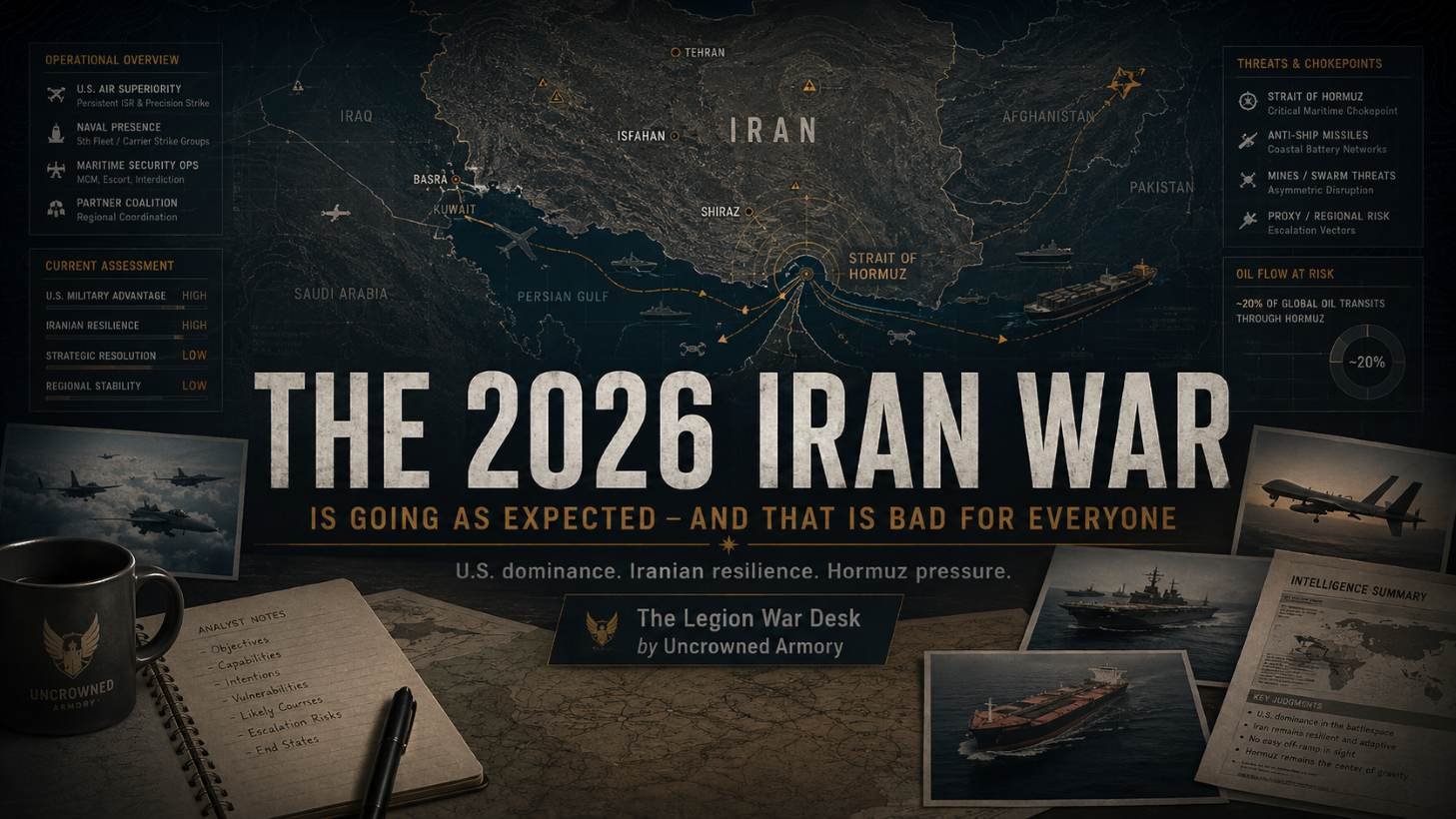
The Iran War Is Going as Expected — and That Is Bad for Everyone

By Uncrowned Guard in 2026 Iran War
· 120 views
The War Is Going Both Better and Worse Than Expected
From a purely military standpoint, the Iran war has largely followed the expected pattern: the United States has demonstrated overwhelming conventional superiority. American airpower, long-range strike capability, surveillance, and command systems have reportedly allowed Washington to hit targets across Iran while maintaining broad air superiority. Even after reported aircraft losses, analysts such as the Institute for the Study of War argued that those losses did not mean the U.S.-led force had lost control of the air.
That part should not surprise anyone. The United States remains the world’s most capable conventional military power, especially when it comes to precision strikes, air operations, logistics, and sustained regional deployment.
But the bigger problem is that military dominance has not translated into a clean strategic result.
Iran has been battered, but not broken. Its leadership has remained functional. The state has not collapsed. Its military and security institutions still appear capable of carrying out national policy. Most importantly, Tehran has continued to use the Strait of Hormuz as its main strategic weapon.
Iran’s Real Leverage Was Never Military Superiority
Much of the public discussion has focused on U.S. strike success. That is understandable. Air superiority is visible, dramatic, and easy to explain. The U.S. can hit Iranian targets. Iran cannot hit the U.S. homeland in the same way. On paper, that looks like dominance.
But Iran’s strongest card was never defeating the U.S. military in a direct fight. Iran’s strongest card was making the war economically and politically expensive.
The Strait of Hormuz is central to that strategy. The waterway is one of the most important energy chokepoints in the world, with roughly a fifth of global oil and liquefied natural gas trade moving through or depending on access to the route. Reuters reported that the war’s closure of Hormuz disrupted more than 14 million barrels per day of oil output, underlining just how much global energy security depends on that narrow passage.
That gives Iran a form of leverage that does not require matching the United States plane for plane, ship for ship, or missile for missile. Tehran only needs to make shipping through the strait unreliable enough that insurers, energy companies, and governments treat the route as unsafe.
In that environment, even limited attacks, drones, mines, missiles, boarding operations, or credible threats can have an outsized effect.
Tactical Victory Is Not Strategic Coercion
This is where many observers struggle to understand the conflict. They see the U.S. landing successful strikes and ask why Iran has not surrendered or accepted whatever deal Washington wants.
The answer is that Iran is not negotiating from the position of a defeated state. It is negotiating from the position of a damaged but still functioning state that controls, or can threaten, a critical artery of the global economy.
That does not mean Iran is unharmed. Sanctions, strikes, infrastructure damage, internal repression, and economic pressure all matter. Iran’s population is paying a serious price. But there is a difference between “hurting badly” and “being close to collapse.”
Iran has spent decades learning to survive under isolation, sanctions, and pressure. Its economy is weaker than it could be, but the state is also structured for endurance rather than prosperity. That matters. Countries built around global trade, foreign investment, and consumer confidence often break faster under pressure. Iran has already been living in a pressure economy.
The Strait Changed the Negotiating Table
The reported interim agreement shows why Hormuz became the center of gravity. Reuters reported that the U.S.-Iran memorandum includes reopening the Strait of Hormuz, easing the U.S. naval blockade, and launching a 60-day negotiation period toward a final deal.
That alone says a great deal. If the United States had achieved decisive coercive leverage, the main question would be what Iran had to give up. Instead, the deal appears focused heavily on restoring energy flows, reducing escalation risk, and getting both sides into a more stable negotiating process.
The Guardian reported that the agreement includes a ceasefire, reopening Hormuz, oil-related waivers, and a 60-day process for unresolved nuclear issues. Reuters also reported that regional rivals are alarmed because the deal may leave Iran with significant strategic and political gains despite the damage it has suffered.
That does not make the deal “pro-Iran” by default. It does suggest that Iran’s endurance and control over Hormuz prevented the U.S. from converting military success into a simple surrender framework.
Why This Matters
The Iran war is a reminder that wars are not won by strike counts alone. The United States can dominate the battlefield and still face a strategic problem it cannot bomb away.
Iran does not need to win a conventional war. It needs to survive, keep its leadership intact, preserve enough military capacity to threaten regional costs, and make the economic consequences of continued war unacceptable to everyone else.
That appears to be exactly what happened.
The likely outcomes now are either a deal that gives Iran more than many U.S. hawks wanted, or a long-term regional restructuring built around bypassing Hormuz. Reuters has already noted that Gulf exporters are accelerating efforts to develop routes that reduce dependence on the strait.
But that kind of infrastructure takes time, money, and political coordination. Until then, Iran’s geography remains a strategic weapon.
The Uncomfortable Question
The uncomfortable question is not whether the United States can defeat Iran in the air. It can.
The harder question is whether U.S. leaders entered this war believing air dominance would force political surrender, or whether they understood the risks and accepted them anyway.
If the goal was to punish Iran militarily, the campaign may be judged successful. If the goal was to force Iran into a weak negotiating position, the result is far less clear.
Iran has been hit hard, but it remains standing. Hormuz became the battlefield that mattered most. And the world is now being reminded that military superiority does not automatically equal strategic victory.
Recommended Comments