



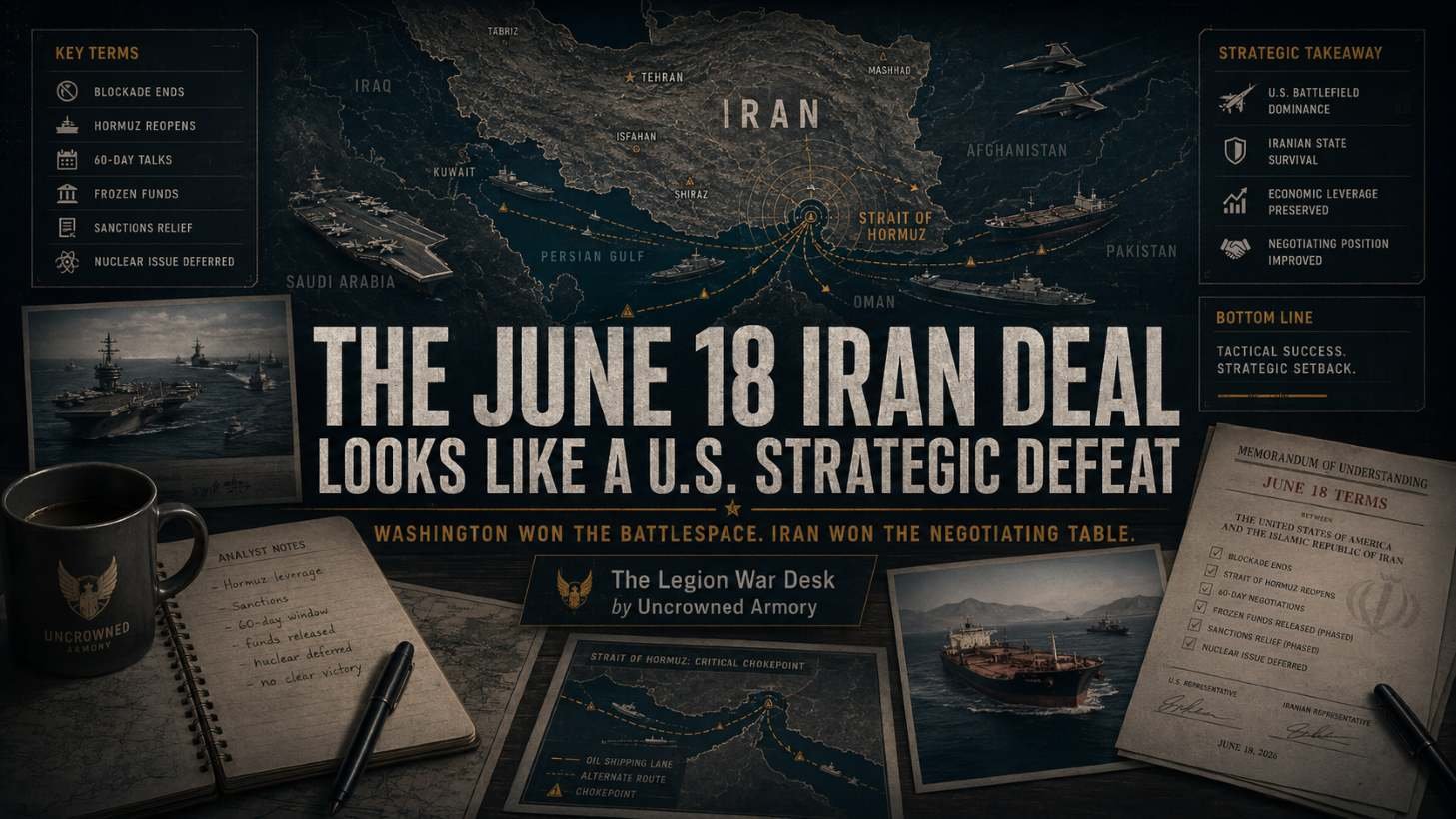
The June 18 Iran Deal Looks Like a U.S. Strategic Defeat

By Uncrowned Guard in 2026 Iran War
· 164 views
A Ceasefire That Rewards Survival
The June 18 agreement is being sold as a ceasefire, and technically that is true. Reuters reported that the White House sent Congress the text of an interim agreement titled the Islamabad Memorandum of Understanding, calling for a mutual end to military operations, including in Lebanon, while also requiring the United States to lift its naval blockade of Iranian ports within 30 days. In return, Iran is expected to allow commercial traffic through the Strait of Hormuz during the 60-day negotiation window.
But the political meaning is harder to ignore. The United States entered the war with overwhelming military advantages. It could strike Iranian targets, dominate the air, and impose severe costs. Yet the terms of the deal show that battlefield dominance did not translate into strategic control.
Iran survived the campaign, kept the state intact, maintained leverage over Hormuz, and reached the negotiating table with major concessions still on the table. That is not a surrender by Iran. If anything, it shows that Iran’s central wartime strategy worked: endure the punishment, keep the chokepoint dangerous, and force Washington to choose between escalation and compromise.
The Strait of Hormuz Became the Real Battlefield
The biggest American objective was not just hitting Iran. It was restoring the flow of energy through the Strait of Hormuz. That alone reveals where the pressure point really was.
Business Insider reported that the agreement includes two major Hormuz-related terms: Iran will reopen the waterway, and the United States will begin lifting its naval blockade immediately, with the blockade fully ending within 30 days. The Strait is described as carrying roughly 20% of the global oil and liquefied natural gas trade.
That makes Hormuz the center of gravity. Iran did not need to defeat the U.S. Navy in open combat. It only needed to make the waterway unstable enough that global markets, insurers, shipping companies, and Gulf states demanded a way out.
That is why the deal looks so lopsided from a strategic perspective. The U.S. gets the Strait reopened, but only by accepting that Iran remains the unavoidable manager of the crisis. Worse for Washington, The Guardian reported that Iran has already announced plans to introduce maritime fees in the Strait of Hormuz within two months, while Gulf states are pushing back against any toll-like future arrangement.
In other words, the deal may reopen Hormuz, but it does not remove Iran’s leverage over it.
The Nuclear Issue Was Deferred, Not Solved
The stated reason for the war was Iran’s nuclear program. Yet the agreement does not appear to fully resolve that issue at the ceasefire stage.
The Guardian reported that the deal commits Iran to avoiding nuclear weapons while leaving significant follow-up questions for later negotiations, including how to manage existing enriched uranium and what the final framework will look like. It also reported that critics argue the agreement does not address Iran’s ballistic missile program.
Reuters separately noted that the current sanctions picture remains complex, with many U.S., UN, and EU restrictions tied not only to the nuclear program but also to human rights issues, oil exports, the IRGC, and regional militant groups. Some sanctions can be reversed quickly by the executive branch, while others are more difficult because they are rooted in law or international mechanisms.
That matters because the nuclear question is the one Washington claimed mattered most. If the war ends with Iran promising not to build a bomb while the hard technical details are pushed into later talks, then the U.S. has not achieved a decisive nuclear settlement. It has bought a negotiation period.
That may still be better than a wider regional war, but it is not the same thing as victory.
Iran Gets Time, Money, and Political Breathing Room
One of the most striking parts of the agreement is the economic side. Reuters reported that the deal includes a $300 billion reconstruction and development fund for Iran, while Reuters cautioned that the financial incentives, including sanctions relief and frozen assets, come with major practical complications and should be treated carefully.
The Trump administration has stressed that the United States will not directly pay Iran. That distinction matters domestically. But from Iran’s perspective, the bigger issue is not whether the money comes from U.S. taxpayers. The bigger issue is that the deal creates a path for outside capital, reconstruction support, oil sales, sanctions relief, and access to frozen assets.
That is a remarkable outcome for a country that was just under sustained attack.
Iran entered the war isolated and under pressure. It leaves the ceasefire window with its government intact, its chokepoint leverage preserved, and a path toward economic relief. That does not mean Iran is thriving. It means Iran survived long enough to make Washington negotiate from urgency.
Lebanon Shows How Far the Deal Reaches
The Lebanon clause may be one of the most politically explosive parts of the agreement. Reuters reported that the interim deal calls for a mutual cessation of military operations, including in Lebanon.
That is significant because it means the United States is not only negotiating over U.S.-Iran hostilities. It is also accepting language that touches on Israel, Hezbollah, and Lebanon’s sovereignty. The Guardian reported that the deal drew criticism from Israeli and Republican hardliners and includes terms connected to restraining regional allies, including Hezbollah.
For Iran, that is a major diplomatic gain. Tehran wanted Lebanon included because its regional strategy depends on more than Iranian territory. For Washington, including Lebanon may reduce escalation risk, but it also creates obvious friction with Israel if Israeli leaders reject limits on their operations.
That is another reason this looks less like a clean ceasefire and more like a bargain made under pressure.
This Is Not a Formal Surrender, But It Looks Like a Strategic One
Legally, the United States did not surrender. There was no American capitulation document, no occupation, and no battlefield defeat in the conventional sense.
Strategically, however, the agreement looks much closer to a climbdown than a victory.
Washington used its military power and proved what everyone already knew: the United States can punish Iran severely. But Iran proved something more relevant to the final deal: it could absorb punishment, keep the state functioning, threaten the global energy system, and wait out American political patience.
That is the core lesson of the June 18 terms. The U.S. won the battlespace, but Iran shaped the negotiation space.
The result is a deal that pauses the war, reopens Hormuz, and creates room for diplomacy. That may be necessary. It may even be preferable to escalation. But it is hard to call it a win.
A war launched to force Iran into a weaker position has ended with Iran still standing, sanctions relief on the table, frozen assets in play, reconstruction money being discussed, Lebanon included, and the nuclear question deferred.
That is why the June 18 terms look less like a ceasefire than a strategic surrender to the reality Iran created.
The Deal Trump Mocked Looks Stronger Than the Deal He Signed
The comparison to the Obama-era Iran nuclear deal is politically brutal. Trump spent years attacking the JCPOA as weak, generous, and too dependent on Iranian promises. Yet the June 18 framework appears to give Iran many of the things Washington once criticized: sanctions relief talks, access to frozen funds, economic reconstruction pathways, and time to negotiate the hardest nuclear details later.
The difference is that the JCPOA at least required major verified nuclear steps before broad relief took effect. The June 18 terms come after a war in which Iran survived U.S. and Israeli strikes, kept the Strait of Hormuz at the center of the crisis, and forced Washington back to the negotiating table.
That does not make the JCPOA perfect. It had real weaknesses, including sunset clauses and limited coverage of Iran’s missile and proxy networks. But the June 18 deal does not clearly fix those problems. Instead, it appears to recreate some of the same weaknesses from a worse American position.
Trump once mocked deals that gave Iran relief for promises. Now his own agreement may be remembered as doing exactly that, only after a costly war that left Iran with more leverage than before.
Recommended Comments