




-
TL;DR: The U.S. Air Force plans to deploy at least 500 semi-autonomous Collaborative Combat Aircraft by 2032, starting with 150 General Atomics FQ-42 Vengeance and Anduril FQ-44 Fury jets by 2030. Designed as lower-cost robotic wingmen for F-22s, F-35s, the planned F-47 and potentially F-15EXs, they will extend sensing, add weapons and take on higher-risk missions in contested airspace.
Air Force Sets 2032 Deployment Target
The U.S. Air Force plans to field at least 500 semi-autonomous Collaborative Combat Aircraft by 2032, pairing lower-cost uncrewed jets with conventional fighters. The service’s longer-term objective is to acquire roughly 1,000 combat-ready aircraft under the program.
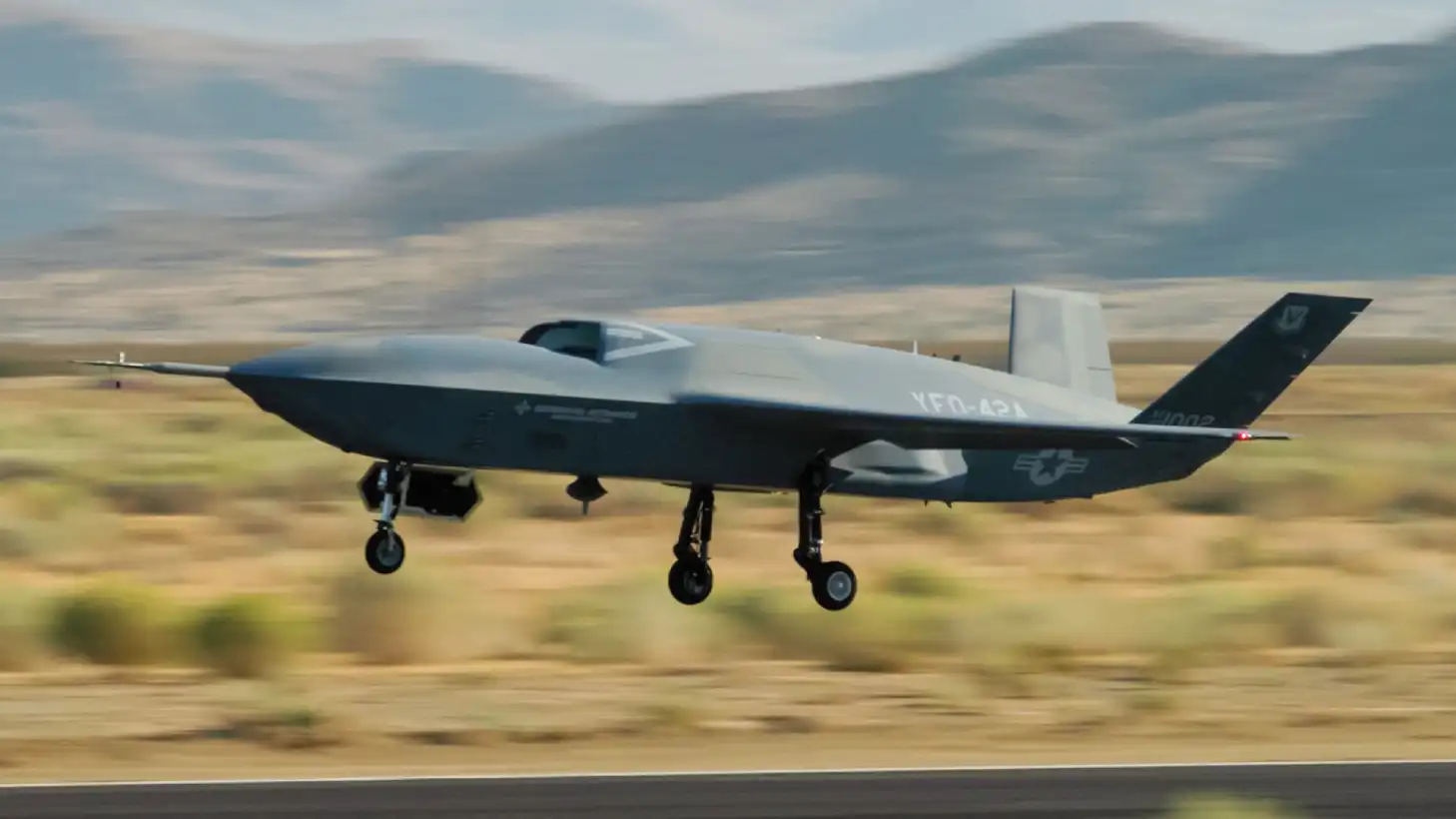
The first production designs are the General Atomics FQ-42 Vengeance and Anduril Industries FQ-44 Fury. Both were selected for Increment I of the Collaborative Combat Aircraft program, and an initial production contract calls for a combined 150 aircraft by 2030. Pricing was not disclosed.
The aircraft are intended to operate alongside the F-22 Raptor, F-35 Lightning II and planned Boeing F-47. The FQ-44 is also identified as a potential partner for the F-15EX Eagle II.
Operational Role
Collaborative Combat Aircraft are designed to serve as robotic wingmen in human-machine formations. Mission-autonomy software will allow them to conduct assigned tasks with limited pilot intervention, including extending sensor coverage, carrying additional air-to-air weapons and operating ahead of crewed fighters.
The Air Force expects the platforms to increase the number of aircraft available in contested airspace while distributing risk across crewed and uncrewed systems. Although neither design is described as expendable, their lower projected cost is intended to let commanders accept risks that may be unsuitable for crewed fighters.
“Developing semi-autonomous platforms alongside traditional fighters fundamentally expands our tactical options in modern contested airspace,” an Air Force official said at the Air & Space Forces Association’s Air, Space & Cyber Conference.
FQ-42 Development
The FQ-42 is derived from General Atomics’ XQ-67A Off-Board Sensing Station demonstrator and belongs to the company’s Gambit family of uncrewed combat aircraft. Its configuration includes a single engine, dorsal-mounted inlet, slender wings, V-tail surfaces and an internal weapons bay. Planned armament includes two AIM-120 AMRAAM missiles.
The YFQ-42A prototype first flew on Aug. 27, 2025. General Atomics named the prototype Dark Merlin in February 2026, while the Air Force assigned Vengeance to the production FQ-42 in September 2026.
One prototype was lost shortly after takeoff on April 6, 2026. The mishap was attributed to an autopilot miscalculation involving aircraft weight and center of gravity. Flight testing resumed May 21.
FQ-44 Development and Specifications
The FQ-44 began as an aggressor-aircraft concept developed by Blue Force Technologies, first called Grackle and later REDmedium and Fury. Anduril acquired Blue Force in 2023 and adapted the design for the Air Force program. The YFQ-44 completed its first flight on Oct. 31, 2025, and the Air Force formally retained the Fury name for the production aircraft in September 2026.
The single-engine aircraft is approximately half the dimensions of an F-16, with swept trapezoidal wings, a chin-mounted inlet and external weapon stations. Estimated specifications include a 20-foot length, 17-foot wingspan and 5,000-pound maximum takeoff weight.
Powered by a Williams FJ44-4M turbofan producing about 4,000 pounds of thrust, the Fury is designed for speeds up to Mach 0.95 and altitudes of 50,000 feet. It has two external weapon stations and is listed as capable of carrying as many as four AIM-120 missiles.
Recommended Comments