




-
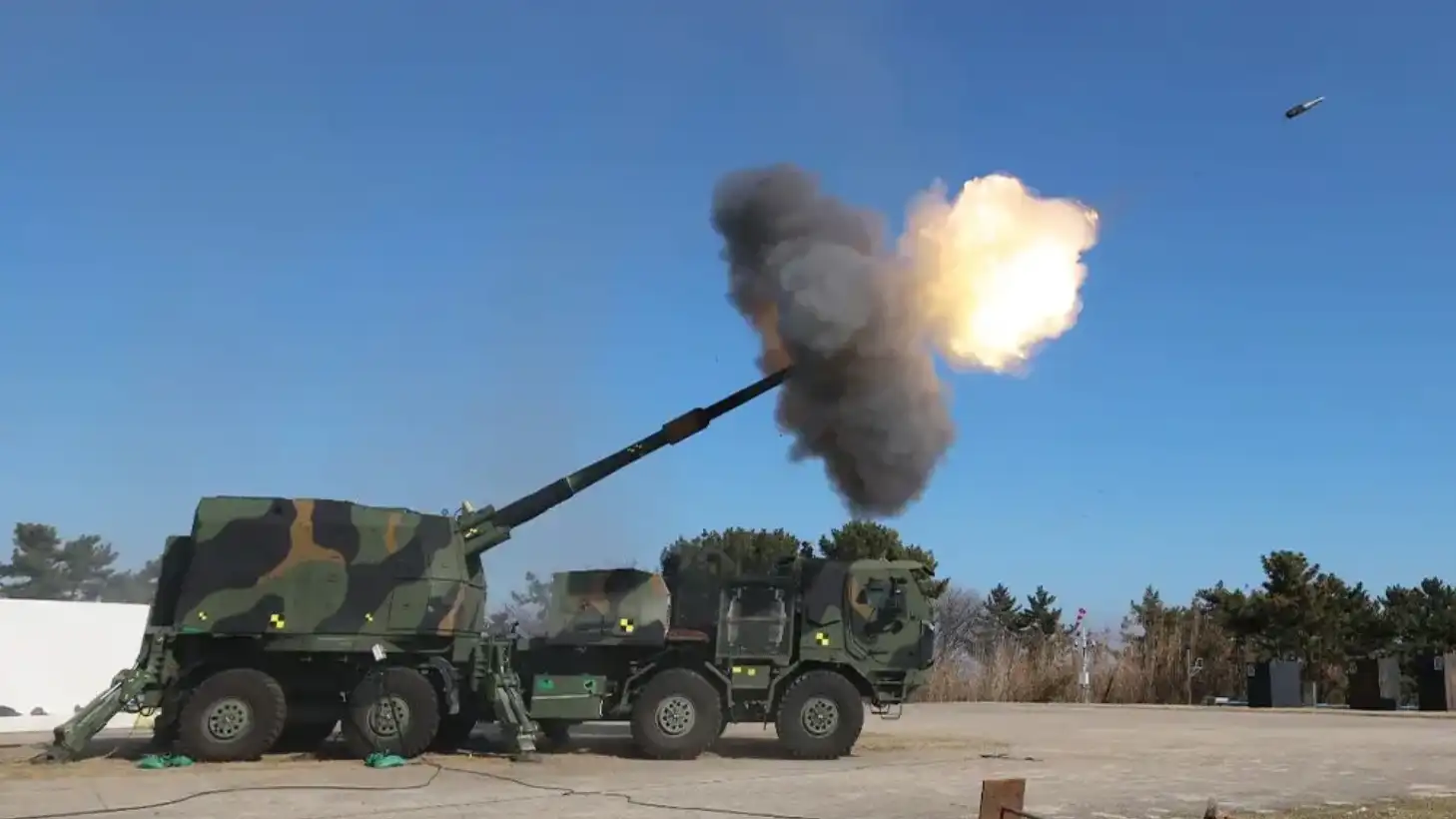
TL;DR: The U.S. Army awarded Hanwha Defense USA $100.3 million for six wheeled K9 Mobile Howitzer prototypes, with options raising the contract ceiling to $262.9 million. Testing through fiscal 2027 will assess firepower, reliability, automation and supportability against competing systems before a production decision; the selected platform is intended to replace roughly 500 M777 towed howitzers in selected brigades, with initial fielding planned for fiscal 2030 and U.S. production required.
Army Awards K9MH Prototype Contract
The U.S. Army awarded Hanwha Defense USA a $100.3 million contract on August 18, 2026, to deliver six K9 Mobile Howitzer prototypes for the Mobile Tactical Cannon program. The agreement includes options for 12 additional systems and has a total ceiling of $262.9 million.
The award begins a four-year period of rapid prototyping, operational testing and soldier experimentation. It is not a final selection or serial-production order. The Army will evaluate firing performance, reliability, automated loading and operational support before choosing a system for production.
The Mobile Tactical Cannon is intended primarily as a more mobile replacement for approximately 498 to 500 M777 155 mm towed howitzers in selected Stryker, Mobile and Infantry Brigade Combat Teams.
Wheeled Platform and Firepower
The K9MH combines an automated turret derived from the K9A2 with a Tatra Force 8×8 wheeled chassis. Unlike the tracked K9 variants already used by several countries, the K9MH is designed to move between firing positions without a separate towing vehicle.
Automation reduces the crew from five personnel in earlier K9 configurations to three by limiting manual ammunition handling. The system uses separate conveyors for projectiles and propellant charges.
Its baseline weapon is the CN98 155 mm/52-caliber cannon, compliant with the Joint Ballistics Memorandum of Understanding standard. Hanwha states a range of 40 km with standard charges and more than 60 km with rocket-assisted or comparable extended-range ammunition. During an April 2026 demonstration, the K9MH fired nine rounds in 59 seconds. Firing-position preparation is stated to take less than 30 seconds.
Competition and Evaluation Schedule
The K9MH remains in competition with Elbit America’s SIGMA, BAE Systems’ Archer, an American Rheinmetall and KNDS RCH 155 proposal, and a Leonardo DRS and KNDS Caesar proposal. The candidates offer differing levels of automation, crew protection, ammunition capacity, road mobility and deployability.
The Army shifted toward evaluating mature wheeled systems after ending the Extended Range Cannon Artillery program in April 2024. Its current approach emphasizes existing platforms that can enter service with limited U.S.-funded development rather than another purpose-built American howitzer.
Soldier experimentation and integration testing are planned through fiscal 2027, with an Army senior-leader downselect scheduled for the fourth quarter of that fiscal year. The selected platform would then undergo engineering, ammunition integration, qualification and production preparation. First Unit Equipped is planned for the fourth quarter of fiscal 2030.
U.S. Production Requirements
Competitors must present a credible plan to establish U.S. production within two years of an award and reach an annual output of 24 to 48 systems. Production cost, domestic supply-chain capacity, ammunition compatibility, delivery schedules and data rights are among the evaluation criteria.
Hanwha Defense USA has leased an idle facility in Opelika, Alabama, for an initial three-year term and is investing about $2 million in K9MH integration and testing capacity. The first phase is expected to create approximately 40 jobs, but it is not a complete serial-production facility. Later manufacturing locations and production rates have not been disclosed.
Hanwha has also committed approximately $1.3 billion to a U.S. ammunition facility in Arkansas. Its broader localization concept includes domestic assembly, sustainment and potential future upgrades.
Potential Longer-Range Development
In December 2025, Hanwha Defense USA entered a cooperative research and development agreement with the Army’s DEVCOM Armaments Center to study integration of a government-designed 155 mm/58-caliber cannon into the K9 family.
That effort is separate from the prototypes entering testing. The current K9MH uses the 52-caliber CN98, while ranges around 70 km are associated with a possible future 58-caliber configuration. The Army’s prototype evaluation will therefore focus initially on the existing cannon, wheeled mobility, automation, reduced crew requirements and supportability.
Recommended Comments