




-
TL;DR: The U.S. Navy selected L3Harris to supply maritime-ruggedized VAMPIRE systems for littoral defense against drones and other small threats. The modular platform can integrate sensors, jammers and laser-guided rockets with a range of about six kilometers, providing a lower-cost defensive layer, though the order’s value, quantity, schedule and exact configuration remain undisclosed.
Navy Selects VAMPIRE for Littoral Defense
The U.S. Navy has selected L3Harris Technologies to deliver VAMPIRE counter-unmanned systems for its integrated C-UxS defense architecture, the company announced Sept. 8, 2026. The system is intended to counter unmanned aerial systems, remotely piloted platforms and potentially other small threats in littoral environments.
L3Harris is ruggedizing the Navy configuration against maritime stresses including humidity, salt exposure and vibration. The company has not disclosed the number of systems ordered, contract value, delivery schedule, or exact configuration.
“VAMPIRE is a flexible and effective system that meets the unique requirements of the U.S. Navy for littoral C-UxS defense,” said Tony Calderon, president of Targeting & Sensor Systems at L3Harris.
Maritime Roles and Variants
VAMPIRE has developed into a family of modular systems combining sensors, precision weapons, electronic jammers and other effectors. Its maritime-focused Black Wake variant is designed for installation on crewed or uncrewed vessels and for lower-cost engagements against small drones and fast attack craft.
L3Harris has not confirmed that Black Wake is the version selected by the Navy. The announced system could be deployed as part of a wider detection and command network to protect forces, bases, logistics sites or other infrastructure near the coast.
Other VAMPIRE configurations include the land-based Stalker XR, airborne Dead Wing, containerized CASKET, BAT system for base protection, and Killcode electronic-warfare variant.
Sensors and System Architecture
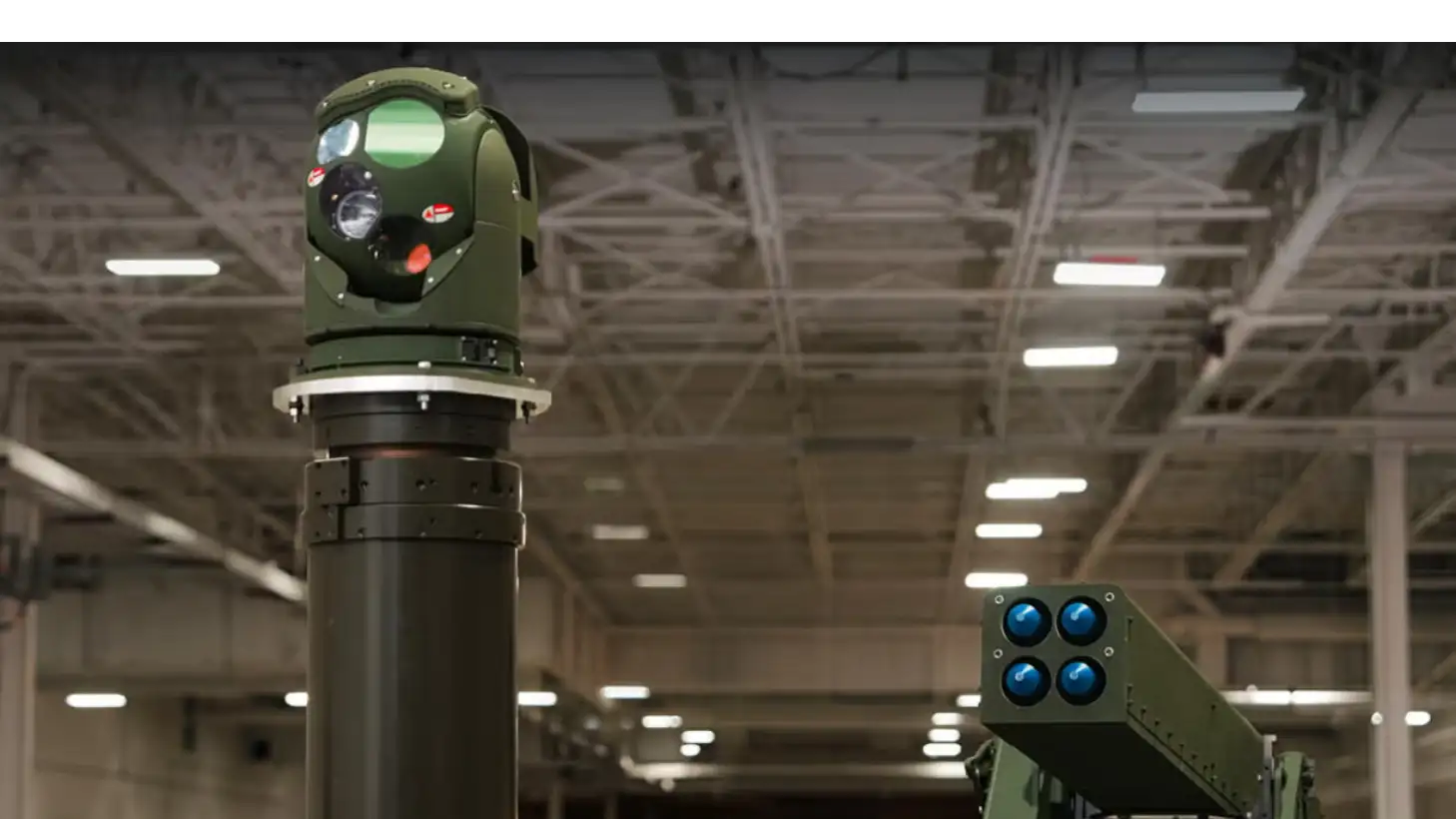
The baseline VAMPIRE uses a self-contained, palletized design that can be fitted to different vehicles or platforms. According to L3Harris, two personnel can install the system in a vehicle cargo bed in about two hours using standard tools.
Its primary sensor is the stabilized WESCAM MX-10D RSTA electro-optical and infrared turret, mounted on a telescopic mast. The sensor supports surveillance, identification, and laser target designation.
VAMPIRE also connects to the Widow Mission Management System, which is compliant with the Forward Area Air Defense Command and Control architecture. Widow integrates sensors, effectors, radios, and navigation functions, allowing individual launchers to operate within a broader counter-unmanned network.
Weapons and Engagement Range
For kinetic engagements, VAMPIRE can use the 70 mm AGR-20A Advanced Precision Kill Weapon System laser-guided rocket. A proximity fuze improves its effectiveness against small aerial targets by allowing an engagement without a direct impact.
Company documentation lists an engagement range of up to approximately six kilometers for the current configuration. The launcher can also accommodate other laser-guided munitions, depending on the selected configuration, host platform, and target.
The system is intended to provide an intermediate defensive layer between electronic warfare, automatic weapons and more expensive surface-to-air missiles. This gives naval forces another option for responding to repeated or numerous unmanned threats without relying exclusively on higher-cost interceptors.
Related Orders and Operational Use
The Navy selection follows a separate U.S. Army VAMPIRE order announced in June 2026 and valued at up to $106 million. L3Harris reports that VAMPIRE systems have accumulated more than 350,000 operational hours in Europe since 2023.
The company has also introduced Wraith Shield software, which uses radios as sensors to help defeat small drones. L3Harris says the software can be integrated with VAMPIRE and Drone Guardian systems as part of a layered defense against unmanned threats.
Recommended Comments