




-
TL;DR: CBO estimates the Navy’s planned 15 nuclear-powered Trump-class battleships would cost $275 billion through 2056, including $23.4 billion for the first ship, USS Defiant. The massive missile-focused vessels could offer lower fuel costs but would cost 13% more to build than conventional versions, while unresolved design, funding, shipyard-capacity and carrier-construction risks make the estimate highly uncertain.
CBO Projects $275 Billion Cost
The Congressional Budget Office estimates that the Navy’s planned fleet of 15 nuclear-powered Trump-class battleships would cost $275 billion. The lead ship, USS Defiant, would cost about $23.4 billion, while the remaining 14 vessels would average approximately $18 billion each.
The estimate assumes the first ship is ordered in 2028 and all 15 are purchased through 2056 at the rate outlined in the Navy’s shipbuilding plan. CBO described its projections as “highly uncertain,” noting that they rely on preliminary assessments of the ship’s design and the broader acquisition program.
A conventionally powered lead ship would cost an estimated $21.3 billion, with a 15-ship conventional fleet totaling about $243 billion. The nuclear-powered program would therefore cost approximately 13 percent more to build. Nuclear propulsion could reduce operating expenses by eliminating conventional fuel purchases, but CBO said it lacked enough information to calculate those savings.
Funding and Construction Schedule
The Navy is seeking approximately $1 billion in advance procurement funding and $837 million for research and development in its fiscal 2027 budget request. Budget documents indicate plans to request about $17 billion in procurement funding for the first ship in fiscal 2028 and roughly $13 billion in 2030 for the second.
Construction of the lead ship was expected to begin in 2028, with delivery projected for 2036. The program was announced by President Donald Trump in December 2025 as part of the administration’s “Golden Fleet” initiative. While the initial announcement called for two ships followed by a 10-ship fleet and potentially 20 to 25 vessels, the current CBO estimate is based on the Navy’s 15-ship plan.
CBO assumes one shipyard would conduct final assembly while other yards build portions or sections. Navy officials have indicated that Newport News Shipbuilding is the most likely location because of the ship’s nuclear propulsion.
Size and Nuclear Propulsion
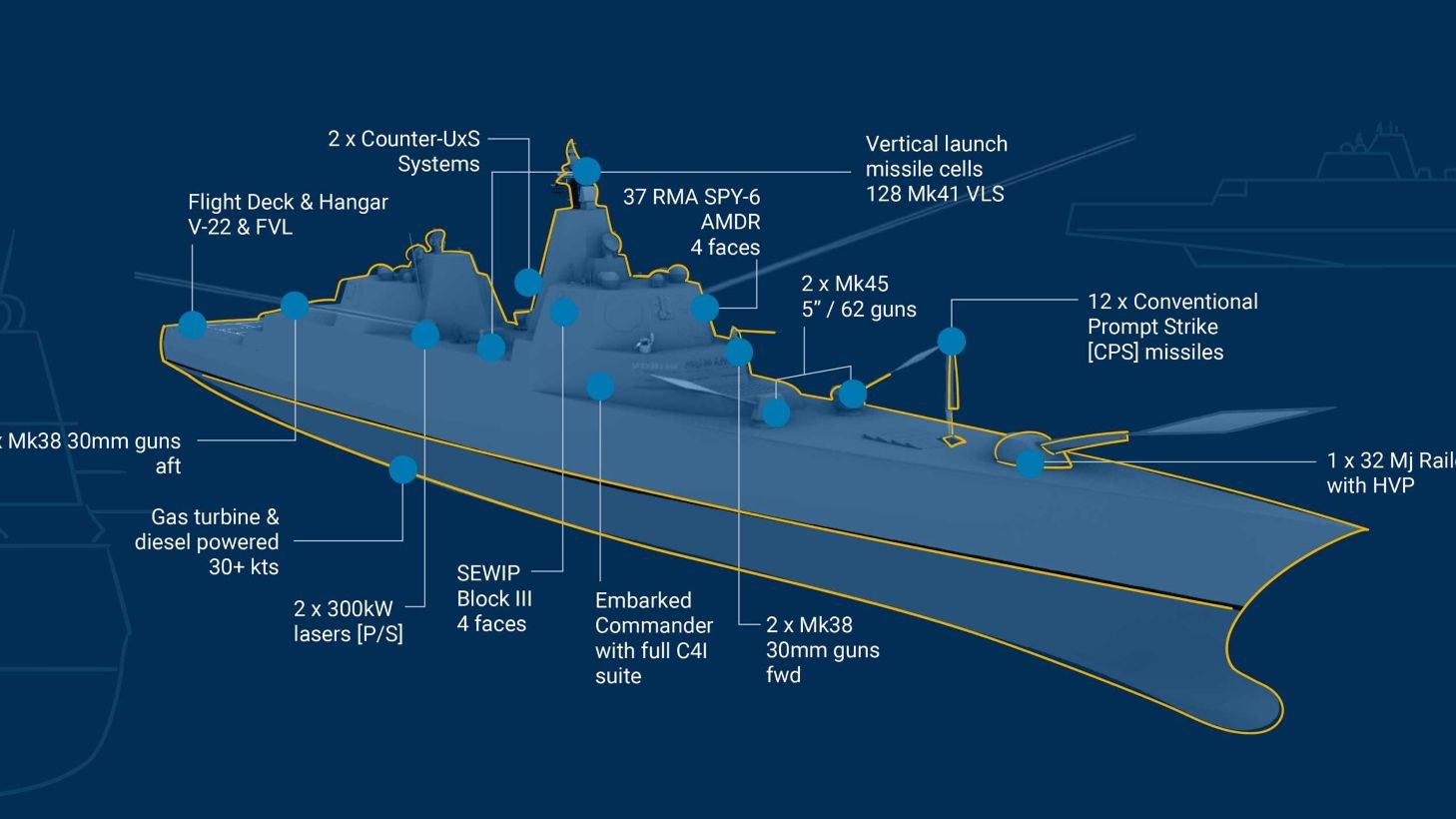
At an estimated 35,000 tons, the Trump class would be roughly three and a half times the size of an Arleigh Burke-class destroyer and would become the world’s largest surface combatant. Navy budget documents provide a broader projected full-load displacement of 35,000 to 41,000 tons.
CBO said increasing displacement to 41,000 tons would raise the lead ship’s cost by 16 percent. The Navy has confirmed that the class will be nuclear-powered, using the same reactor design as the Gerald R. Ford-class aircraft carrier.
The House Armed Services Committee has directed the Navy to provide an acquisition report by March 2027, including plans to mitigate possible effects on Ford-class carrier construction.
Planned Weapons and Capabilities
The ships are intended to carry the nuclear-armed sea-launched cruise missile, known as SLCM-N. CBO said the number aboard would probably be small but remains unknown. Its inclusion would give the ship more firepower than any Navy vessel other than the 14 Ohio-class ballistic missile submarines.
Other planned systems include Conventional Prompt Strike hypersonic missiles, Mark 41 vertical-launch cells, 5-inch guns, railguns, laser weapons and short-range defensive launchers. Acting Navy Secretary Hung Cao said in May 2026 that the ship would have 200 vertical-launch cells. Plans also call for an enclosed hangar supporting helicopters, V-22 Ospreys and future crewed or uncrewed vertical-lift aircraft.
Program Background and Uncertainty
The Trump class, also designated BBG(X) or BBGN, emerged from the Navy’s work on a successor to the DDG(X) large surface combatant. Officials concluded that the DDG(X) hull was too small to accommodate the desired combination of hypersonic missiles and a gun mount.
The Navy has not operated a battleship since USS Missouri retired in 1992. The Trump class would differ from historical battleships by relying primarily on guided missiles rather than heavy armor and large-caliber guns, leading some analysts to question its classification. Analysts have also raised concerns about funding, development costs, shipyard capacity, and the skilled workforce needed for the unprecedented design.
Recommended Comments