




-
TL;DR: House appropriators unveiled a roughly $1–$1.1 trillion FY2027 defense bill funding most of the Pentagon’s request, increasing troop levels and military pay, and prioritizing munitions, advanced weapons, and major procurement programs like F-35s, hypersonics, ships, and aircraft while restoring some canceled efforts. The proposal signals continued expansion of defense spending and capabilities, though it faces political debate over its size and tradeoffs with domestic funding.
House panel releases FY27 defense spending bill
The House Appropriations Committee has released its fiscal 2027 defense bill, described in the provided reports as roughly $1 trillion to $1.1 trillion. The measure covers most of the Pentagon’s $1.15 trillion discretionary request, while military construction funding is handled separately. The Defense subcommittee is scheduled to mark up the bill on Thursday, with full committee consideration set for June 24.
According to the bill, it would fund a total end strength of 2,112,200 military personnel, 44,500 above the fiscal 2026 authorized level. It also supports tiered military pay raises requested by the administration: 7% for E-5 and below, 6% for E-6 through O-3, and 5% for O-4 and above.
Munitions, procurement, and major Pentagon-wide funding
The legislation provides about $248 billion for procurement, $221 billion for research and development, $335.3 billion for operations and maintenance, and $204.1 billion for personnel accounts.
Munitions production is a central focus. Lawmakers included $10.6 billion for critical weapons such as PAC-3, THAAD, and Tomahawk, along with $836 million for first-time procurement of low-cost munitions. The bill would also authorize about a dozen multiyear procurement deals, allowing the Pentagon to move ahead with longer-term contracting for systems including PAC-3 and THAAD.
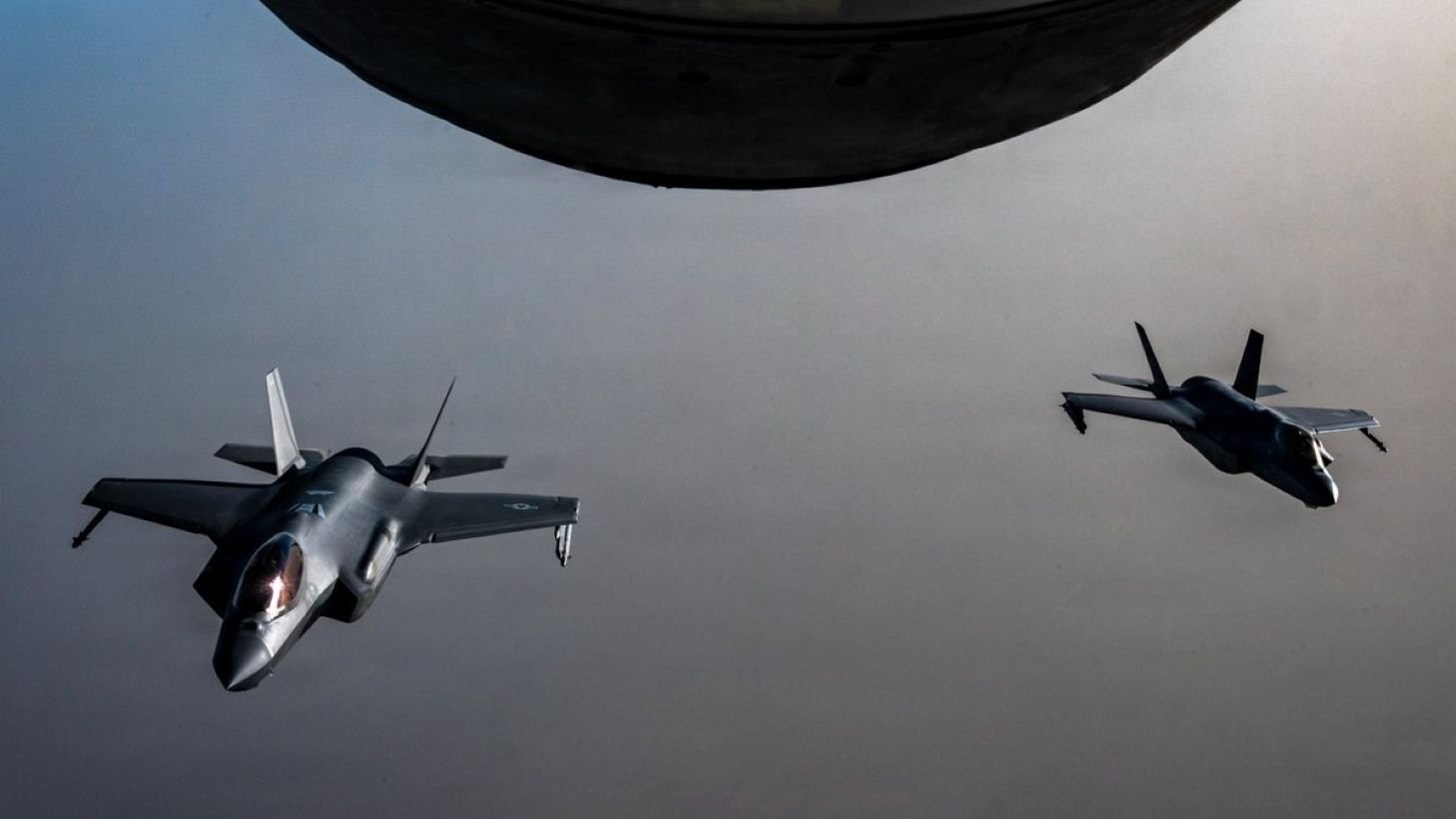
Other major items include full funding for F-35 procurement at $6.9 billion and roughly $380 million to $400 million for the Golden Dome missile defense effort. The bill also directs more than $7.5 billion to hypersonic weapons and testing, and about $2 billion to drone and counter-drone programs, including $1 billion for the Defense Autonomous Warfare Group and $1.4 billion for Joint Interagency Task Force 401.
Air Force and Space Force programs
For the Air Force, the most notable change is the restoration of nearly $1.6 billion for E-7 Wedgetail development after earlier plans to cancel the program again in FY27. The bill also funds 15 KC-46 aircraft at $3.5 billion, 24 F-15EX fighters at $2.6 billion, $2.2 billion for B-21 Raider procurement, and $977 million for Collaborative Combat Aircraft.
It also includes $660 million for three Compass Call aircraft, $300 million for additional Air National Guard C-130Js, $5 billion for F-47 development, $2.8 billion for further B-21 development, and $355 million for the Family of Affordable Mass Missiles.
For the Space Force, appropriators included $3.7 billion for 20 launch services and $680.9 million for two GPS III Follow-On satellites, plus $200 million for Next Generation Overhead Persistent Infrared Polar spacecraft and $100.7 million for commercial space services.
Navy, Marine Corps, and Army funding
The bill provides $56.7 billion for 21 ships, including 11 battle force ships: one Columbia-class submarine, two Virginia-class submarines, one frigate, one destroyer, one amphibious assault ship, one amphibious transport dock, two oilers, one AS(X) submarine tender, and one T-AGOS SURTASS ship. It also includes $828 million for the submarine industrial base, $1.3 billion for shipyard productivity improvements, and $471 million for wage enhancements.
Naval aviation funding includes $2.1 billion for six E-2D aircraft, $771 million for three MQ-25 drones, $3 billion for 22 CH-53K helicopters, and $1.6 billion for 11 KC-130Js for the Marine Corps and Navy Reserve.
For the Army, lawmakers added funding for additional UH/HH-60M Black Hawks and CH-47F Block II Chinooks, $661.2 million for M109A7 and M992A3 vehicles, $655 million to upgrade 22 Abrams tanks to the M1A2 SEP v3 standard, $1.1 billion for Armored Multi-Purpose Vehicles, and $2.1 billion for the Future Long Range Assault Aircraft program.
Political debate and separate funding requests
Republican appropriators said the bill strengthens support for service members and addresses lessons from recent conflicts through heavier investment in munitions, weapons, and newer technology. Democratic lawmakers criticized the measure’s size, arguing that record defense spending could come at the expense of domestic priorities.
Recommended Comments