




-
TL;DR: Japan, South Korea and the U.S. launched the five-day Freedom Edge 2026 exercise near Jeju Island and Kyushu, emphasizing real-time data sharing, missile defense, cyber operations and logistics. For the second straight iteration, the drills omit a U.S. aircraft carrier and instead rely on Aegis destroyers, land-based aircraft, tankers and distributed command networks amid North Korea’s expanding missile and naval capabilities.
Five-Day Trilateral Exercise Begins
Japan, South Korea and the United States began Freedom Edge 2026 on Sept. 7, launching five days of air, maritime, cyber, logistics and Integrated Air and Missile Defense training.
The exercise runs through Sept. 11 in international waters and airspace east and south of Jeju Island, with Japanese activities also conducted west of Kyushu in the East China Sea. Military bases and command posts in Japan and South Korea are participating.
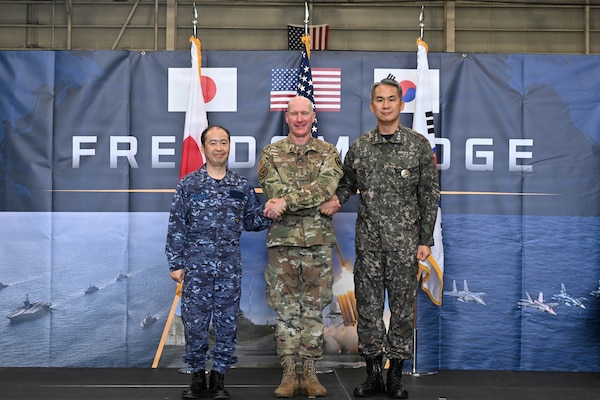
This is the fourth Freedom Edge exercise in 27 months. It is also the second consecutive iteration without a U.S. aircraft carrier, placing greater emphasis on destroyers, land-based tactical aircraft, aerial refueling and distributed command networks.
Ships and Aircraft
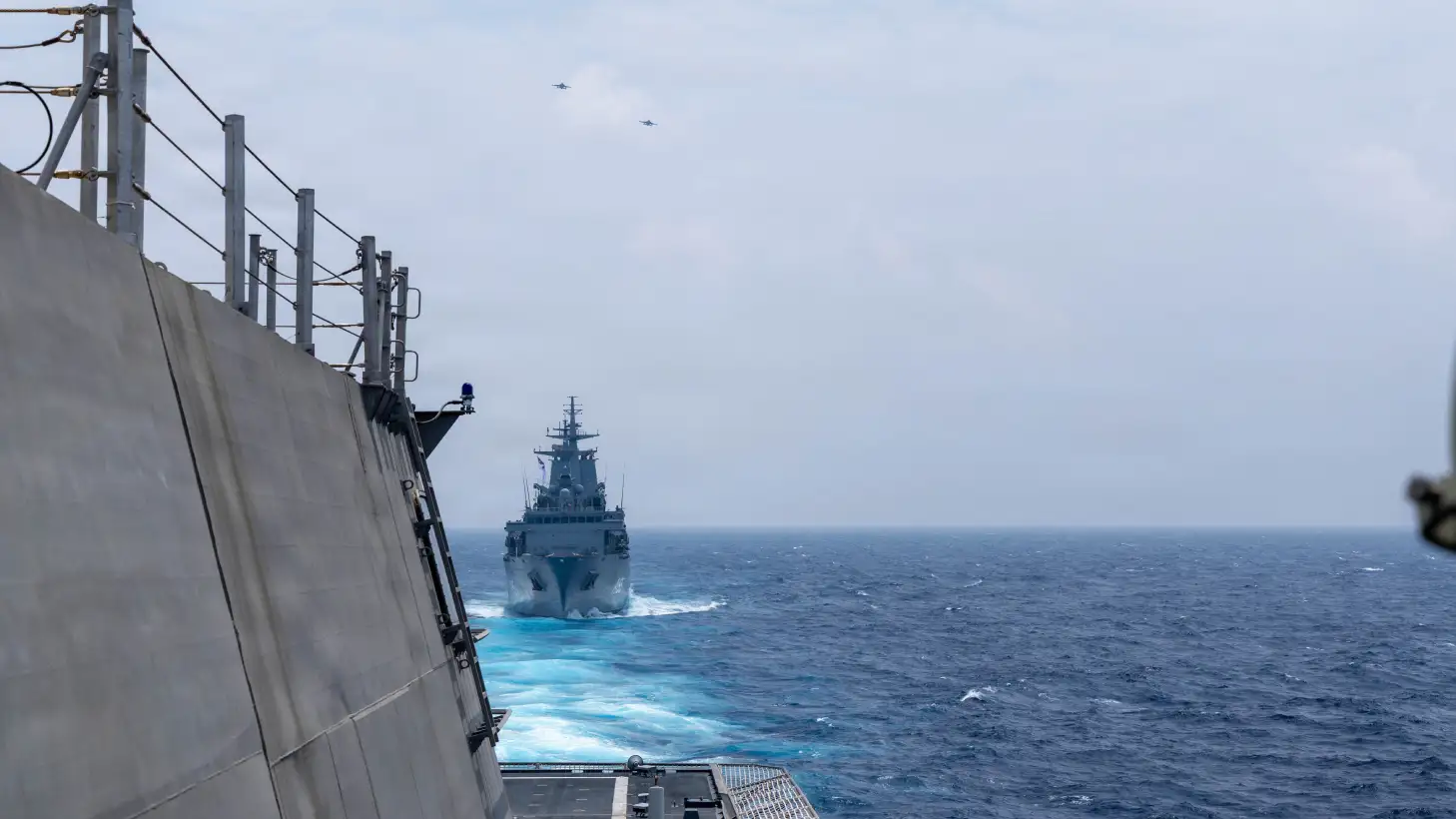
The naval component comprises six surface combatants, although five had been identified when the exercise began. South Korea deployed the Sejong the Great-class destroyers ROKS Yulgok Yi I and ROKS Seoae Ryu Seong-ryong. Japan contributed the destroyers JS Atago and JS Asahi, while the United States deployed the Arleigh Burke-class destroyer USS Benfold, which arrived in Busan on Sept. 3.
Four of the five identified ships use the Aegis combat system, providing shipborne air and missile defense capability.
Japan’s aircraft include P-1 maritime patrol aircraft, SH-60K helicopters, F-15 and F-2 fighters, E-767 and E-2D airborne early warning and control aircraft, and KC-46A and KC-767 tankers. U.S. F-16 fighters and KC-135 tankers are also participating. Aircraft quantities, the identity of the sixth ship, and the combined personnel total were not specified.
Japan committed approximately 560 personnel from six organizations, including joint, maritime, air, support and cyber commands. That is 140 fewer than its reported contribution to the 2025 exercise.
Training Priorities
Freedom Edge 2026 covers integrated air and missile defense, maritime missile defense, enhanced air defense, maritime interdiction, cyber defense, logistics and medical training. A central element is real-time data sharing among Japanese, South Korean, and U.S. command systems.
The carrier-free force distributes functions across ships, shore-based aircraft and tankers. Aegis destroyers provide air and missile defense nodes; maritime patrol aircraft and helicopters support surface and undersea surveillance; fighters conduct tactical aviation missions; and airborne early warning aircraft provide radar coverage and battle management.
Tankers extend fighter endurance and operating range, while shared sensor tracks support identification, interception and missile-defense decisions across the three national networks. U.S. Forces Japan commander Lt. Gen. Stephen Jost said it was “not safe to say” the absence of a carrier had become the new normal.
Shift From Carrier-Led Operations
The first two Freedom Edge exercises lasted three days and included U.S. carriers. USS Theodore Roosevelt participated in June 2024, while USS George Washington joined the November 2024 iteration. The latter involved approximately 7,000 personnel, seven ships, and more than 20 fighters, patrol aircraft, and tankers.
Freedom Edge 2025 expanded to five days but omitted a carrier, relying in part on land-based U.S. F-35A fighters and KC-135 tankers. The 2026 exercise retains that five-day structure and distributed aviation model. Across all four iterations, the series has accumulated 16 exercise days.
North Korean Missile Context
The exercise opened one day after North Korea commissioned the approximately 5,000-ton guided-missile destroyer Kang Kon at Wonsan. The ship partially capsized during its May 2025 launch, was recovered and relaunched the following month, and later underwent repairs, sea trials and weapons testing.
Kang Kon is the sister ship of Choe Hyon, commissioned in June, and carries the same weapons suite. North Korea has tested cruise missiles from the new destroyer and associates the class with conventional and nuclear-capable missile missions. Freedom Edge’s missile-defense and sensor-sharing drills also address threats from North Korean land-based ballistic and cruise missiles, aircraft, and submarines.
Recommended Comments