




-
TL;DR: The future USS John F. Kennedy completed the Ford class’s first arrested F-35C landing on October 13, 2026, confirming initial compatibility with its Advanced Arresting Gear. The milestone begins shipboard testing needed for sustained F-35C operations ahead of the carrier’s planned March 2027 delivery.
First F-35C Recovery on a Ford-Class Carrier
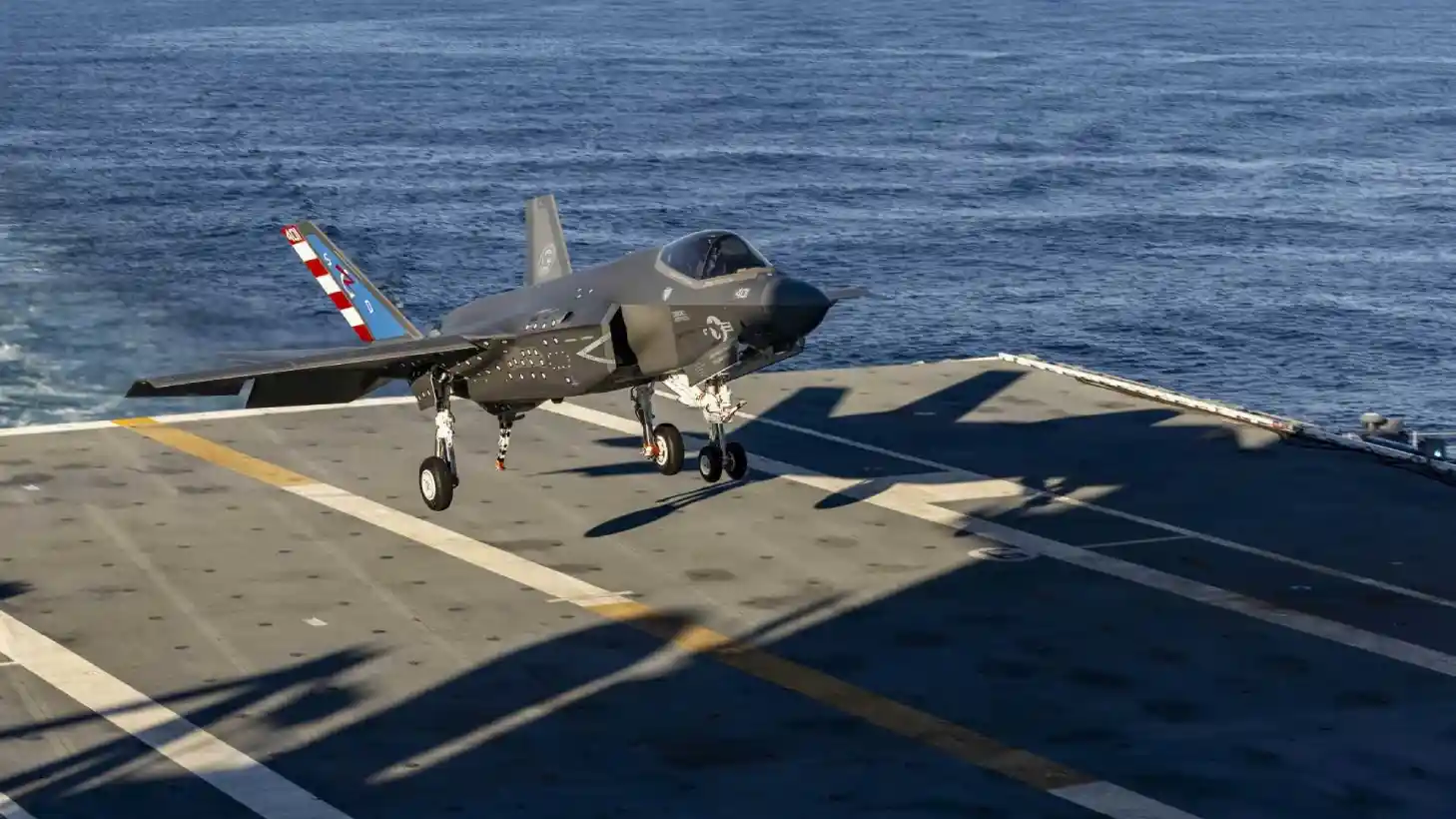
The U.S. Navy completed the first arrested landing of an F-35C Lightning II on a Ford-class aircraft carrier during Aircraft Compatibility Testing aboard the future USS John F. Kennedy (CVN-79) in the Western Atlantic.
The October 13, 2026, recovery confirmed initial compatibility between the carrier-based stealth fighter and the ship’s Advanced Arresting Gear (AAG). Test pilots from Air Test and Evaluation Squadron 23 (VX-23), based at Naval Air Station Patuxent River, Maryland, used two specially instrumented F-35Cs to gather data supporting future operations.
The milestone begins shipboard F-35C compatibility testing for the Ford class ahead of Kennedy’s planned fleet delivery in spring 2027. The landing mass, engagement speed, stopping distance and peak deceleration were not disclosed.
Why Testing Began With Kennedy
The lead ship, USS Gerald R. Ford (CVN-78), entered service in 2017 without several installations required for sustained F-35C operations. Aircraft-specific requirements matured after major construction decisions had been made, while acquisition cost restrictions contributed to deferred modifications.
Required infrastructure includes suitable jet blast deflectors, thermal protection and cooling for the F135 engine’s exhaust, which can reach temperatures up to 1,982°C. Routine operations also require heat-resistant deck surfaces, stealth-coating repair facilities, secure mission-data processing spaces, F135 servicing equipment and maintenance connectivity.
Ford-class carriers also replace the Nimitz class’s steam catapults and conventional arresting equipment with the Electromagnetic Aircraft Launch System and AAG, requiring aircraft-specific compatibility testing.
Carrier Delivery and Modifications
A November 2, 2020, contract modification incorporated F-35C requirements into Kennedy during construction, reducing the extent of post-delivery alterations. The revised single-phase delivery strategy also added the Enterprise Air Surveillance Radar and replaced an earlier two-phase arrangement.
Kennedy began construction at Newport News Shipbuilding in June 2015. Section 124 of the Fiscal Year 2020 National Defense Authorization Act requires the carrier to have F-35C operational capability before completing its post-shakedown availability.
The revised construction plan added two years of work, while AAG certification and Advanced Weapons Elevator issues moved delivery from July 2025 to March 2027. By August 2026, seven of 11 elevators were complete and all ammunition magazines were accessible, though four elevators still required testing. The carrier received preliminary acceptance on September 29, 2026, at 99% completion.
F-35C Carrier Configuration
The F-35C was designed for catapult launches and arrested recoveries. It has a 13.1-meter wingspan, folding wingtips, strengthened landing gear, a reinforced airframe and an arresting hook. Its larger wing and flight-control surfaces support lower-speed, stable carrier approaches.
The aircraft measures 15.7 meters long and has a maximum takeoff weight of 31,751 kg. It carries up to 8,958 kg of internal fuel and uses a Pratt & Whitney F135-PW-400 engine producing 191 kN of maximum afterburning thrust.
Integrated Direct Lift Control adjusts lift without equivalent pitch changes, while Precision Landing Mode stabilizes the final approach. Pilots must still maintain alignment and execute a bolter if the hook misses an arresting wire.
Air Wing Capabilities
The F-35C combines an AN/APG-81 active electronically scanned array radar, Distributed Aperture System, AN/ASQ-239 electronic warfare equipment and sensor fusion. Its published combat radius exceeds 1,111 km, compared with a representative 926 km for the F/A-18E/F, depending on mission configuration.
Its current internal air-to-air load is four AIM-120 missiles. The planned Sidekick modification would increase that to six, while Technology Refresh 3 adds processing capacity for later Block 4 improvements.
In mixed carrier air wings, F-35Cs can provide low-observable sensing and strike capabilities while Super Hornets carry larger external weapon loads. E-2D Hawkeyes, EA-18G Growlers and planned MQ-25 Stingray tankers would provide surveillance, electronic attack and aerial refueling support.
Recommended Comments