




-
TL;DR: Saudi Arabia, Turkey and Pakistan signed a collective-defence pact on August 7, 2026, treating an armed attack on one as an attack on all. Signed amid escalating regional conflict and attacks by Iran-backed forces, the agreement expands defence cooperation but leaves required military support, command structures, and response mechanisms unspecified.
Three States Sign Collective-Defence Pact
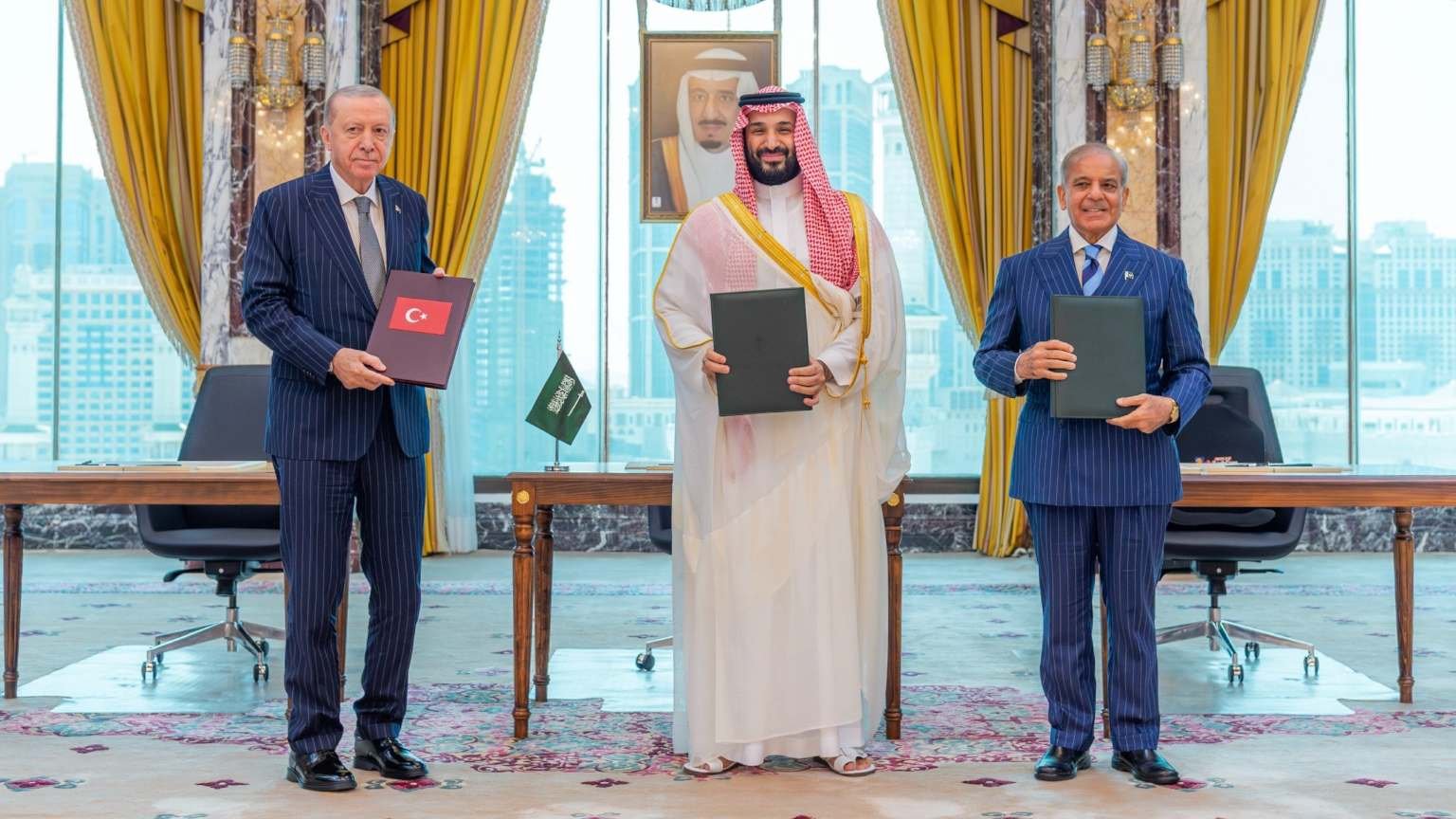
Saudi Arabia, Turkey and Pakistan signed the Makkah Joint Defence Agreement on August 7, 2026, establishing a trilateral commitment to treat an armed attack against any member as an attack against all three.
Saudi Crown Prince Mohammed bin Salman, Turkish President Recep Tayyip Erdoğan and Pakistani Prime Minister Shehbaz Sharif concluded the agreement at the Makkah Al-Mukarramah Summit for Joint Defence at Al-Safa Palace in Mecca.
A joint statement said the pact is intended to strengthen collective deterrence and enhance “all aspects of defence cooperation” among the countries. It did not specify the forces, equipment or other military support each state would be required to provide in response to an attack.
Scope and Existing Commitments
A Turkish official described the agreement as defensive and not directed at a particular country. The official also said it remains open to other regional states and does not replace existing bilateral or multilateral arrangements involving the signatories.
The pact expands upon the Strategic Mutual Defence Agreement signed by Saudi Arabia and Pakistan on September 17, 2025. That earlier accord formalized a long-running military relationship in which Pakistan has provided training and technical assistance to Saudi forces.
Reports differ on the nuclear implications of the arrangements. The Saudi-Pakistani agreement has been characterized as placing Riyadh under Pakistan’s nuclear umbrella, but defence analyst Mansoor Ahmed of the Australian National University said Pakistan’s nuclear posture remains focused on India and that the trilateral pact is unlikely to extend its nuclear deterrent to the other parties.
Agreement Follows Regional Attacks
The signing took place during a wider conflict involving Iran, Israel and the United States that began after US and Israeli strikes on Iranian targets on February 28, 2026. Iran and allied forces, including Houthi fighters in Yemen and Shiite militias in Iraq, subsequently carried out missile and drone attacks against Saudi Arabia and other regional states.
Hours before the agreement was signed, a senior Saudi official said the kingdom was preparing for possible attacks by Iran-backed forces in Yemen and Iraq, citing intelligence gathered domestically and from regional allies and the United States.
Pakistan has also participated in diplomatic efforts concerning the Iran conflict. Turkey, a NATO member, has been less directly exposed to the fighting but shares concerns about the security and economic effects of broader regional instability.
Established Defence Relationships
The three countries had expanded bilateral military and industrial cooperation before forming the new grouping. Turkey and Pakistan have exchanged warships and training aircraft, while Saudi Arabia agreed in 2023 to buy Turkish-made drones in what Ankara then described as its largest defence export contract.
By mid-2026, Pakistan had reportedly deployed several thousand troops, fighter aircraft, drones and an air-defence system to Saudi Arabia. Pakistan also opened discussions with Kuwait in July on a broader security arrangement.
Ahmed said the pact could provide a framework combining the established defence industries of Pakistan and Turkey with potential Saudi financial and technological investment. He argued that it is better understood as a regional security and defence-cooperation framework than as an alliance directly comparable with NATO.
Implementation Remains Unspecified
The joint statement emphasized historical ties, Islamic solidarity and shared strategic interests but provided no detailed command structure, deployment plan or automatic military-response mechanism.
Michael Kugelman of the Atlantic Council described the pact as a logical result of deepening security ties and said its focus on regional burden-sharing could be welcomed in Washington. H. A. Hellyer of the Royal United Services Institute cautioned that the signing alone does not establish how quickly or fully the collective-defence provision would be implemented during a crisis.
Turkey has previously sought to include Egypt in a broader regional defence arrangement, but no expansion beyond the three signatories has been announced.
Recommended Comments