




-
TL;DR: USS George Washington is heading from Japan to the Middle East to relieve USS Abraham Lincoln after its war-driven, record-long stretch at sea, temporarily leaving the western Pacific without a U.S. carrier. Other U.S. forces remain in the Indo-Pacific, but the shift reduces a key deterrence capability and highlights deployment, maintenance and crew-readiness pressures.
The departure of the USS George Washington from the western Pacific has generated a wave of competing headlines, with some portraying the move as evidence that the United States is abandoning Asia while others dismiss the development as little more than a routine carrier rotation.
Neither description tells the full story.
The United States is indeed moving its only forward-deployed aircraft carrier in Japan toward the Middle East, temporarily leaving the western Pacific without a U.S. carrier on station. The move is unusual enough to matter, particularly at a time of heightened tensions with China, but it does not leave the Indo-Pacific undefended or fundamentally change the regional military balance.
What it does reveal is something more practical: the continuing U.S.–Iran war is consuming enough naval capacity that the Navy is being forced to draw on forces normally assigned to one of Washington's highest-priority strategic regions.
That makes the current carrier gap less a story about an immediate Chinese opportunity and more a story about fleet availability, endurance, and the difficulty of sustaining major military commitments in multiple theaters at once.
George Washington Heads Toward Middle East
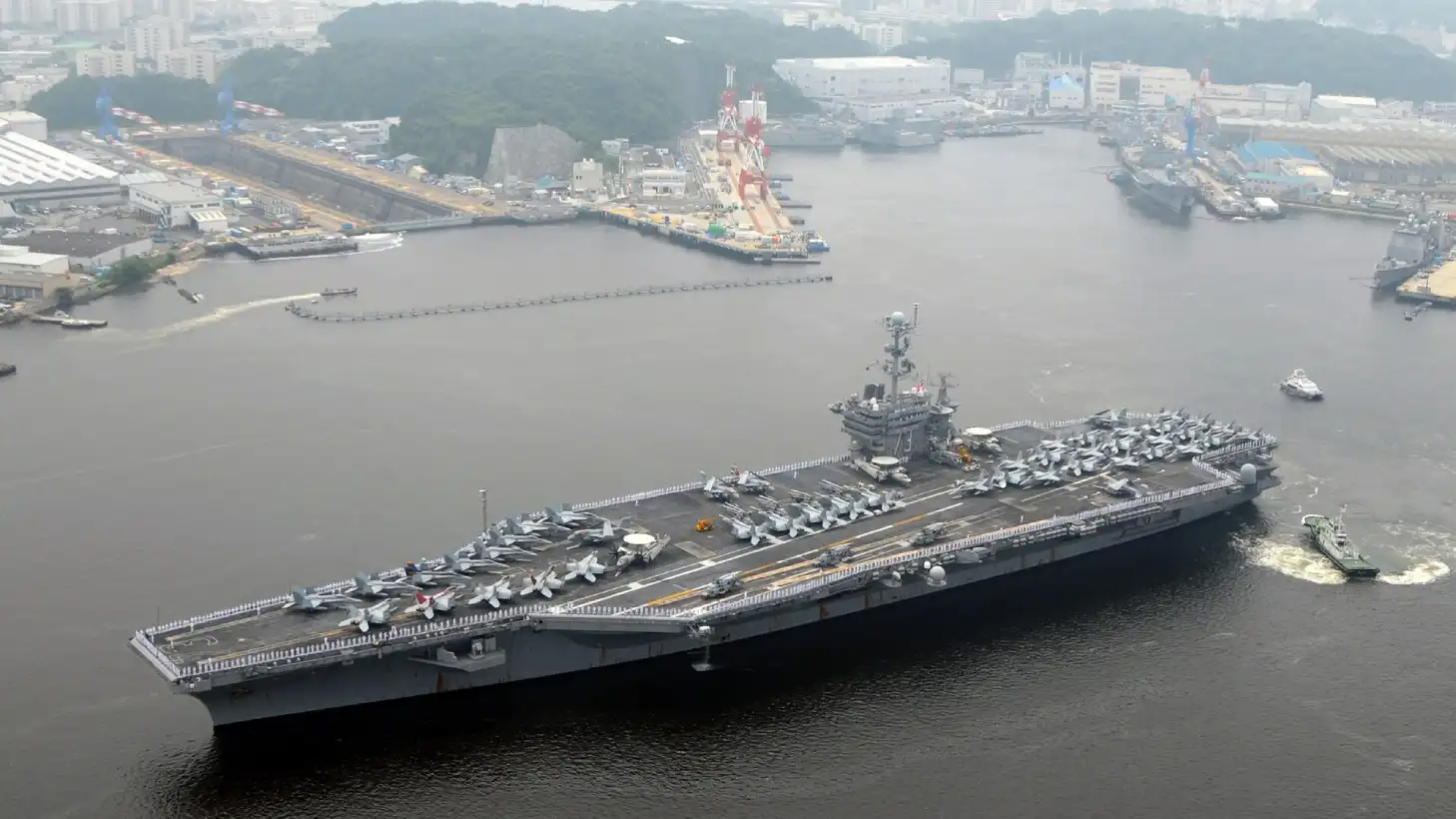
USS George Washington, the only U.S. aircraft carrier permanently forward-deployed to Japan, is moving toward the Middle East, temporarily leaving the western Pacific without a U.S. carrier on station.
The carrier departed Yokosuka in May for its 2026 patrol and operated across the western Pacific, including the South China Sea on July 22 and 23. After leaving Da Nang, Vietnam, George Washington, the cruiser USS Robert Smalls and destroyer USS Shoup passed through the Singapore Strait and entered the Strait of Malacca by August 13.
The strike group is expected to replace USS Abraham Lincoln, which has supported U.S. operations against Iran since January. The move reduces the Navy’s most visible form of forward presence in the Pacific but does not leave the region undefended.
Extended Deployment Drives Relief
Abraham Lincoln left San Diego on November 21, 2025, and was originally expected home in May. Its deployment was extended because of the U.S.–Iran war.
By August 13, the carrier had been deployed for about 265 days and spent more than 240 consecutive days at sea, exceeding the previous modern record of 206 uninterrupted days set by USS Dwight D. Eisenhower during the COVID-19 pandemic. Lincoln reportedly had not made a port call since visiting Guam in December.
Sailors’ families have raised concerns about mental health, supplies and shipboard conditions. The Navy said it had not identified an increase in reported suicidal ideation or suicide attempts, while acknowledging the effects of extended deployments on personnel and families. Disruptions at traditional Middle Eastern supply hubs have also required commanders to prioritize food, hygiene supplies and mail.
George Washington’s movement provides relief for Lincoln, its air wing, escorts, and crew, which require maintenance, training resets, and personnel recovery after the extended deployment.
Carrier Inventory Versus Availability
Although the United States operates 11 aircraft carriers, only two or three are normally deployed at a time. The remainder may be in maintenance, shipyard work, training, certification, crew recovery, or pre-deployment preparation.
USS Gerald R. Ford returned to Norfolk on May 16 after a 326-day deployment covering more than 57,000 nautical miles, making an immediate return unlikely. USS George H.W. Bush is already operating in the Arabian Sea alongside Lincoln.
USS Theodore Roosevelt remains in California while preparing for a possible deployment. It was in San Diego as recently as August 8 for a friends-and-family cruise. A future Roosevelt deployment could allow George Washington to return to the Pacific sooner.
Indo-Pacific Forces Remain in Place
The carrier gap does not amount to a U.S. withdrawal from Asia. American forces in the region include surface ships, submarines, land-based aircraft, Marines, Army units, special operations forces and logistics infrastructure. Major bases remain in Japan, Guam, South Korea, Hawaii and elsewhere, supported by treaty allies including Japan, South Korea, Australia and the Philippines.
U.S. forces also continue regional exercises and operations with Brunei, Indonesia, South Korea, Japan, the Philippines and partners operating from Guam.
A carrier nonetheless provides a distinctive capability: a mobile airbase with combat aircraft, escorts, sensors, missiles, helicopters, electronic-warfare systems and command assets. Its visibility also supports deterrence and signaling around Taiwan, Japan, the Philippines and the South China Sea.
Readiness and Maintenance Pressures
Temporary Pacific carrier gaps have occurred before. During the 2015 transition between George Washington and USS Ronald Reagan, George Washington left Japan in May, and Reagan did not arrive in Yokosuka until October 2. In 2018, the Navy also experienced a 22-day period without a fully certified carrier strike group deployed and available for national tasking under one assessment.
The current gap is notable because it results from an ongoing war rather than a planned homeport transition or routine maintenance. Ford has returned from a lengthy deployment, Lincoln has remained at sea beyond schedule, Bush is in the Middle East, and George Washington is being redirected from the Pacific.
Extended operations can create later maintenance and readiness costs for carriers, aircraft, escorts, and crews. The gap’s significance will depend largely on its duration and whether another carrier can relieve George Washington, allowing it to resume western Pacific operations.
Recommended Comments