




-
TL;DR: The U.S. Navy advanced seven companies to prototype testing for its Medium Unmanned Surface Vessel program, offering $15 million and potential production contracts to designs that pass trials by October, with initial fielding planned for FY2027. The effort reflects a shift toward faster acquisition using commercially mature platforms and aims to expand the Navy’s unmanned fleet in the Indo-Pacific, while a first carrier strike group deployment of a Seahawk MUSV will help refine operational concepts. The program’s progress will shape future procurement and integration decisions as Congress pushes for clearer deployment strategies.
Listen to this article
Navy expands MUSV competition
The U.S. Navy has selected seven companies to advance to prototype testing for its Medium Unmanned Surface Vessel program: Sea Machines, Leidos, Saronic Technologies, Galliano Marine Services, PacMar Technologies, Birdon, and Huntington Ingalls Industries.
According to the Navy, vessels that successfully complete at-sea trials will receive $15 million and become eligible for follow-on production. The service said testing is expected to conclude by October, with an initial goal of making MUSVs available to lease or procure in fiscal 2027. After trials, the selected contractor is expected to be prepared to field five to 10 operational MUSVs in FY2027.
Shift toward faster acquisition
The MUSV effort is part of a broader Navy push to expand its unmanned surface fleet, with officials aiming to grow from four to 30 vessels in the Indo-Pacific by 2030.
In March, the Navy replaced its Modular Attack Surface Craft program with a new MUSV marketplace intended to move beyond prolonged prototyping and focus on production-ready, mission-capable platforms. The service said the approach is meant to open the field to smaller, non-traditional shipyards and to use mature commercial solutions where possible. Navy Times report said the marketplace received roughly $2.1 billion in funding through President Donald Trump’s “One Big Beautiful Bill.”
The Navy has described the marketplace as a recurring process rather than a one-time competition.
Seahawk deployment marks operational step
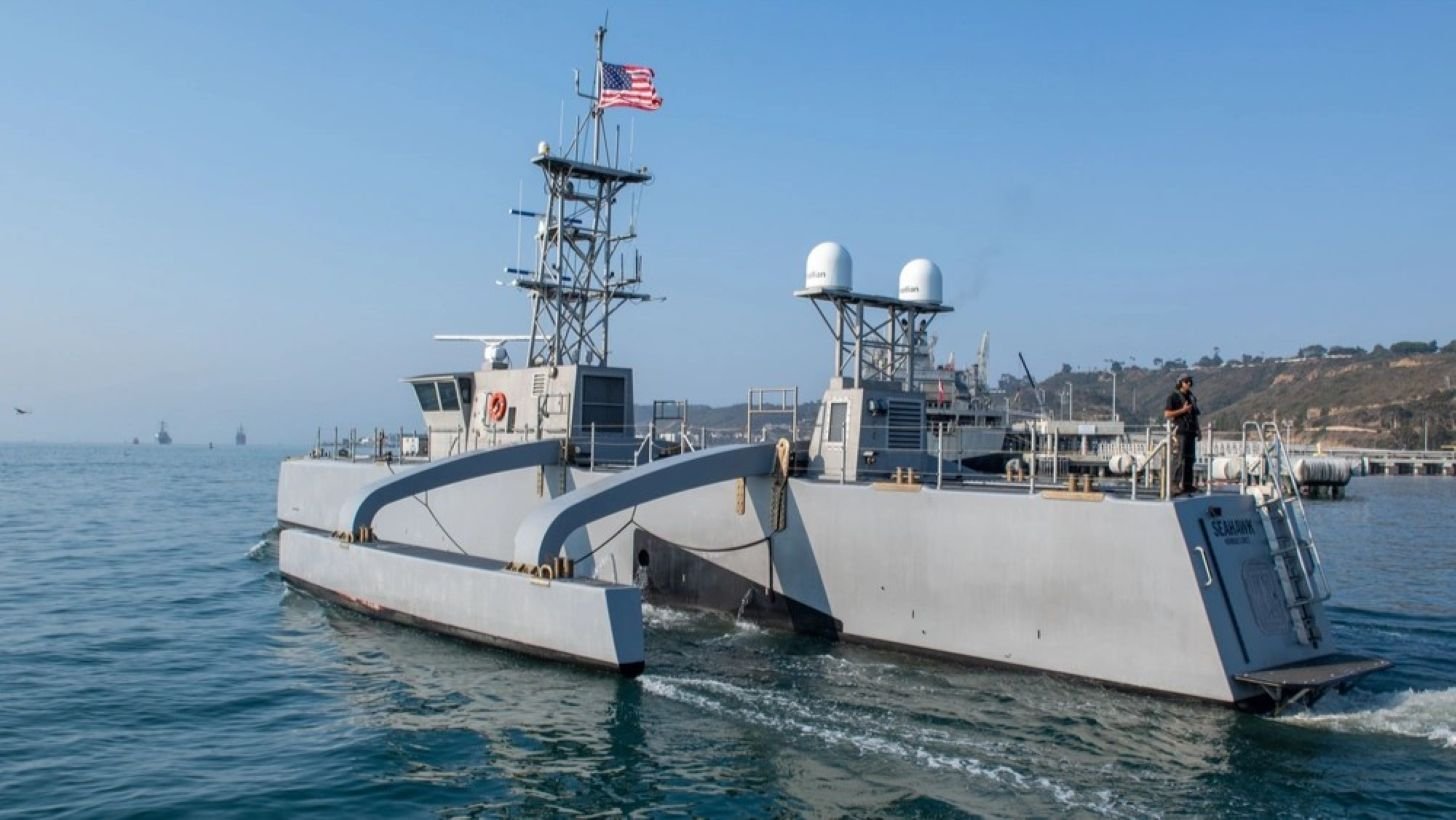
Separately, per a Breaking Defense report, the Navy has said the aircraft carrier Theodore Roosevelt will deploy with a Seahawk MUSV as part of its strike group, the first such deployment for the vessel in a carrier formation. Seahawk, built by Leidos and derived from the Sea Hunter program, supports anti-submarine warfare and maritime domain awareness.
The Navy previously sent four unmanned ships — Sea Hunter, Sea Hawk, Mariner, and Ranger — to the Indo-Pacific for a five-month deployment in 2024, and those vessels remain in use for further development of the program. An earlier Western Pacific deployment in 2023 also included Sea Hunter and Seahawk.
Navy leaders have pointed to the Theodore Roosevelt deployment as a way to develop concepts of operations for integrating unmanned systems with crewed ships. Chief of Naval Operations Adm. Daryl Caudle has tied that effort to a broader “hedge force strategy” and has highlighted contested logistics, including moving food and parts without putting sailors at risk, as a major use case.
Performance requirements
The latest solicitation calls for a vessel able to travel 2,500 nautical miles at 25 knots while carrying a 25-ton payload in moderate conditions. The MUSV must operate autonomously day and night, function in moderate to rough seas autonomously, and remain survivable through sea state 7.
It must also be able to restrict all radio-frequency emissions on command, continue autonomous operation in a passive no-emissions mode, and monitor and report its own health and status to an offboard command-and-control station.
Policy and oversight
The Navy has not publicly detailed exactly how Seahawk will be employed on the Theodore Roosevelt deployment, but officials and analysts cited in the provided reports expect the deployment to inform both fleet tactics and future procurement choices.
Congress is also pressing for clearer planning. A House Armed Services Committee proposal released in May would require the Navy to verify that concepts of operations for unmanned systems are in place before accepting a USV and would direct the service to produce a broader fleet integration strategy.
Recommended Comments