



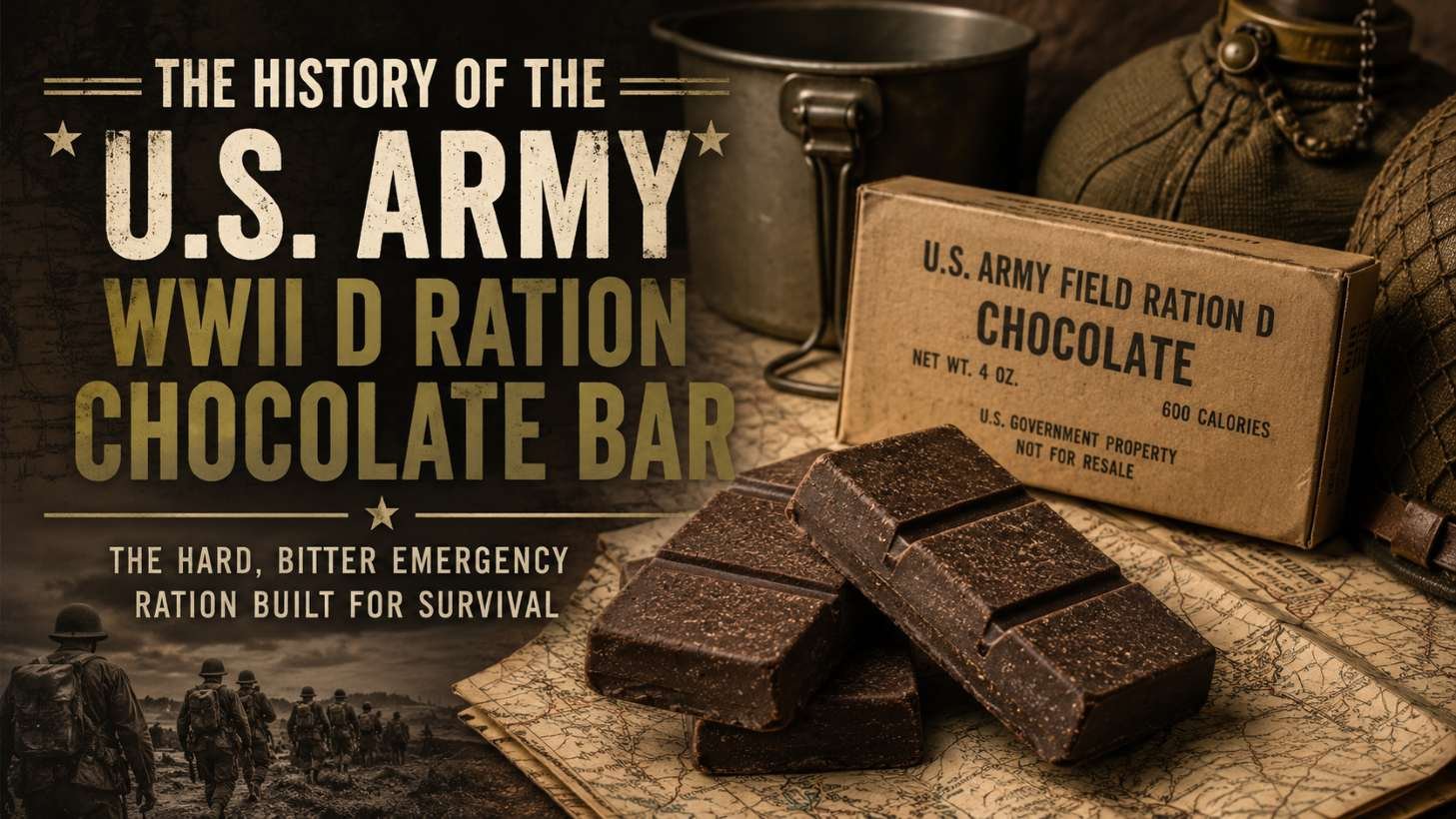

The U.S. Army D Ration chocolate bar is one of the strangest food inventions of World War II. It looked like chocolate, contained chocolate, and was manufactured by one of America's most famous chocolate companies, but it was never meant to be enjoyed like a candy bar.
It was built as emergency fuel.
Hard, bitter, dense, and difficult to eat, the D Ration was designed to survive heat, fit inside a soldier's pocket, and provide enough calories to keep a man going when normal food was unavailable. It was not comfort food. It was not a treat. In many ways, it was closer to a survival tool than a snack.
That is what makes it fascinating.
The D Ration tells a story about military logistics, wartime food science, industrial manufacturing, and the uncomfortable truth that emergency food does not always need to taste good. Sometimes, the goal is simply to keep someone alive.
If you want to make one yourself, be sure to check out our Historical WWII D Ration Chocolate Bar Recipe, which recreates the known structure of the original as closely as possible for a home kitchen. If you want something easier to eat, our Modern D Ration-Inspired Chocolate Bar Recipe keeps the spirit of the original while making the bar more practical for hiking, camping, and emergency kits.
A Chocolate Bar Designed for War
In April 1937, Captain Paul Logan of the U.S. Army Quartermaster General's office approached Hershey Chocolate Corporation with an unusual request. The Army wanted a compact emergency ration that could be carried by soldiers, survive high temperatures, provide significant calories, and remain unappealing enough that troops would not eat it casually. Logan met with Hershey president William Murrie and chief chemist Sam Hinkle, and Milton Hershey reportedly encouraged them to begin work on the project immediately.
This was not a normal candy commission.
The Army did not simply ask Hershey to make a better chocolate bar. Regular chocolate melted too easily in heat and was too enjoyable to be trusted as an emergency ration. If soldiers ate it like candy, it would not be available when they truly needed it.
Captain Logan's requirements became legendary. The finished bar needed to weigh about four ounces, withstand high temperatures, provide substantial food energy, and taste only "a little better than a boiled potato."
That final requirement sounds almost comical today, but it served a serious purpose. The D Ration was supposed to be eaten only in emergencies, not during boredom, marching, or downtime. A bar that tasted too good would disappear before it was needed.
The Logan Bar
Before it became widely known as Field Ration D, the early version was often called the Logan Bar, after Captain Paul Logan.
Hershey's chief chemist Sam Hinkle developed the formula. The known ingredient list included chocolate liquor, sugar, skim milk powder, cocoa butter, oat flour, and vanillin. Compared with normal chocolate, sugar was reduced, and chocolate liquor was increased, creating a darker, denser, more bitter product.
This ingredient list is important because it reveals the bar's real purpose. It was chocolate, but it was engineered chocolate. The oat flour helped create density and add energy. The reduced sugar made the bar less appealing. Cocoa butter and chocolate liquor helped supply calories and structure. Skim milk powder added nutrition and body. Vanillin provided a simple chocolate-bar flavor without making the bar too pleasant.
The result was not a smooth, pourable chocolate mixture. Hershey Archives describes it as a heavy paste that had to be pressed rather than poured into molds. Each four-ounce bar contained about 600 calories.
That 600-calorie figure was central to its role. Three bars could provide roughly 1,800 calories, a minimal daily emergency ration for a soldier in the field.
What Was Actually in the D Ration?
One of the confusing parts of recreating the D Ration today is ingredient terminology. Historical sources often describe the bar as containing chocolate liquor, while home recipes may use chocolate liquor, cocoa mass, cocoa paste, or unsweetened baking chocolate.
These terms can sound like different ingredients, but they are closely related.
Chocolate liquor does not contain alcohol. In chocolate-making, chocolate liquor is finely ground cacao nibs in a solid or semi-plastic form. The U.S. federal definition describes chocolate liquor as food prepared by finely grinding cacao nibs, with its cacao fat content adjusted by adding or removing cocoa butter.
Chocolate liquor is also commonly called cocoa mass or cocoa paste. Depending on temperature and processing, it may be solid, thick, or paste-like.
That is why historical recipes may list:
Chocolate liquor
Cocoa mass
Cocoa paste
Unsweetened baking chocolate
These are not meant to confuse the recipe. They are meant to make the recipe more practical.
For many home cooks, unsweetened baking chocolate is the easiest grocery-store form of the same basic ingredient. It is essentially chocolate liquor formed into a solid block for baking. If you can buy true chocolate liquor, cocoa mass, or cocoa paste from a chocolate-making supplier, use that. If not, unsweetened baking chocolate is a practical and historically reasonable substitute.
This is why our Historical WWII D Ration Chocolate Bar Recipe uses the ingredient line:
Unsweetened baking chocolate (100% cacao)
The goal is not to claim that Hershey's factory formula used grocery-store baking chocolate. The goal is to help modern readers recreate the known ingredient structure of the original bar using ingredients they can actually obtain. Plus, 160 grams of Baileys Chocolate Liqueur is roughly 5 shots of alcohol, and we don't want people doing that in their emergency ration when they Google "what is chocolate liquor."
The historical structure is:
Chocolate liquor / cocoa mass / unsweetened baking chocolate for the cacao base
Cocoa butter for fat, firmness, and heat resistance
Sugar for energy, but less sweetness than a normal candy bar
Skim milk powder / nonfat dry milk powder for body and nutrition
Oat flour for density and calories
Vanillin or vanilla for simple flavoring
Optional thiamine, or Vitamin B1, reflecting later wartime fortification
That makes the home recipe an authentic-style recreation rather than an exact factory formula. Hershey's precise manufacturing process and exact proportions were industrial, proprietary, and not written as a household recipe.
Why It Had to Taste Bad
The D Ration's poor flavor was not a mistake. It was a design feature.
Modern consumers usually expect survival foods and energy bars to taste good. The D Ration came from a different philosophy. The Army needed a ration that soldiers would carry but not casually consume.
Smithsonian Magazine describes Logan's directive clearly: the bar needed to provide useful nutrition and energy, but by design, it should not taste too good. It needed to supply carbohydrates, protein, fats, and minerals, but it also needed to be unappealing enough that soldiers would save it for real emergencies.
That led to a ration that was intentionally hard, dry, and bitter.
Soldiers often complained about it. Some shaved pieces off with a knife. Others dissolved it in hot water to make a bitter chocolate drink. It was so hard that biting directly into it could be difficult, especially for anyone with poor teeth.
In other words, it did exactly what the Army asked for.
The Problem with Making It
The D Ration was not only hard to eat. It was hard to manufacture.
Normal chocolate production depends on chocolate becoming fluid when warm. It can be poured, molded, and processed using machinery designed around that flowing consistency. The D Ration formula broke that system.
Because the mixture was so dense and heat-resistant, it would not flow at any useful temperature. Hershey had to develop special production methods and machinery. Early bars required each four-ounce portion to be weighed, kneaded, and pressed into molds by hand.
In June 1937, Hershey produced 90,000 bars for the Quartermaster Corps. Hershey Archives notes that this initial run took three weeks and required hand pressing.
Smithsonian similarly notes that the first 90,000 bars were made by hand because the bars were too dense for standard machinery.
That production challenge reveals how unusual the D Ration really was. It used chocolate ingredients, but it behaved more like a compressed survival block than a candy bar.
Field Testing Around the World
After the first production run, the Army tested the bars in a variety of environments.
According to Hershey Archives, the first Field Ration D bars were tested in the Philippines, Hawaii, Panama, along the Texas border, and at various Army posts and depots in the United States. They were also taken to Antarctica with Admiral Byrd's 1939 expedition. The results were considered satisfactory, and Field Ration D was approved for wartime use.
Those test locations mattered. The Army was concerned about heat, transportation, storage, and field durability. A chocolate bar that melted in a soldier's pocket would be useless in tropical or desert conditions. The D Ration had to survive climates where ordinary candy would fail.
The result was a bar that could reportedly hold its shape in high heat, resist casual eating, and provide concentrated calories in a compact package.
Vitamin B1 and Tropical Warfare
The original formula was later adjusted with the addition of thiamine hydrochloride, a source of Vitamin B1. Hershey Archives notes that this was added to help prevent beriberi, a vitamin deficiency disease that could be encountered in tropical regions.
Smithsonian also notes the addition of Vitamin B1, explaining that it was useful in tropical climates where troops might face vitamin deficiencies and related diseases.
This detail is important because it shows the D Ration slowly shifting from a simple emergency calorie bar toward a more considered military ration. It was still not nutritionally complete by modern standards, but the addition of thiamine reflected growing awareness of vitamins and deficiency diseases in wartime planning.
This is also why our historical recipe includes optional thiamine/Vitamin B1 as a historically relevant addition.
Packaging for the Battlefield
After the United States entered World War II, packaging became more important.
Following the attack on Pearl Harbor on December 7, 1941, the Quartermaster Corps revised packaging specifications to better protect rations from contamination and damage. Hershey Archives describes a detailed packaging process: each bar was placed in a heavy cellophane bag, heat sealed, inserted into a cardboard carton, glued, waxed, packed into master cartons, then packed into wooden cases.
That may sound excessive for a chocolate bar, but the D Ration was not being treated like candy. It was being treated like military equipment.
The packaging had to protect the bar from moisture, heat, contamination, pests, rough handling, transport across oceans and battlefields, and possible chemical warfare attacks. A ration that failed in storage was no ration at all.
How Soldiers Actually Used It
The D Ration was intended as a last-resort food.
Each bar provided around 600 calories, and soldiers were expected to eat it slowly. Smithsonian notes that instructions suggested nibbling the bar over about half an hour or dissolving it in water as a drink.
That says a lot about the texture. This was not something most people wanted to bite into like a Hershey bar. It was too dense, too dry, and too hard.
Some soldiers appreciated it in emergencies. Others hated it. Many considered it nearly inedible unless softened, shaved, or melted into a drink. The D Ration became one of those wartime objects that was respected for its purpose but disliked in practice.
Its reputation was not helped by the fact that soldiers often compared it unfavorably with real chocolate. It looked close enough to candy to raise expectations, then punished those expectations with bitterness and hardness.
A Life-Saving Ration
Despite its reputation, the D Ration could matter when food was scarce.
Smithsonian highlights the case of Louis Zamperini, the Olympic runner and Army Air Corps lieutenant whose aircraft crashed over the Pacific in 1943. He survived for 47 days on a lifeboat with only a few chocolate bars and fish he could catch at sea before being captured by the Japanese Navy.
Stories like that help explain why the D Ration existed. It was not built for morale. It was built for the moment when there was nothing else to eat.
That is the uncomfortable brilliance of the design. In daily use, soldiers disliked it. In survival conditions, it could be invaluable.
From D Ration to Tropical Chocolate Bar
As the war continued, commanders recognized a problem. A ration that soldiers hated too much risked being discarded, traded, or ignored. The Army still needed heat-resistant chocolate, but it wanted something more acceptable.
That led to the development of the Hershey's Tropical Chocolate Bar in 1943. Smithsonian describes it as a more appetizing successor that came in one- and two-ounce blocks. It was still designed to withstand heat, but it was closer to a conventional chocolate product than the original D Ration.
The Tropical Bar gradually replaced the original D Ration concept. While D Ration production ended after World War II, the Tropical Bar had a much longer life. Smithsonian notes that the Tropical Bar remained in use after the war, appeared in later conflicts, went to the moon with Apollo 15 in 1971, and was reportedly issued to soldiers as late as 1991.
That long afterlife shows that the Army had not abandoned the idea of heat-resistant chocolate. It had simply learned that emergency food still needed some degree of acceptability.
Why the D Ration Still Fascinates People
The D Ration remains fascinating because it sits at the intersection of food, war, science, and psychology.
It was a chocolate bar designed not to be too enjoyable.
It was a food product that could not be produced like normal food.
It was a ration that soldiers hated until they needed it.
It was a survival item disguised as candy.
For modern cooks and historians, the D Ration offers a rare opportunity to taste an idea from the past. A homemade recreation is not just about flavor. It is about understanding the priorities of wartime logistics: calories, durability, portability, heat resistance, and controlled use.
Today's energy bars are built to sell. The D Ration was built to endure.
Recreating the D Ration Today
If you want to experience the D Ration as closely as possible, start with our Historical WWII D Ration Chocolate Bar Recipe. That version follows the known ingredient structure of the wartime bar: chocolate liquor or cocoa mass, cocoa butter, sugar, nonfat dry milk powder, oat flour, and vanillin or vanilla. It is intentionally hard, dense, and not overly sweet.
If you want something more practical for modern use, try our Modern D Ration-Inspired Chocolate Bar Recipe. That version keeps the calorie-dense concept but improves the flavor and texture with ingredients better suited for hiking, camping, road trips, and emergency kits.
For readers who want to push the concept further, our How to Enhance Homemade D Ration Chocolate Bars guide explains how to add caffeine, protein, electrolytes, vitamins, minerals, and fiber to create a more complete modern emergency ration bar.
The three approaches serve different goals:
Version | Best For |
|---|---|
Historical D Ration Recreation | Military history, reenactment, authentic experience |
Modern D Ration-Inspired Bar | Hiking, camping, better flavor, practical snacking |
Enhanced D Ration Bar | Emergency kits, alertness, nutrition, endurance |
Each version tells part of the same story: how a hard, bitter wartime emergency ration can be understood, recreated, and adapted for modern needs.
The Legacy of the D Ration
The U.S. Army D Ration was not beloved, but it was influential.
It helped establish the idea that compact, engineered food could support soldiers in extreme conditions. It pushed chocolate manufacturing into unusual territory. It also demonstrated the tension between nutritional function and human preference—a tension that still exists in modern emergency rations, survival bars, and military field foods.
Its successor, the Tropical Bar, showed the next step in that evolution: a ration still built for heat and durability, but with more attention to taste.
The D Ration itself stands as a reminder that wartime innovation often produces strange compromises. It was chocolate stripped of indulgence, reshaped into a tool of survival.
For anyone recreating it today, that is the most important lesson. The D Ration was never supposed to be delicious. It was supposed to be there when nothing else was.
And in that role, it did exactly what it was designed to do.
Join the conversation
You can post now and register later. If you have an account, sign in now to post with your account.