

Uncrowned Guard
Empire Staff
-
Joined
-
Last visited
Everything posted by Uncrowned Guard
-
Springfield Armory Introduces Echelon Pistols with Factory-Mounted Aimpoint COA Springfield Armory has launched a new series of Echelon 9mm pistols factory-equipped with the Aimpoint COA closed-emitter red dot sight. The initial rollout includes select Echelon variants machined for Aimpoint’s proprietary A-CUT interface, integrating the optic directly into the slide without adapter plates. The collaboration marks an expansion of Springfield’s optics-ready handgun offerings, delivering a factory-installed solution designed to streamline mounting and enhance durability. A-CUT Interface and Mounting System The A-CUT system utilizes a full-length dovetail interface secured by a front hook and rear wedge. This wedge-locking mechanism is engineered to redirect lateral forces into the dovetail rather than the mounting screws, reducing stress on fasteners and supporting long-term zero retention under sustained firing. The optic’s ultra-low mounting position allows co-witnessing with standard-height iron sights, maintaining backup sight capability without suppressor-height replacements. By integrating the optic directly into the slide, the system eliminates the need for intermediary plates and aims to provide a more rigid attachment method. Aimpoint COA Optic Specifications The Aimpoint COA features a 7075-T6 aluminum housing and a 3.5 MOA aiming dot. Powered by a single CR2032 battery, the optic offers a claimed runtime exceeding five years. Brightness settings accommodate both daylight visibility and night vision compatibility. Designed for duty and carry use, the COA employs a fully enclosed emitter to protect against debris and environmental exposure. Aimpoint rates the optic for submersion up to 25 meters. A side-access battery compartment allows battery replacement without removing the optic from the slide. Available Echelon Variants and Capacity At launch, three Echelon models are offered with the factory-mounted COA: Echelon 4.5F: Full-size configuration with a 4.5-inch barrel. Echelon 4.0FC: Hybrid model pairing a full-size frame with a compact slide. Echelon 4.0C: Compact model featuring a 4-inch barrel. Magazine capacities range from 15 to 20 rounds, depending on the variant and configuration. Pricing and Market Position All three COA-equipped Echelon pistols carry an MSRP of $1,119. Springfield Armory positions the package as a factory-integrated optics solution within the Echelon lineup. With the Aimpoint COA optic priced separately at $617 and standard Echelon models starting at $710, the combined offering represents a bundled configuration at a lower total cost than purchasing components individually. According to Springfield Armory Vice President of Marketing Steve Kramer, the partnership aims to provide a combination suited for demanding environments, including military, law enforcement, concealed carry, and competitive applications. Springfield Armory also confirmed that 1911 and 1911 DS models configured with the A-CUT interface and Aimpoint COA are planned for future release. View full article
-
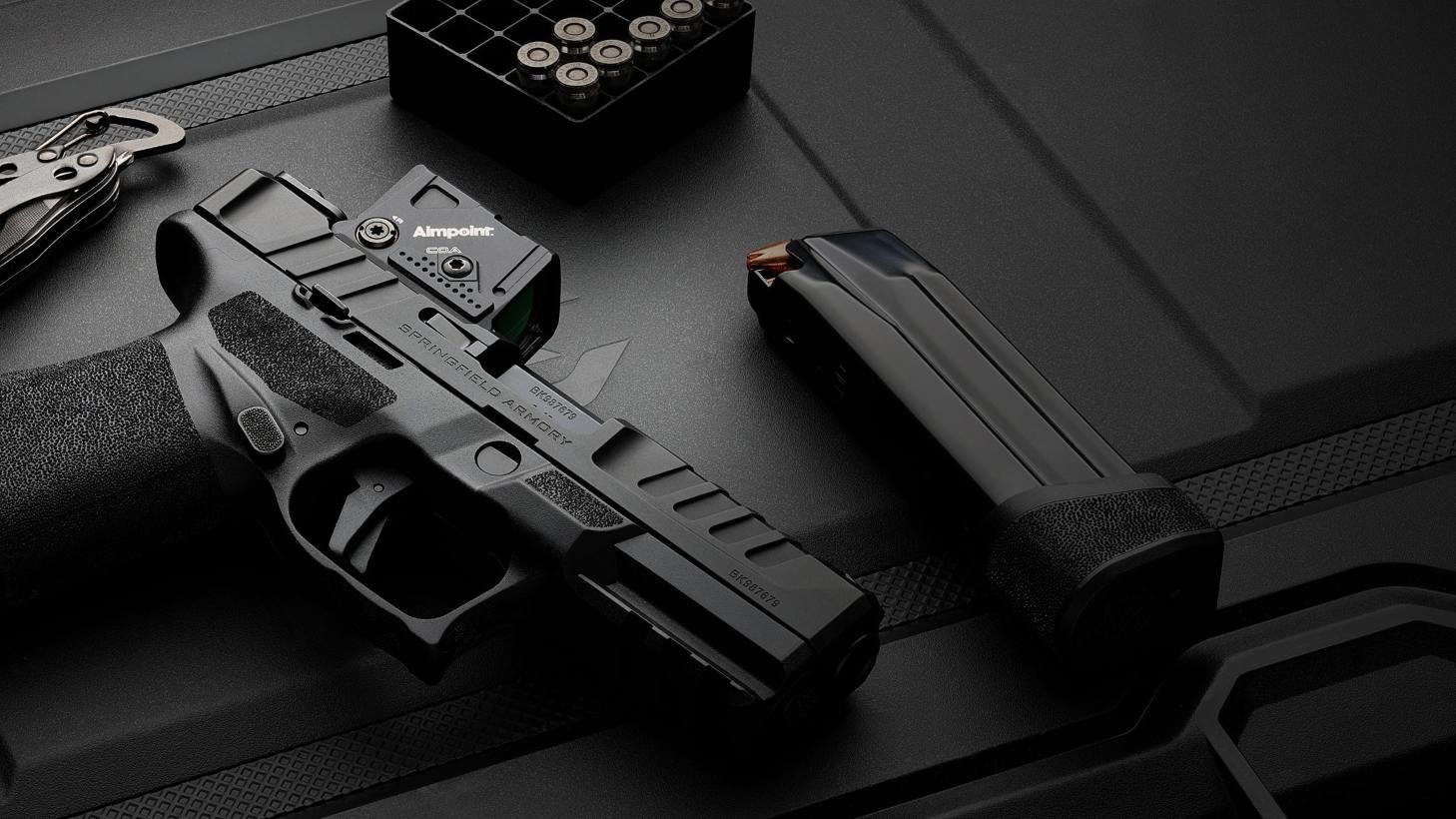 Springfield Armory Introduces Echelon Pistols with Factory-Mounted Aimpoint COA Springfield Armory has launched a new series of Echelon 9mm pistols factory-equipped with the Aimpoint COA closed-emitter red dot sight. The initial rollout includes select Echelon variants machined for Aimpoint’s proprietary A-CUT interface, integrating the optic directly into the slide without adapter plates. The collaboration marks an expansion of Springfield’s optics-ready handgun offerings, delivering a factory-installed solution designed to streamline mounting and enhance durability. A-CUT Interface and Mounting System The A-CUT system utilizes a full-length dovetail interface secured by a front hook and rear wedge. This wedge-locking mechanism is engineered to redirect lateral forces into the dovetail rather than the mounting screws, reducing stress on fasteners and supporting long-term zero retention under sustained firing. The optic’s ultra-low mounting position allows co-witnessing with standard-height iron sights, maintaining backup sight capability without suppressor-height replacements. By integrating the optic directly into the slide, the system eliminates the need for intermediary plates and aims to provide a more rigid attachment method. Aimpoint COA Optic Specifications The Aimpoint COA features a 7075-T6 aluminum housing and a 3.5 MOA aiming dot. Powered by a single CR2032 battery, the optic offers a claimed runtime exceeding five years. Brightness settings accommodate both daylight visibility and night vision compatibility. Designed for duty and carry use, the COA employs a fully enclosed emitter to protect against debris and environmental exposure. Aimpoint rates the optic for submersion up to 25 meters. A side-access battery compartment allows battery replacement without removing the optic from the slide. Available Echelon Variants and Capacity At launch, three Echelon models are offered with the factory-mounted COA: Echelon 4.5F: Full-size configuration with a 4.5-inch barrel. Echelon 4.0FC: Hybrid model pairing a full-size frame with a compact slide. Echelon 4.0C: Compact model featuring a 4-inch barrel. Magazine capacities range from 15 to 20 rounds, depending on the variant and configuration. Pricing and Market Position All three COA-equipped Echelon pistols carry an MSRP of $1,119. Springfield Armory positions the package as a factory-integrated optics solution within the Echelon lineup. With the Aimpoint COA optic priced separately at $617 and standard Echelon models starting at $710, the combined offering represents a bundled configuration at a lower total cost than purchasing components individually. According to Springfield Armory Vice President of Marketing Steve Kramer, the partnership aims to provide a combination suited for demanding environments, including military, law enforcement, concealed carry, and competitive applications. Springfield Armory also confirmed that 1911 and 1911 DS models configured with the A-CUT interface and Aimpoint COA are planned for future release.
 -
Marines Authorized to Use Red Dot Optics for Pistol Qualification The U.S. Marine Corps has authorized the use of red dot optics during Combat Pistol Program (CPP) qualifications, marking the first time Marines may qualify with an optic-equipped sidearm. The update was announced in MARADMIN 104/26, signed March 13, 2026, as a change to the Fiscal Year 2026 Combat Marksmanship Symposium post-symposium guidance. Effective immediately, Marines may use the unit-funded M17 Romeo red dot optic, National Stock Number 1240-01-713-9795, during CPP qualification. All other guidance outlined in MARADMIN 095/26 remains in effect. Optic Details and Authorization The approved optic, manufactured by Sig Sauer, is designed for the M17 and M18 service pistols, which are standard-issue sidearms across the U.S. military. The Romeo optic uses a light-emitting diode (LED) to project an illuminated aiming point onto the lens, allowing the shooter to maintain focus on the target while aligning the dot. According to the Marine Corps Training and Education Command, this is the first time optics have been permitted during pistol qualifications. Units are responsible for purchasing the optics, and installation must be conducted by qualified unit armorers. Marines authorized to carry pistols may also employ the optic in operational environments. Combat Pistol Program Requirements While all Marines qualify annually with the service rifle, only specific personnel are required to qualify with a pistol. Those issued sidearms due to rank, billet, or assignment—such as members of the Marine Corps Physical Security Program—must complete the CPP qualification. Established in 2012, the Combat Pistol Program evaluates marksmanship at distances of 7, 15, and 25 yards. Marines must achieve a minimum score of 264 out of 400 points to qualify. The program is governed by Marine Corps Order 3574.2M and aligned with the broader Marine Corps Marksmanship Campaign Plan. The policy change allows Marines to train and qualify with the same optic-equipped configuration they may carry in the field, supporting consistency between training and operational use. Continued Shift Toward Combat Optics The authorization reflects the Marine Corps’ broader adoption of advanced optics across its weapons platforms. More than a decade ago, Marine recruits transitioned from iron sights to optics for rifle qualification during boot camp. In 2025, the Corps confirmed that deploying Marines would receive an advanced smart optic capable of mounting to the M4 carbine to assist in countering small unmanned aerial systems. The addition of pistol-mounted optics to qualification standards aligns with this modernization trend, emphasizing improved target acquisition and marksmanship performance through standardized combat equipment. Release of MARADMIN 104/26 was authorized by Lt. Gen. Benjamin T. Watson, Deputy Commandant for Training and Education. View full article
-
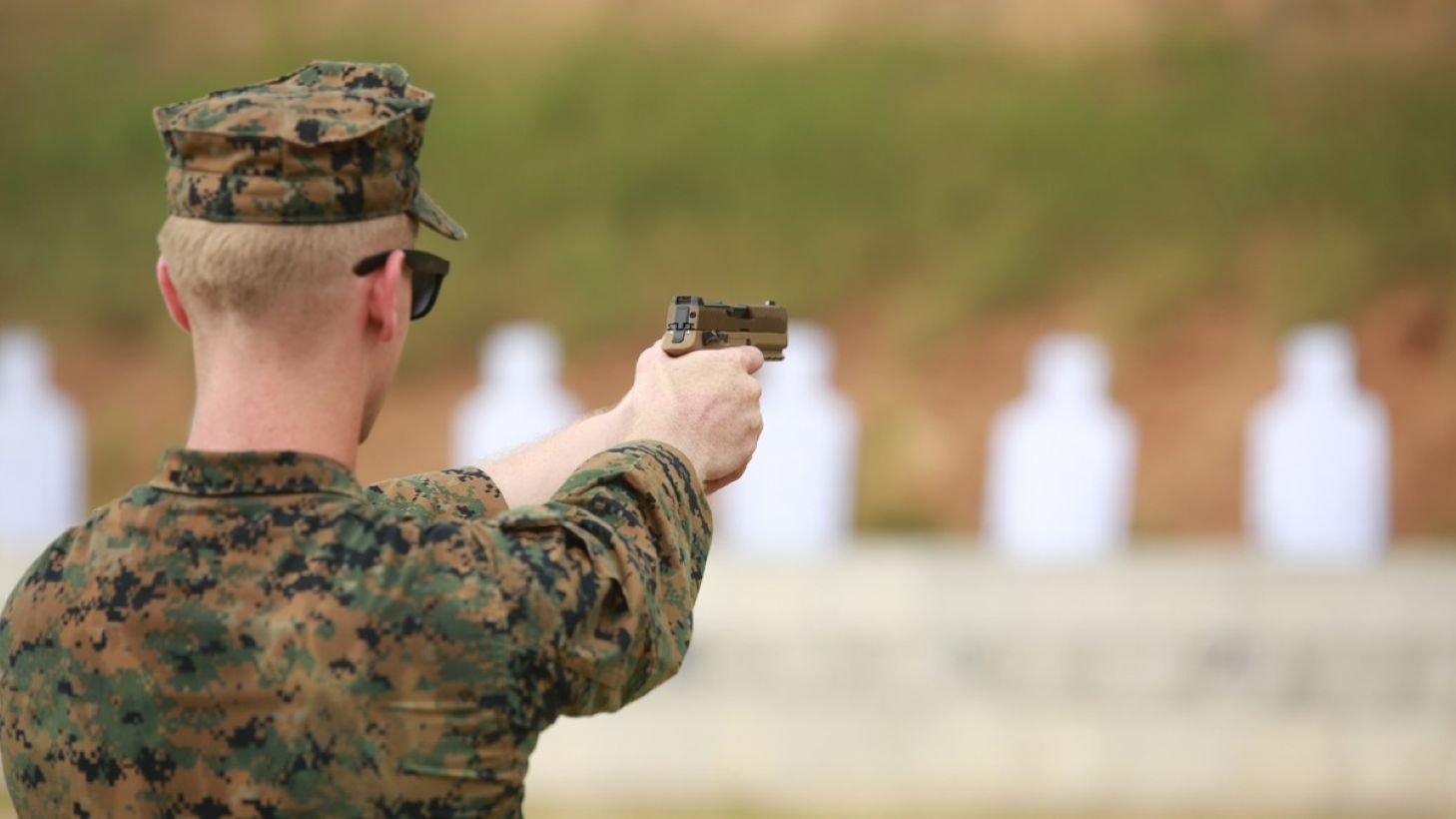 Marines Authorized to Use Red Dot Optics for Pistol Qualification The U.S. Marine Corps has authorized the use of red dot optics during Combat Pistol Program (CPP) qualifications, marking the first time Marines may qualify with an optic-equipped sidearm. The update was announced in MARADMIN 104/26, signed March 13, 2026, as a change to the Fiscal Year 2026 Combat Marksmanship Symposium post-symposium guidance. Effective immediately, Marines may use the unit-funded M17 Romeo red dot optic, National Stock Number 1240-01-713-9795, during CPP qualification. All other guidance outlined in MARADMIN 095/26 remains in effect. Optic Details and Authorization The approved optic, manufactured by Sig Sauer, is designed for the M17 and M18 service pistols, which are standard-issue sidearms across the U.S. military. The Romeo optic uses a light-emitting diode (LED) to project an illuminated aiming point onto the lens, allowing the shooter to maintain focus on the target while aligning the dot. According to the Marine Corps Training and Education Command, this is the first time optics have been permitted during pistol qualifications. Units are responsible for purchasing the optics, and installation must be conducted by qualified unit armorers. Marines authorized to carry pistols may also employ the optic in operational environments. Combat Pistol Program Requirements While all Marines qualify annually with the service rifle, only specific personnel are required to qualify with a pistol. Those issued sidearms due to rank, billet, or assignment—such as members of the Marine Corps Physical Security Program—must complete the CPP qualification. Established in 2012, the Combat Pistol Program evaluates marksmanship at distances of 7, 15, and 25 yards. Marines must achieve a minimum score of 264 out of 400 points to qualify. The program is governed by Marine Corps Order 3574.2M and aligned with the broader Marine Corps Marksmanship Campaign Plan. The policy change allows Marines to train and qualify with the same optic-equipped configuration they may carry in the field, supporting consistency between training and operational use. Continued Shift Toward Combat Optics The authorization reflects the Marine Corps’ broader adoption of advanced optics across its weapons platforms. More than a decade ago, Marine recruits transitioned from iron sights to optics for rifle qualification during boot camp. In 2025, the Corps confirmed that deploying Marines would receive an advanced smart optic capable of mounting to the M4 carbine to assist in countering small unmanned aerial systems. The addition of pistol-mounted optics to qualification standards aligns with this modernization trend, emphasizing improved target acquisition and marksmanship performance through standardized combat equipment. Release of MARADMIN 104/26 was authorized by Lt. Gen. Benjamin T. Watson, Deputy Commandant for Training and Education.
 -
Russia Proposes Intelligence Trade-Off With United States Russia has reportedly proposed halting its intelligence-sharing with Iran if the United States agrees to suspend intelligence support to Ukraine, according to a March 20 report by Politico citing two individuals familiar with ongoing U.S.–Russia discussions. The proposal was presented as part of broader negotiations between Washington and Moscow. U.S. officials have rejected the offer, Politico reported, indicating that Washington does not view the suggested exchange as acceptable within the current strategic context. CIA Testimony and Iranian Requests During congressional testimony on March 18, CIA Director John Ratcliffe confirmed that Iran has requested intelligence from Russia regarding U.S. military assets in the Middle East. Ratcliffe’s remarks provided public acknowledgment of Tehran’s efforts to obtain sensitive information amid heightened regional tensions. The disclosure followed earlier comments by U.S. Special Envoy Steve Witkoff, who is involved in negotiations with Moscow. On March 10, Witkoff stated that Russia had denied sharing intelligence with Iran and said he believed the United States could “take them at their word.” His comments reflected a cautious but open stance toward Russian assurances at that time. Diverging Assessments in Washington Public messaging from U.S. leadership has varied. On March 7, President Donald Trump downplayed concerns about intelligence cooperation between Russia and Iran, stating that such activity was “not doing much.” However, subsequent reporting suggested growing concern within parts of the U.S. government. On March 8, The Washington Post reported that the United States had begun repositioning components of its air defense systems from South Korea to the Middle East. The move was described as part of broader preparations amid rising tensions linked to Iran and regional security developments in the Gulf. These developments indicate that, despite public statements minimizing the threat, U.S. defense planners have taken precautionary measures in response to evolving intelligence assessments. Ukraine Intelligence Support and Diplomatic Reaction The Russian proposal also intersects with ongoing U.S. intelligence support for Ukraine. The Trump administration has previously signaled that intelligence sharing with Kyiv could be curtailed if peace negotiations with Moscow failed to progress. The reported Russian offer appears to leverage that precedent by linking Ukraine-related cooperation to Moscow’s ties with Tehran. According to Politico, the proposal has unsettled some European Union diplomats. Concerns center on the potential strategic implications of reducing Western intelligence support for Ukraine during continued hostilities. At least one EU official, however, sought to downplay the potential impact, stating that France currently provides approximately “two-thirds” of Ukraine’s military intelligence. The comment suggests that European intelligence capabilities could mitigate any shift in U.S. policy, though the broader operational effects remain unclear. The reported exchange underscores the complex interplay between regional conflicts, intelligence partnerships, and ongoing diplomatic negotiations involving the United States, Russia, Iran, and European allies. View full article
-
 Russia Proposes Intelligence Trade-Off With United States Russia has reportedly proposed halting its intelligence-sharing with Iran if the United States agrees to suspend intelligence support to Ukraine, according to a March 20 report by Politico citing two individuals familiar with ongoing U.S.–Russia discussions. The proposal was presented as part of broader negotiations between Washington and Moscow. U.S. officials have rejected the offer, Politico reported, indicating that Washington does not view the suggested exchange as acceptable within the current strategic context. CIA Testimony and Iranian Requests During congressional testimony on March 18, CIA Director John Ratcliffe confirmed that Iran has requested intelligence from Russia regarding U.S. military assets in the Middle East. Ratcliffe’s remarks provided public acknowledgment of Tehran’s efforts to obtain sensitive information amid heightened regional tensions. The disclosure followed earlier comments by U.S. Special Envoy Steve Witkoff, who is involved in negotiations with Moscow. On March 10, Witkoff stated that Russia had denied sharing intelligence with Iran and said he believed the United States could “take them at their word.” His comments reflected a cautious but open stance toward Russian assurances at that time. Diverging Assessments in Washington Public messaging from U.S. leadership has varied. On March 7, President Donald Trump downplayed concerns about intelligence cooperation between Russia and Iran, stating that such activity was “not doing much.” However, subsequent reporting suggested growing concern within parts of the U.S. government. On March 8, The Washington Post reported that the United States had begun repositioning components of its air defense systems from South Korea to the Middle East. The move was described as part of broader preparations amid rising tensions linked to Iran and regional security developments in the Gulf. These developments indicate that, despite public statements minimizing the threat, U.S. defense planners have taken precautionary measures in response to evolving intelligence assessments. Ukraine Intelligence Support and Diplomatic Reaction The Russian proposal also intersects with ongoing U.S. intelligence support for Ukraine. The Trump administration has previously signaled that intelligence sharing with Kyiv could be curtailed if peace negotiations with Moscow failed to progress. The reported Russian offer appears to leverage that precedent by linking Ukraine-related cooperation to Moscow’s ties with Tehran. According to Politico, the proposal has unsettled some European Union diplomats. Concerns center on the potential strategic implications of reducing Western intelligence support for Ukraine during continued hostilities. At least one EU official, however, sought to downplay the potential impact, stating that France currently provides approximately “two-thirds” of Ukraine’s military intelligence. The comment suggests that European intelligence capabilities could mitigate any shift in U.S. policy, though the broader operational effects remain unclear. The reported exchange underscores the complex interplay between regional conflicts, intelligence partnerships, and ongoing diplomatic negotiations involving the United States, Russia, Iran, and European allies.
 -
Dual Marine Expeditionary Units Deploy Toward Middle East The United States is moving two Marine Expeditionary Units (MEUs) toward the Middle East as conflict involving Iran intensifies, expanding U.S. amphibious and ground-capable options in a theater largely defined by air and naval operations. Defense officials confirm that one unit is already en route while a second has been ordered to deploy, creating a dual-MEU presence that marks a notable increase in forward-positioned combat capability. 31st MEU Advances Aboard USS Tripoli The 31st Marine Expeditionary Unit, forward-deployed in the Indo-Pacific, is heading toward the region embarked on the amphibious assault ship USS Tripoli (LHA-7) with its amphibious ready group. The 31st MEU is typically the Marine Corps’ most immediately available crisis-response force. A standard MEU consists of approximately 2,000–2,200 Marines organized as a self-contained, combined-arms formation. It includes an infantry battalion as its ground combat element, an aviation combat element equipped with F-35B Lightning II fighters, MV-22 Osprey tiltrotor aircraft, and helicopters, as well as logistics and command units. Operating from the sea, a MEU can conduct amphibious assaults, air assaults, limited raids, evacuation missions, and the seizure of ports, airfields, or coastal infrastructure. Its sea-based posture allows rapid repositioning without reliance on host-nation basing. 11th MEU Ordered to Deploy Aboard USS Boxer A second force centered on the 11th Marine Expeditionary Unit has been directed to deploy from the United States aboard USS Boxer (LHD-4). This group is expected to include roughly 2,200–2,500 Marines along with supporting amphibious ships, aircraft, and logistics elements. Unlike the 31st MEU, which is already forward-positioned, the 11th MEU will require additional transit time before arriving in theater. Once in place, it will expand U.S. operational flexibility and provide additional amphibious and aviation capacity. Expanded Amphibious and Ground Capabilities The establishment of two MEUs in a single theater is not typical during routine operations. The United States generally maintains one forward-deployed MEU while holding others in reserve. A dual-MEU posture enables overlapping operations, sustained presence, and broader geographic coverage. MEUs introduce capabilities distinct from carrier strike groups. While aircraft carriers provide sustained air operations, air superiority, and missile defense, MEUs offer integrated air-ground teams capable of conducting limited objective ground operations from the sea. Their aviation components can deliver close air support, insert forces inland, and move personnel rapidly between ships and shore. Scale and Strategic Context Each MEU represents a relatively small but highly capable force. Combined, two MEUs total approximately 4,500–5,000 Marines. This is substantially smaller than troop levels associated with major ground campaigns and reflects a focus on precision, short-duration missions rather than large-scale occupation. The deployment signals an expansion of available options rather than a transition to full-scale ground war. By reinforcing carrier and surface naval forces with amphibious units, the United States is establishing a layered posture that integrates air, sea, and limited ground capabilities while maintaining a predominantly sea-based footprint. View full article
-
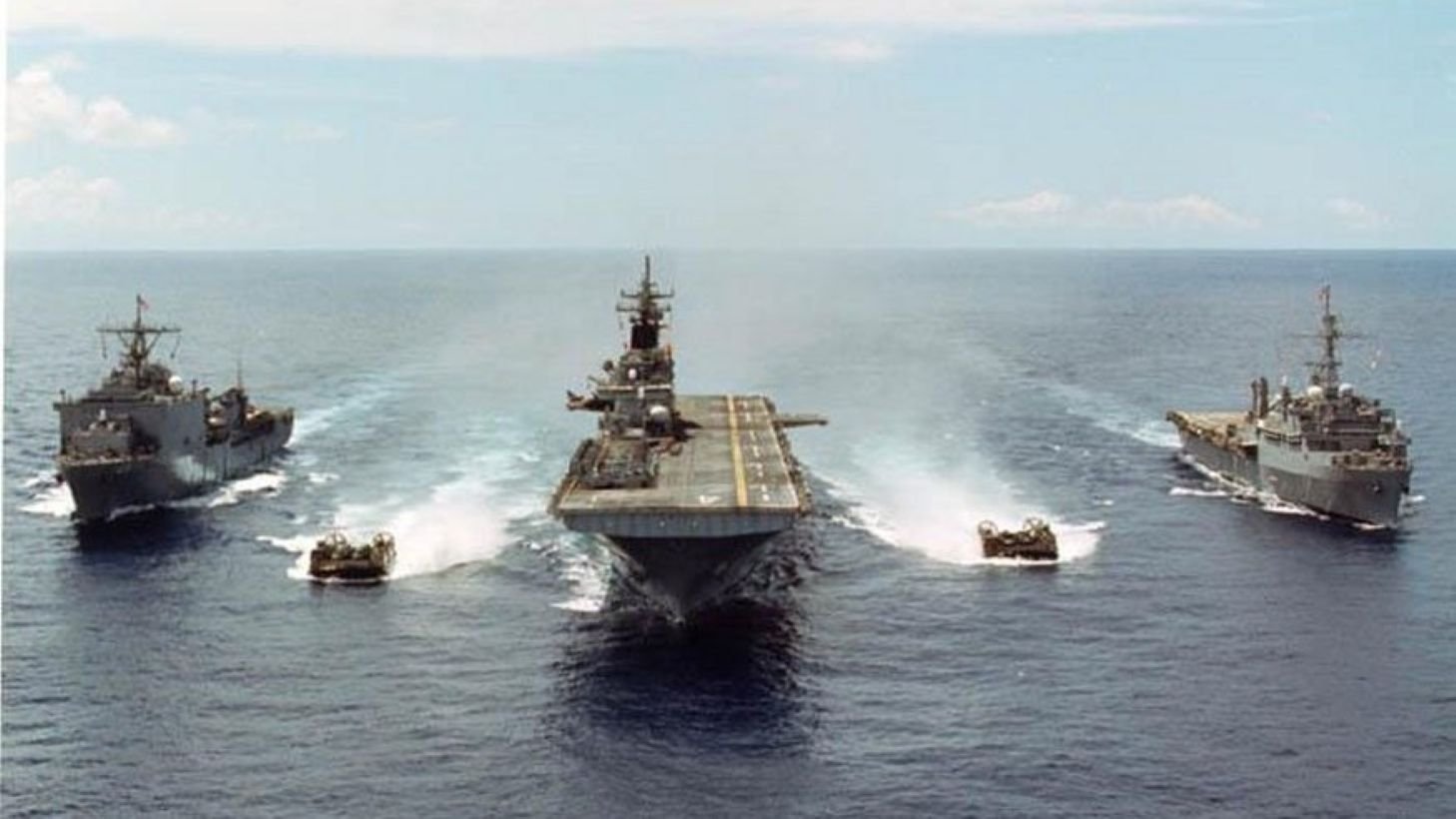 Dual Marine Expeditionary Units Deploy Toward Middle East The United States is moving two Marine Expeditionary Units (MEUs) toward the Middle East as conflict involving Iran intensifies, expanding U.S. amphibious and ground-capable options in a theater largely defined by air and naval operations. Defense officials confirm that one unit is already en route while a second has been ordered to deploy, creating a dual-MEU presence that marks a notable increase in forward-positioned combat capability. 31st MEU Advances Aboard USS Tripoli The 31st Marine Expeditionary Unit, forward-deployed in the Indo-Pacific, is heading toward the region embarked on the amphibious assault ship USS Tripoli (LHA-7) with its amphibious ready group. The 31st MEU is typically the Marine Corps’ most immediately available crisis-response force. A standard MEU consists of approximately 2,000–2,200 Marines organized as a self-contained, combined-arms formation. It includes an infantry battalion as its ground combat element, an aviation combat element equipped with F-35B Lightning II fighters, MV-22 Osprey tiltrotor aircraft, and helicopters, as well as logistics and command units. Operating from the sea, a MEU can conduct amphibious assaults, air assaults, limited raids, evacuation missions, and the seizure of ports, airfields, or coastal infrastructure. Its sea-based posture allows rapid repositioning without reliance on host-nation basing. 11th MEU Ordered to Deploy Aboard USS Boxer A second force centered on the 11th Marine Expeditionary Unit has been directed to deploy from the United States aboard USS Boxer (LHD-4). This group is expected to include roughly 2,200–2,500 Marines along with supporting amphibious ships, aircraft, and logistics elements. Unlike the 31st MEU, which is already forward-positioned, the 11th MEU will require additional transit time before arriving in theater. Once in place, it will expand U.S. operational flexibility and provide additional amphibious and aviation capacity. Expanded Amphibious and Ground Capabilities The establishment of two MEUs in a single theater is not typical during routine operations. The United States generally maintains one forward-deployed MEU while holding others in reserve. A dual-MEU posture enables overlapping operations, sustained presence, and broader geographic coverage. MEUs introduce capabilities distinct from carrier strike groups. While aircraft carriers provide sustained air operations, air superiority, and missile defense, MEUs offer integrated air-ground teams capable of conducting limited objective ground operations from the sea. Their aviation components can deliver close air support, insert forces inland, and move personnel rapidly between ships and shore. Scale and Strategic Context Each MEU represents a relatively small but highly capable force. Combined, two MEUs total approximately 4,500–5,000 Marines. This is substantially smaller than troop levels associated with major ground campaigns and reflects a focus on precision, short-duration missions rather than large-scale occupation. The deployment signals an expansion of available options rather than a transition to full-scale ground war. By reinforcing carrier and surface naval forces with amphibious units, the United States is establishing a layered posture that integrates air, sea, and limited ground capabilities while maintaining a predominantly sea-based footprint.
 -
Pentagon Bars Stars and Stripes From Press Conference The Pentagon declined to approve attendance for its own publication, Stars and Stripes, at a recent morning press conference held by Defense Secretary Pete Hegseth regarding the ongoing war in Iran. Reporter Matthew Adams said on social media that he was informed the outlet was not authorized to attend and would instead watch remotely. Adams noted the decision was unusual, given that the Pentagon had recently issued a memo outlining operational changes for the newspaper. The exclusion follows a series of new directives affecting the publication, which is funded by the Department of Defense but operates with congressionally mandated editorial independence. New Content Guidelines and “Good Order and Discipline” A Pentagon memo introduced updated restrictions requiring Stars and Stripes to comply with standards tied to “good order and discipline,” a term traditionally associated with military conduct. The document states the outlet will retain editorial independence while adhering to new departmental policies and avoiding certain forms of critical content. Editor-in-chief Erik Slavin said he learned of the policy changes three days after they were posted online by the Defense Department, only after a staff member discovered them. Slavin questioned how the new language would be interpreted in practice, particularly whether coverage deemed inconsistent with “good order and discipline” could expose staff to legal or professional consequences. The policy shift places the publication in what observers describe as a gray area, requiring editors to evaluate reporting against criteria defined by the same institution they cover. Congressional Protections and Free Speech Concerns Stars and Stripes employees are civilian personnel of the U.S. Army, and the outlet’s editorial independence is protected by Congress to prevent political influence over reporting aimed at service members. Reporter Kevin Baron publicly criticized the Pentagon’s decision to bar the paper from the press event, emphasizing that the newsroom was structured to avoid becoming a government mouthpiece. Timothy Richardson of PEN America said the new guidelines signal increased Pentagon involvement in editorial decisions. He characterized the changes as a potential threat to First Amendment principles and to the independence historically guaranteed to the publication. Broader Media Tensions In January, chief Pentagon spokesperson Sean Parnell announced that the administration sought to “modernize” Stars and Stripes and refocus its content away from what he described as “woke distractions that siphon morale.” While the memo affirmed continued publication, it underscored alignment with updated Defense Department policies. The dispute arises amid broader tensions between Pentagon leadership and segments of the media over coverage of the Iran conflict. Hegseth has accused news organizations of misrepresenting military progress and amplifying negative aspects of the war effort. At a recent press conference, he criticized what he described as “dishonest” reporting. President Donald Trump has also sharply criticized outlets he views as unfavorable, stating on social media that certain reporting he considers false could amount to “treason.” During Trump’s first term, the Pentagon previously moved to shut down Stars and Stripes, though the effort was halted after the president expressed public support for the publication, calling it a “wonderful source of information” for service members. The current dispute marks a renewed test of the balance between Pentagon oversight and the newsroom’s congressionally protected independence. View full article
-
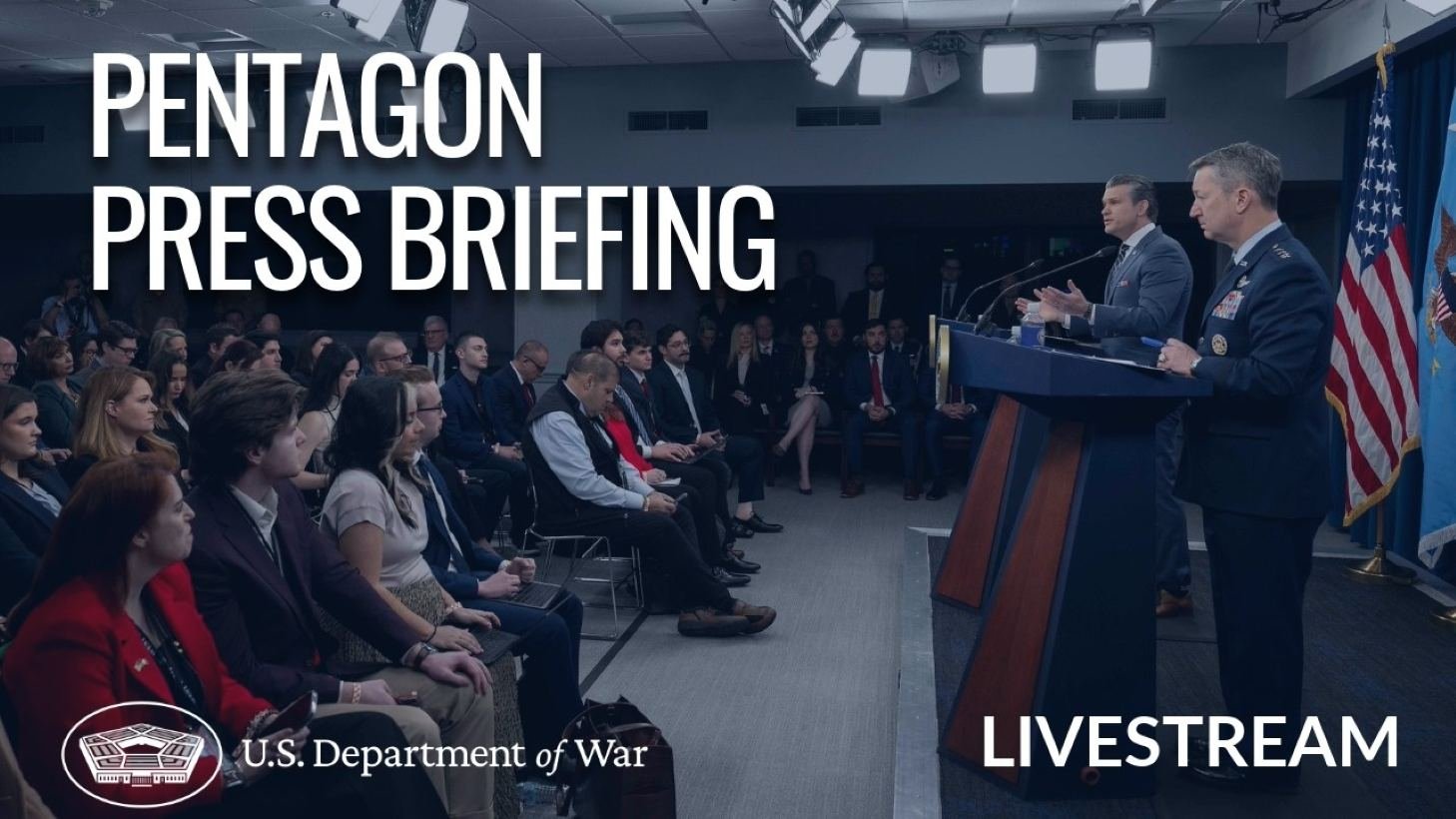 Pentagon Bars Stars and Stripes From Press Conference The Pentagon declined to approve attendance for its own publication, Stars and Stripes, at a recent morning press conference held by Defense Secretary Pete Hegseth regarding the ongoing war in Iran. Reporter Matthew Adams said on social media that he was informed the outlet was not authorized to attend and would instead watch remotely. Adams noted the decision was unusual, given that the Pentagon had recently issued a memo outlining operational changes for the newspaper. The exclusion follows a series of new directives affecting the publication, which is funded by the Department of Defense but operates with congressionally mandated editorial independence. New Content Guidelines and “Good Order and Discipline” A Pentagon memo introduced updated restrictions requiring Stars and Stripes to comply with standards tied to “good order and discipline,” a term traditionally associated with military conduct. The document states the outlet will retain editorial independence while adhering to new departmental policies and avoiding certain forms of critical content. Editor-in-chief Erik Slavin said he learned of the policy changes three days after they were posted online by the Defense Department, only after a staff member discovered them. Slavin questioned how the new language would be interpreted in practice, particularly whether coverage deemed inconsistent with “good order and discipline” could expose staff to legal or professional consequences. The policy shift places the publication in what observers describe as a gray area, requiring editors to evaluate reporting against criteria defined by the same institution they cover. Congressional Protections and Free Speech Concerns Stars and Stripes employees are civilian personnel of the U.S. Army, and the outlet’s editorial independence is protected by Congress to prevent political influence over reporting aimed at service members. Reporter Kevin Baron publicly criticized the Pentagon’s decision to bar the paper from the press event, emphasizing that the newsroom was structured to avoid becoming a government mouthpiece. Timothy Richardson of PEN America said the new guidelines signal increased Pentagon involvement in editorial decisions. He characterized the changes as a potential threat to First Amendment principles and to the independence historically guaranteed to the publication. Broader Media Tensions In January, chief Pentagon spokesperson Sean Parnell announced that the administration sought to “modernize” Stars and Stripes and refocus its content away from what he described as “woke distractions that siphon morale.” While the memo affirmed continued publication, it underscored alignment with updated Defense Department policies. The dispute arises amid broader tensions between Pentagon leadership and segments of the media over coverage of the Iran conflict. Hegseth has accused news organizations of misrepresenting military progress and amplifying negative aspects of the war effort. At a recent press conference, he criticized what he described as “dishonest” reporting. President Donald Trump has also sharply criticized outlets he views as unfavorable, stating on social media that certain reporting he considers false could amount to “treason.” During Trump’s first term, the Pentagon previously moved to shut down Stars and Stripes, though the effort was halted after the president expressed public support for the publication, calling it a “wonderful source of information” for service members. The current dispute marks a renewed test of the balance between Pentagon oversight and the newsroom’s congressionally protected independence.
 -
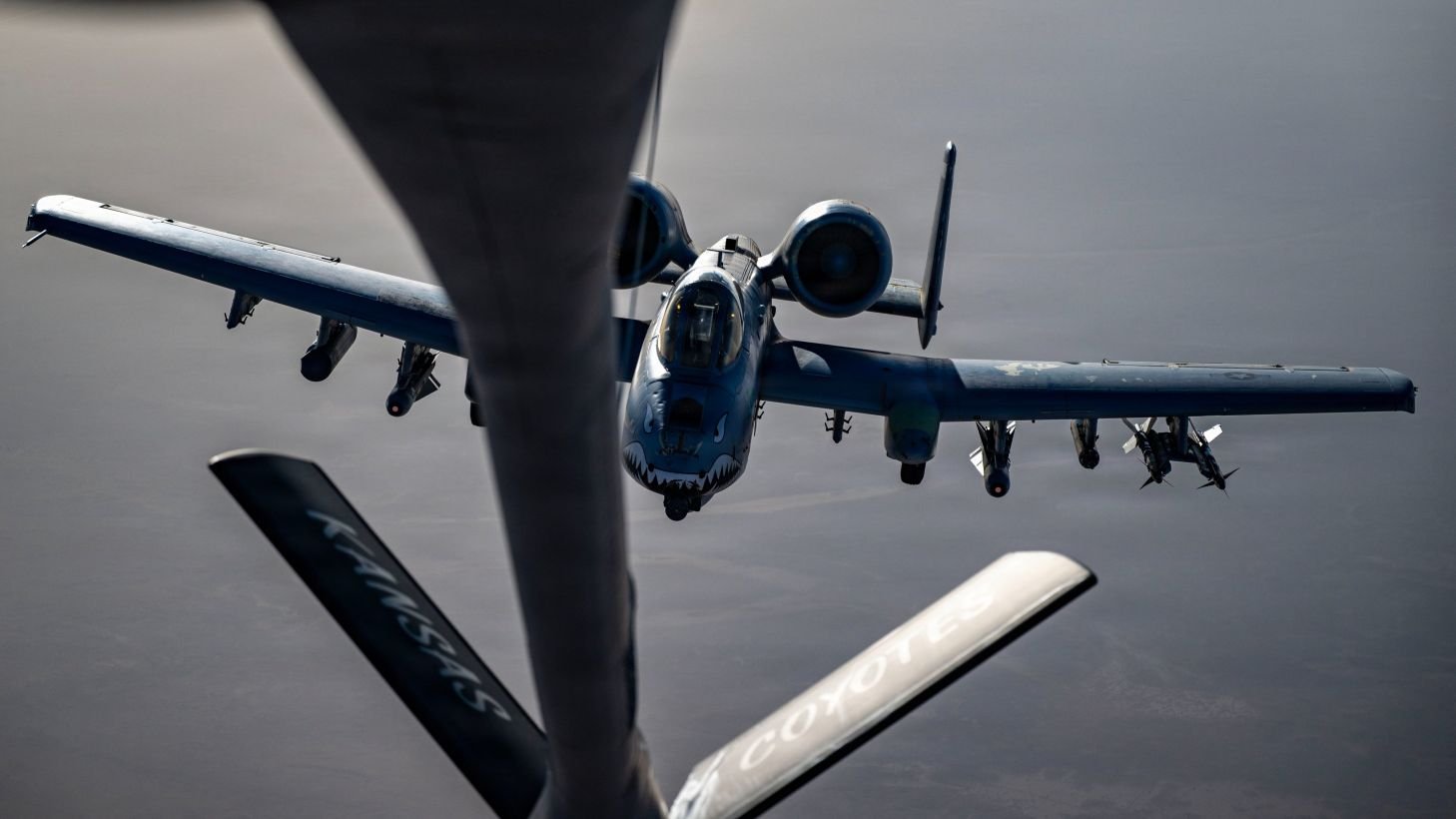
Apache Helicopters Conduct Strikes on Iranian-Backed Militias in Iraq U.S. Army AH-64 Apache attack helicopters are conducting strikes against Iranian-aligned militia groups in Iraq, according to Air Force Gen. Dan Caine, Chairman of the Joint Chiefs of Staff. Speaking at a Pentagon news conference Thursday, Caine said the operations are intended to suppress threats to U.S. forces and American interests in the country. “In Iraq, AH-64s have been striking against Iranian-aligned militia groups to make sure that we suppress any threat in Iraq against us, forces, or U.S. interests,” Caine stated. He did not provide details on the number of combat missions flown since the launch of U.S. operations against Iran on Feb. 28, nor did he identify specific militia groups targeted. Operation Epic Fury Expands Regional Conflict The strikes in Iraq are part of a broader U.S. campaign against Iran known as Operation Epic Fury. Since the operation began, the U.S. Embassy in Baghdad has faced repeated drone and missile attacks. In a statement Tuesday, the embassy said Iranian-backed militias have “encouraged and conducted widespread attacks on U.S. citizens and targets associated with the United States throughout Iraq,” including assaults on Baghdad’s international zone. Tensions between the United States and Iran have spanned decades and intensified following the 2003 U.S.-led invasion of Iraq. The Defense Department estimates that Iranian-backed militias were responsible for the deaths of more than 600 U.S. troops in Iraq between 2003 and 2011. Hostilities have persisted during the U.S.-led campaign against the Islamic State, launched in 2014. American forces have engaged militia groups supported by Iran, including Kata’ib Hezbollah and Harakat-al-Nujaba, and have conducted airstrikes against facilities linked to Iran’s Islamic Revolutionary Guard Corps. After Hamas’ Oct. 7, 2023, attack on Israel, the Islamic Resistance in Iraq—a network of Iranian-backed factions—began targeting U.S. forces in the region. The group claimed responsibility for a January 2024 drone strike on a U.S. outpost in Jordan that killed three American soldiers. A-10 Aircraft Target Fast Attack Craft in Strait of Hormuz Caine also announced that the Air Force’s A-10 Thunderbolt II aircraft are engaged in operations aimed at preventing Iran from disrupting maritime traffic in the Strait of Hormuz. The strategic waterway handles roughly 20 percent of global oil shipments. “The A-10 Warthog is now in the fight across the southern flank and is hunting and killing fast attack watercraft in the Strait of Hormuz,” Caine said. U.S. officials had expressed concern that Iran might deploy sea mines to impede tanker traffic. As of Thursday, U.S. forces had destroyed 44 Iranian vessels assessed to be used for laying mines, according to Caine. A-10 Role Expands Amid Retirement Debate The A-10, traditionally used for close air support missions, has played a prominent role in ground combat operations. Earlier this year, A-10s conducted airstrikes against ISIS targets in Syria following the December killings of two Iowa National Guard soldiers and a civilian translator. Despite repeated Air Force efforts to retire the aircraft, Congress has directed the service to maintain 103 A-10s through the end of the fiscal year on Sept. 30, ensuring the platform remains operational amid expanding regional missions. View full article
-
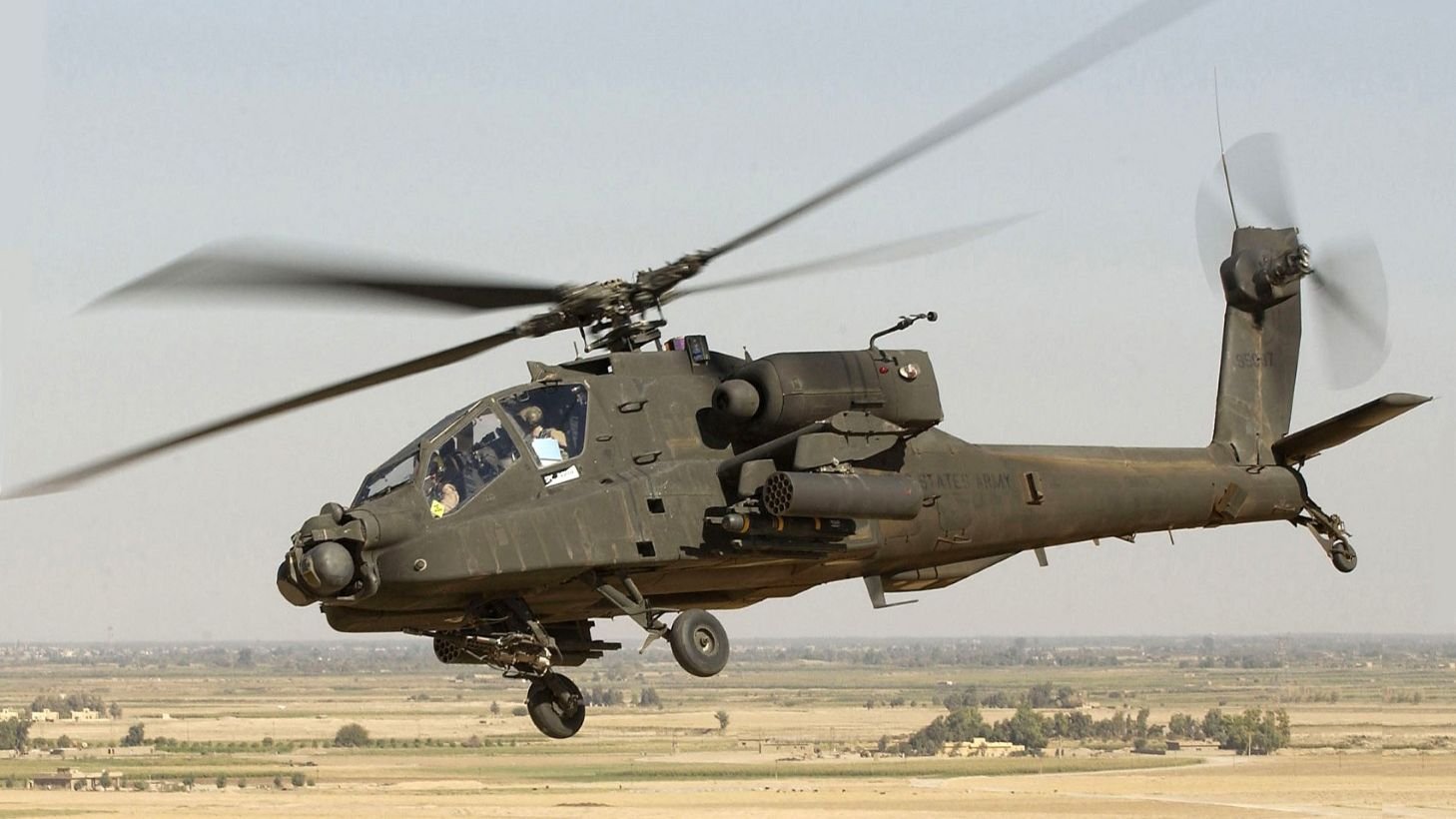 Apache Helicopters Conduct Strikes on Iranian-Backed Militias in Iraq U.S. Army AH-64 Apache attack helicopters are conducting strikes against Iranian-aligned militia groups in Iraq, according to Air Force Gen. Dan Caine, Chairman of the Joint Chiefs of Staff. Speaking at a Pentagon news conference Thursday, Caine said the operations are intended to suppress threats to U.S. forces and American interests in the country. “In Iraq, AH-64s have been striking against Iranian-aligned militia groups to make sure that we suppress any threat in Iraq against us, forces, or U.S. interests,” Caine stated. He did not provide details on the number of combat missions flown since the launch of U.S. operations against Iran on Feb. 28, nor did he identify specific militia groups targeted. Operation Epic Fury Expands Regional Conflict The strikes in Iraq are part of a broader U.S. campaign against Iran known as Operation Epic Fury. Since the operation began, the U.S. Embassy in Baghdad has faced repeated drone and missile attacks. In a statement Tuesday, the embassy said Iranian-backed militias have “encouraged and conducted widespread attacks on U.S. citizens and targets associated with the United States throughout Iraq,” including assaults on Baghdad’s international zone. Tensions between the United States and Iran have spanned decades and intensified following the 2003 U.S.-led invasion of Iraq. The Defense Department estimates that Iranian-backed militias were responsible for the deaths of more than 600 U.S. troops in Iraq between 2003 and 2011. Hostilities have persisted during the U.S.-led campaign against the Islamic State, launched in 2014. American forces have engaged militia groups supported by Iran, including Kata’ib Hezbollah and Harakat-al-Nujaba, and have conducted airstrikes against facilities linked to Iran’s Islamic Revolutionary Guard Corps. After Hamas’ Oct. 7, 2023, attack on Israel, the Islamic Resistance in Iraq—a network of Iranian-backed factions—began targeting U.S. forces in the region. The group claimed responsibility for a January 2024 drone strike on a U.S. outpost in Jordan that killed three American soldiers. A-10 Aircraft Target Fast Attack Craft in Strait of Hormuz Caine also announced that the Air Force’s A-10 Thunderbolt II aircraft are engaged in operations aimed at preventing Iran from disrupting maritime traffic in the Strait of Hormuz. The strategic waterway handles roughly 20 percent of global oil shipments. “The A-10 Warthog is now in the fight across the southern flank and is hunting and killing fast attack watercraft in the Strait of Hormuz,” Caine said. U.S. officials had expressed concern that Iran might deploy sea mines to impede tanker traffic. As of Thursday, U.S. forces had destroyed 44 Iranian vessels assessed to be used for laying mines, according to Caine. A-10 Role Expands Amid Retirement Debate The A-10, traditionally used for close air support missions, has played a prominent role in ground combat operations. Earlier this year, A-10s conducted airstrikes against ISIS targets in Syria following the December killings of two Iowa National Guard soldiers and a civilian translator. Despite repeated Air Force efforts to retire the aircraft, Congress has directed the service to maintain 103 A-10s through the end of the fiscal year on Sept. 30, ensuring the platform remains operational amid expanding regional missions.
 -
US Approves $16B in Emergency Air Defense Sales to Middle East Allies The United States has approved more than $16 billion in proposed “emergency” Foreign Military Sales to Middle Eastern partners, citing urgent security needs as regional allies contend with Iranian missile and drone attacks. The largest packages include $8 billion in radar systems for Kuwait and $8.4 billion in air defense equipment for the United Arab Emirates (UAE). According to State Department notices, the Secretary of State determined that an emergency exists requiring immediate sales in the national security interests of the United States, thereby waiving standard congressional review requirements. Major Radar and Missile Packages Detailed Kuwait’s proposed $8 billion package centers on the Lower Tier Air and Missile Defense Sensor (LTAMDS) radar and associated equipment designed to enhance detection and tracking of aerial threats. The UAE package totals approximately $8.4 billion and includes a $4.5 billion long-range radar system intended to integrate with Terminal High Altitude Area Defense (THAAD) systems. Additional components include $2.1 billion in counter-drone systems, $1.2 billion in air-to-air missiles, and $644 million in F-16 munitions and upgrades. Jordan is slated to receive a smaller $70.5 million package focused on aircraft repair services and spare parts. Iranian Attacks Drive Urgency The emergency determinations follow a surge in Iranian missile and unmanned aerial vehicle (UAV) strikes targeting US partners in the region after large-scale US and Israeli military operations against Tehran last month. Kuwait reported the deaths of six American soldiers in a drone strike on a US command center. The UAE has also faced repeated attacks, with its Ministry of Defense stating it engaged seven missiles and 15 UAVs in a single day. Officials say the proposed sales aim to replenish expended munitions and strengthen layered air defenses against continued threats. Gulf States Seek Ukrainian Counter-Drone Expertise Beyond US systems, several Gulf nations are exploring counter-drone solutions from Ukraine, whose forces have developed extensive experience defending against Iranian-designed Shahed drones used by Russia. Ukrainian manufacturers report receiving numerous inquiries through government and private channels. President Volodymyr Zelenskyy recently said Kyiv dispatched teams to Middle Eastern countries to demonstrate air defense technologies, emphasizing that both funding and technological partnerships are critical as Ukraine sustains its defense industrial base. Ukraine has built a layered air defense ecosystem that pairs relatively low-cost interceptors with inexpensive threats, avoiding reliance on high-cost systems such as Patriot missiles for every engagement. Interceptor drones—often modified first-person-view designs—have evolved to counter Shahed-type UAVs at speed and scale. Oleksandr Syrskyi, Ukraine’s commander-in-chief, reported 6,300 interceptor drone sorties in February alone. Zelenskyy stated Ukraine could produce up to 2,000 interceptor drones per day, with roughly half required domestically. Export Controls and Market Competition Despite strong foreign interest, Ukrainian arms exports remain subject to government authorization under wartime controls. Industry representatives indicate that while inquiries are frequent, approvals rest with Kyiv. Analysts note that global competitors, including US manufacturers, are developing similar capabilities. The United States has already delivered 10,000 Merops drones—developed under a project linked to former Google CEO Eric Schmidt—to support infrastructure defense in the Middle East. Observers caution that the current demand surge may be temporary as other producers expand output. Nonetheless, the combination of emergency US sales and emerging Ukrainian technology underscores a rapidly evolving air defense market shaped by persistent missile and drone threats across the region. View full article
-
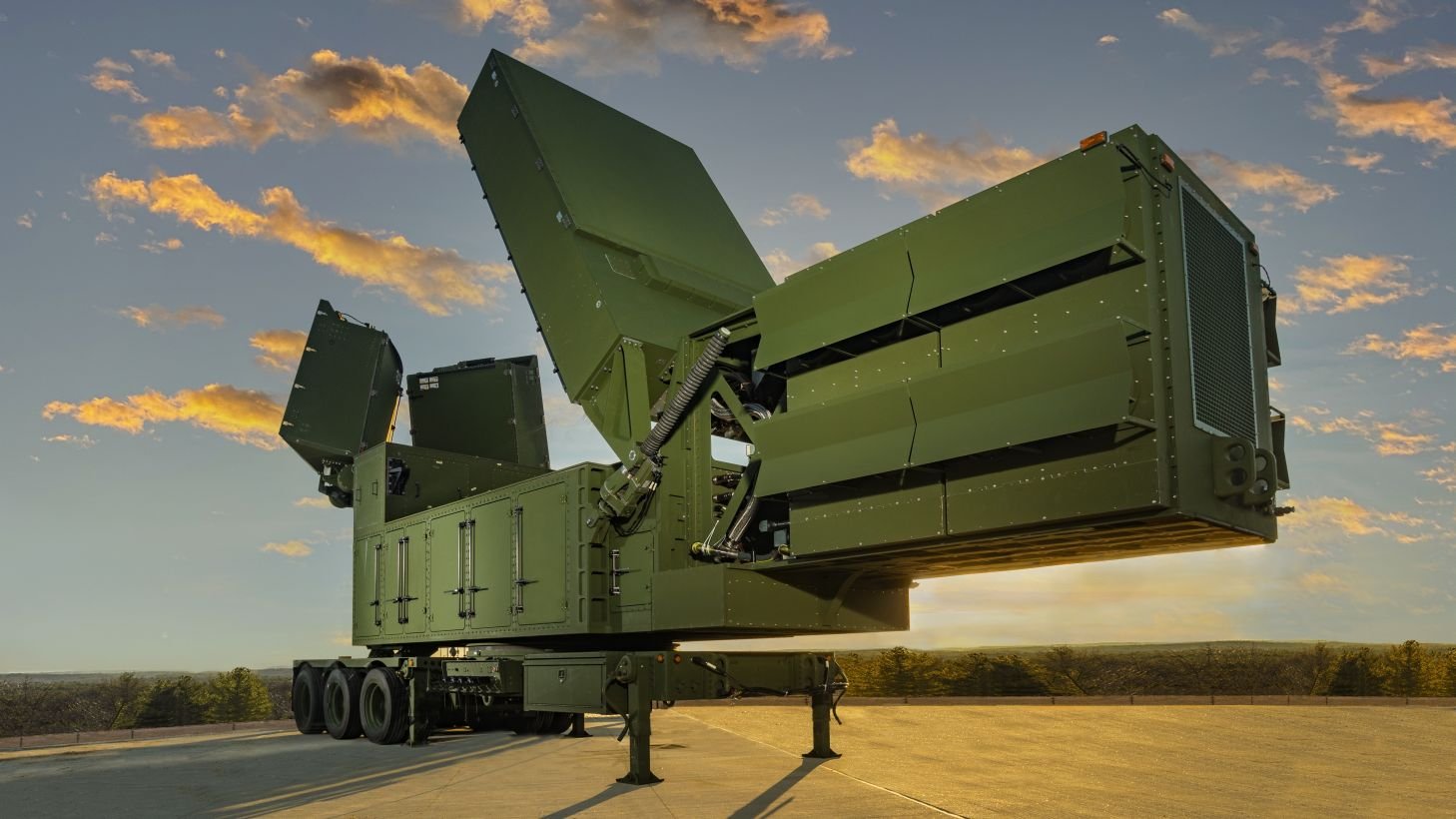 US Approves $16B in Emergency Air Defense Sales to Middle East Allies The United States has approved more than $16 billion in proposed “emergency” Foreign Military Sales to Middle Eastern partners, citing urgent security needs as regional allies contend with Iranian missile and drone attacks. The largest packages include $8 billion in radar systems for Kuwait and $8.4 billion in air defense equipment for the United Arab Emirates (UAE). According to State Department notices, the Secretary of State determined that an emergency exists requiring immediate sales in the national security interests of the United States, thereby waiving standard congressional review requirements. Major Radar and Missile Packages Detailed Kuwait’s proposed $8 billion package centers on the Lower Tier Air and Missile Defense Sensor (LTAMDS) radar and associated equipment designed to enhance detection and tracking of aerial threats. The UAE package totals approximately $8.4 billion and includes a $4.5 billion long-range radar system intended to integrate with Terminal High Altitude Area Defense (THAAD) systems. Additional components include $2.1 billion in counter-drone systems, $1.2 billion in air-to-air missiles, and $644 million in F-16 munitions and upgrades. Jordan is slated to receive a smaller $70.5 million package focused on aircraft repair services and spare parts. Iranian Attacks Drive Urgency The emergency determinations follow a surge in Iranian missile and unmanned aerial vehicle (UAV) strikes targeting US partners in the region after large-scale US and Israeli military operations against Tehran last month. Kuwait reported the deaths of six American soldiers in a drone strike on a US command center. The UAE has also faced repeated attacks, with its Ministry of Defense stating it engaged seven missiles and 15 UAVs in a single day. Officials say the proposed sales aim to replenish expended munitions and strengthen layered air defenses against continued threats. Gulf States Seek Ukrainian Counter-Drone Expertise Beyond US systems, several Gulf nations are exploring counter-drone solutions from Ukraine, whose forces have developed extensive experience defending against Iranian-designed Shahed drones used by Russia. Ukrainian manufacturers report receiving numerous inquiries through government and private channels. President Volodymyr Zelenskyy recently said Kyiv dispatched teams to Middle Eastern countries to demonstrate air defense technologies, emphasizing that both funding and technological partnerships are critical as Ukraine sustains its defense industrial base. Ukraine has built a layered air defense ecosystem that pairs relatively low-cost interceptors with inexpensive threats, avoiding reliance on high-cost systems such as Patriot missiles for every engagement. Interceptor drones—often modified first-person-view designs—have evolved to counter Shahed-type UAVs at speed and scale. Oleksandr Syrskyi, Ukraine’s commander-in-chief, reported 6,300 interceptor drone sorties in February alone. Zelenskyy stated Ukraine could produce up to 2,000 interceptor drones per day, with roughly half required domestically. Export Controls and Market Competition Despite strong foreign interest, Ukrainian arms exports remain subject to government authorization under wartime controls. Industry representatives indicate that while inquiries are frequent, approvals rest with Kyiv. Analysts note that global competitors, including US manufacturers, are developing similar capabilities. The United States has already delivered 10,000 Merops drones—developed under a project linked to former Google CEO Eric Schmidt—to support infrastructure defense in the Middle East. Observers caution that the current demand surge may be temporary as other producers expand output. Nonetheless, the combination of emergency US sales and emerging Ukrainian technology underscores a rapidly evolving air defense market shaped by persistent missile and drone threats across the region.
 -
U.S.-Focused Expansion Debuts at IWA 2026 At IWA OutdoorClassics 2026 in Nuremberg, Pistollo unveiled a U.S.-specific variant of its pistol platform alongside a limited production model developed in partnership with American distributor Deluxe Arms. The announcement marks a targeted effort to increase the brand’s presence in the United States through enhanced compatibility and exclusive offerings. The standard U.S. configuration incorporates several technical modifications designed to meet American consumer preferences, particularly in the areas of accessory mounting and suppressor readiness. Expanded Accessory Compatibility A key change to the U.S. variant is the addition of a rear-mounted Weaver/Picatinny rail. This interface enables users to attach accessories such as stabilizing braces, stocks (where legally permitted), or other rear-mounted components. The addition reflects growing demand in the U.S. market for modular firearm platforms capable of accommodating various configurations. At the top of the slide, Pistollo has replaced the standard collimator cover with a Picatinny rail section. This modification allows direct mounting of a broad range of red dot optics currently available on the market, eliminating the need for proprietary mounting solutions and expanding compatibility with widely used sighting systems. Threaded Compensator for Suppressor Use The compensator on the American model has also been revised. It now features a ½×28 thread pitch, a common U.S. standard for muzzle devices and suppressor attachment. This threading enables users to install compatible suppressors or quick-detach adapters without requiring additional modification. The update aligns the platform with prevailing U.S. accessory standards and provides greater flexibility for owners seeking suppressor-ready configurations. Pistollo 77 Launch Edition Limited to 150 Units In addition to the standard U.S. version, Pistollo introduced the Pistollo 77 Launch Edition, a limited production model capped at 150 units. Priced at $4,377.77, the edition emphasizes exclusivity and distinctive aesthetics. The Launch Edition features a Greenback Cerakote finish complemented by gold-colored controls and a matching muzzle device. Engraving on the frame incorporates Bald Eagle and Liberty-themed artwork, underscoring its American-market focus. Included Optic and Stabilizing Brace Each Pistollo 77 Launch Edition pistol is delivered with a Holosun AEMS Core X2 optic featuring a gold reticle. The package also includes a custom Pistollo stabilizing brace designed to integrate with the platform’s rear rail system. With the introduction of the U.S.-specific configuration and the limited Launch Edition, Pistollo is positioning its platform to compete more directly in the American market through standardized compatibility, suppressor-ready features, and a premium collector-oriented offering. View full article
-
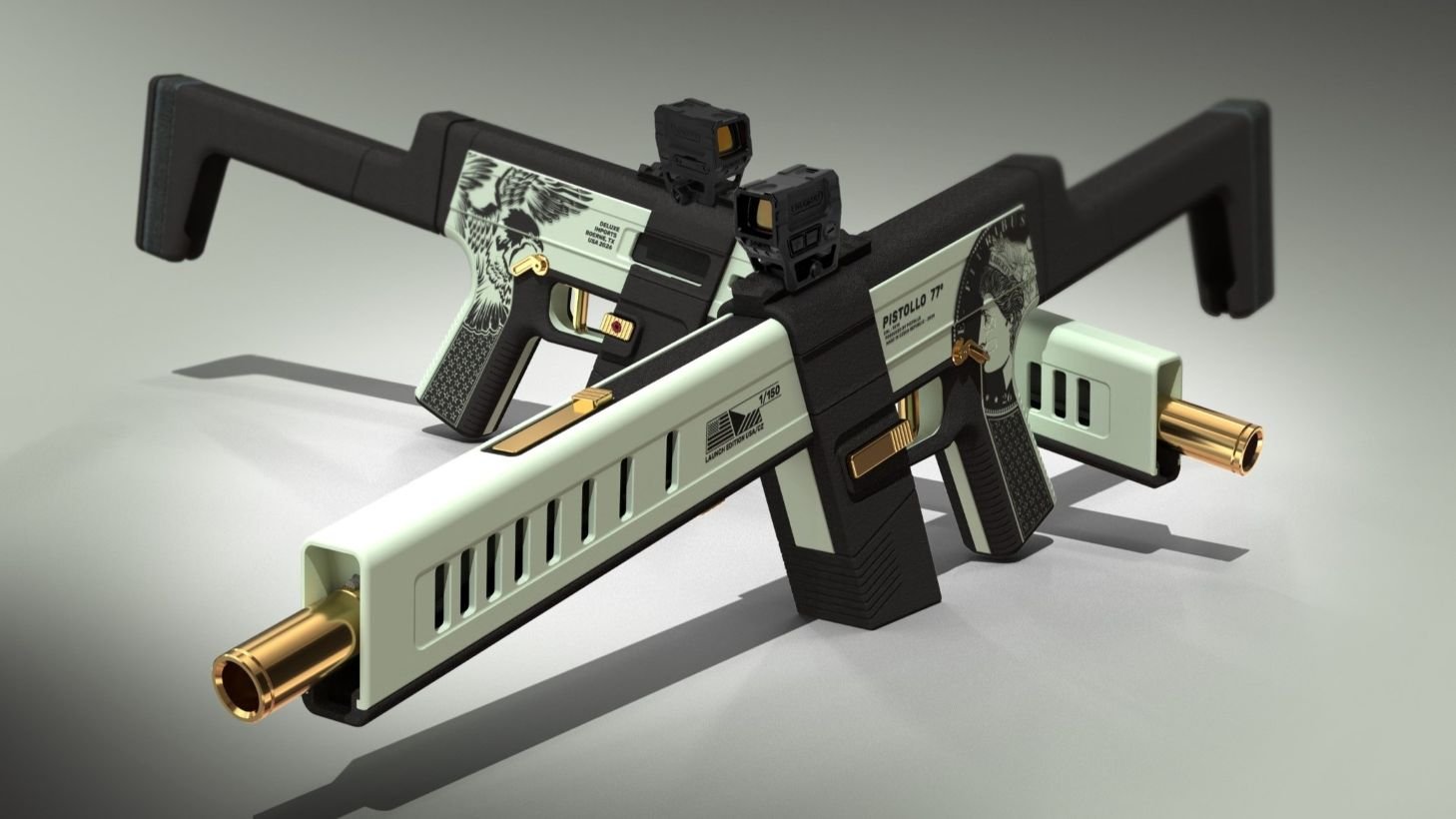 U.S.-Focused Expansion Debuts at IWA 2026 At IWA OutdoorClassics 2026 in Nuremberg, Pistollo unveiled a U.S.-specific variant of its pistol platform alongside a limited production model developed in partnership with American distributor Deluxe Arms. The announcement marks a targeted effort to increase the brand’s presence in the United States through enhanced compatibility and exclusive offerings. The standard U.S. configuration incorporates several technical modifications designed to meet American consumer preferences, particularly in the areas of accessory mounting and suppressor readiness. Expanded Accessory Compatibility A key change to the U.S. variant is the addition of a rear-mounted Weaver/Picatinny rail. This interface enables users to attach accessories such as stabilizing braces, stocks (where legally permitted), or other rear-mounted components. The addition reflects growing demand in the U.S. market for modular firearm platforms capable of accommodating various configurations. At the top of the slide, Pistollo has replaced the standard collimator cover with a Picatinny rail section. This modification allows direct mounting of a broad range of red dot optics currently available on the market, eliminating the need for proprietary mounting solutions and expanding compatibility with widely used sighting systems. Threaded Compensator for Suppressor Use The compensator on the American model has also been revised. It now features a ½×28 thread pitch, a common U.S. standard for muzzle devices and suppressor attachment. This threading enables users to install compatible suppressors or quick-detach adapters without requiring additional modification. The update aligns the platform with prevailing U.S. accessory standards and provides greater flexibility for owners seeking suppressor-ready configurations. Pistollo 77 Launch Edition Limited to 150 Units In addition to the standard U.S. version, Pistollo introduced the Pistollo 77 Launch Edition, a limited production model capped at 150 units. Priced at $4,377.77, the edition emphasizes exclusivity and distinctive aesthetics. The Launch Edition features a Greenback Cerakote finish complemented by gold-colored controls and a matching muzzle device. Engraving on the frame incorporates Bald Eagle and Liberty-themed artwork, underscoring its American-market focus. Included Optic and Stabilizing Brace Each Pistollo 77 Launch Edition pistol is delivered with a Holosun AEMS Core X2 optic featuring a gold reticle. The package also includes a custom Pistollo stabilizing brace designed to integrate with the platform’s rear rail system. With the introduction of the U.S.-specific configuration and the limited Launch Edition, Pistollo is positioning its platform to compete more directly in the American market through standardized compatibility, suppressor-ready features, and a premium collector-oriented offering.
 -
Casualty Update From Operation Epic Fury At least 200 U.S. service members have been wounded during the first three weeks of Operation Epic Fury, according to U.S. Central Command (CENTCOM). The figure, confirmed Monday, marks an increase from the 140 injuries reported the previous week and reflects the continuing pace of combat operations across the Middle East. Officials said approximately 180 of the wounded troops have returned to duty. Ten service members were described as having sustained “serious” injuries as a result of Iranian retaliatory strikes following the launch of U.S. and Israeli offensives on Feb. 28. CENTCOM did not specify the countries where injuries occurred, the service branches involved, or the roles of the affected personnel. Nature of Injuries and Ongoing Combat According to Navy Capt. Tim Hawkins, a CENTCOM spokesperson, the majority of injuries are related to traumatic brain injuries. Additional reporting indicates that some troops have sustained shrapnel wounds and burns. Iran has launched repeated drone and missile attacks targeting U.S. installations across the region. Explosions have been reported at or near bases in Bahrain, Saudi Arabia, Iraq, the United Arab Emirates, Qatar, and Jordan. Despite U.S. strikes aimed at degrading Iran’s missile and drone infrastructure, Iranian forces continue to conduct retaliatory attacks. U.S. operations remain active daily, involving ground forces stationed in regional countries as well as air and naval assets conducting strike missions. Fatalities and Aircraft Incident Under Investigation Thirteen American service members have died since the conflict began. Six were killed in Shuiba, Kuwait, when an Iranian drone struck an outpost. Another soldier died from injuries sustained in a March 1 attack on Prince Sultan Air Base in Saudi Arabia. In a separate incident, six airmen were killed when a KC-135 aerial refueling tanker crashed in western Iraq. CENTCOM officials have ruled out hostile or friendly fire as causes and are continuing to investigate the crash. Medical Evacuations and Strategic Impact Wounded personnel requiring advanced care have been evacuated from the region to medical facilities in Europe and the United States, including Landstuhl Regional Medical Center in Germany and Walter Reed National Military Medical Center. U.S. officials report that American aircraft have struck more than 7,000 Iranian targets since the start of the air campaign. Monitoring organizations estimate that more than 1,400 military personnel and civilians have been killed in Iran during the same period. The latest casualty figures underscore the intensity of the ongoing conflict, as U.S. and allied forces continue sustained operations amid persistent Iranian counterattacks. View full article
-
 Casualty Update From Operation Epic Fury At least 200 U.S. service members have been wounded during the first three weeks of Operation Epic Fury, according to U.S. Central Command (CENTCOM). The figure, confirmed Monday, marks an increase from the 140 injuries reported the previous week and reflects the continuing pace of combat operations across the Middle East. Officials said approximately 180 of the wounded troops have returned to duty. Ten service members were described as having sustained “serious” injuries as a result of Iranian retaliatory strikes following the launch of U.S. and Israeli offensives on Feb. 28. CENTCOM did not specify the countries where injuries occurred, the service branches involved, or the roles of the affected personnel. Nature of Injuries and Ongoing Combat According to Navy Capt. Tim Hawkins, a CENTCOM spokesperson, the majority of injuries are related to traumatic brain injuries. Additional reporting indicates that some troops have sustained shrapnel wounds and burns. Iran has launched repeated drone and missile attacks targeting U.S. installations across the region. Explosions have been reported at or near bases in Bahrain, Saudi Arabia, Iraq, the United Arab Emirates, Qatar, and Jordan. Despite U.S. strikes aimed at degrading Iran’s missile and drone infrastructure, Iranian forces continue to conduct retaliatory attacks. U.S. operations remain active daily, involving ground forces stationed in regional countries as well as air and naval assets conducting strike missions. Fatalities and Aircraft Incident Under Investigation Thirteen American service members have died since the conflict began. Six were killed in Shuiba, Kuwait, when an Iranian drone struck an outpost. Another soldier died from injuries sustained in a March 1 attack on Prince Sultan Air Base in Saudi Arabia. In a separate incident, six airmen were killed when a KC-135 aerial refueling tanker crashed in western Iraq. CENTCOM officials have ruled out hostile or friendly fire as causes and are continuing to investigate the crash. Medical Evacuations and Strategic Impact Wounded personnel requiring advanced care have been evacuated from the region to medical facilities in Europe and the United States, including Landstuhl Regional Medical Center in Germany and Walter Reed National Military Medical Center. U.S. officials report that American aircraft have struck more than 7,000 Iranian targets since the start of the air campaign. Monitoring organizations estimate that more than 1,400 military personnel and civilians have been killed in Iran during the same period. The latest casualty figures underscore the intensity of the ongoing conflict, as U.S. and allied forces continue sustained operations amid persistent Iranian counterattacks.
 -
Army Clears M111 Offensive Grenade for Service The U.S. Army has approved the M111 Offensive Hand Grenade for Full Material Release, marking the first new lethal hand grenade cleared for service since the Mk3A2 entered use in 1968. The M111 was developed by the Capabilities Program Executive Office for Ammunition and Energetics in partnership with the U.S. Army Combat Capabilities Development Command (DEVCOM) Armaments Center at Picatinny Arsenal. It is intended to replace the Mk3A2 series, which has faced restrictions due to its asbestos-containing body. Unlike its predecessor, the M111 features a plastic body that is fully consumed during detonation, eliminating asbestos-related concerns and modernizing the Army’s offensive grenade capability. Designed for Close-Quarters Combat The M111 is engineered specifically for confined and enclosed environments. Rather than relying on fragmentation, it incapacitates targets through blast overpressure (BOP). This makes it particularly suited for urban combat scenarios such as rooms, bunkers, trenches, and tunnels, where fragmentation effects may be deflected by walls or structures and pose a risk to friendly forces. Army officials cited lessons from urban fighting in Iraq, noting that fragmentation grenades such as the M67 were not always appropriate for room-clearing due to the risk of fratricide through walls or confined spaces. In contrast, the M111’s blast overpressure effect is less influenced by obstacles and is intended to deliver consistent lethality within enclosed areas. In open terrain, soldiers will continue to employ the M67 fragmentation grenade to maximize fragment dispersion. The introduction of the M111 provides an additional option tailored to restricted terrain. Technical Specifications and Standardization The M111 measures 4.41 inches in length, 2.37 inches in diameter, and weighs approximately 12.6 ounces. Its octagonal shape is designed to improve grip and prevent rolling after deployment. The grenade uses a 4- to 5.5-second delay fuze and is paired with the M213 fuze assembly. Standardization was a key design objective. The M111 and its training variant, the M112, use the same five-step arming process as the M67 and its training counterpart, the M69. Both also share common fuze components. This alignment allows soldiers to train with procedures identical to operational use while enabling the Army to leverage existing fuze production lines, reducing procurement costs. The Army retains government-owned intellectual property rights for the system, allowing competitive contracting across the industrial base. Production and Fielding Initial qualification quantities of the M111 were produced by Battelle. Full-rate production will be carried out by Day & Zimmermann, Inc. The Army expects the new grenade to improve operational readiness by providing a safer and more adaptable capability for close-quarters engagements. With the M111’s approval, the Army adds a modernized offensive grenade to its inventory, expanding tactical flexibility while maintaining compatibility with existing training and logistics systems. View full article
-
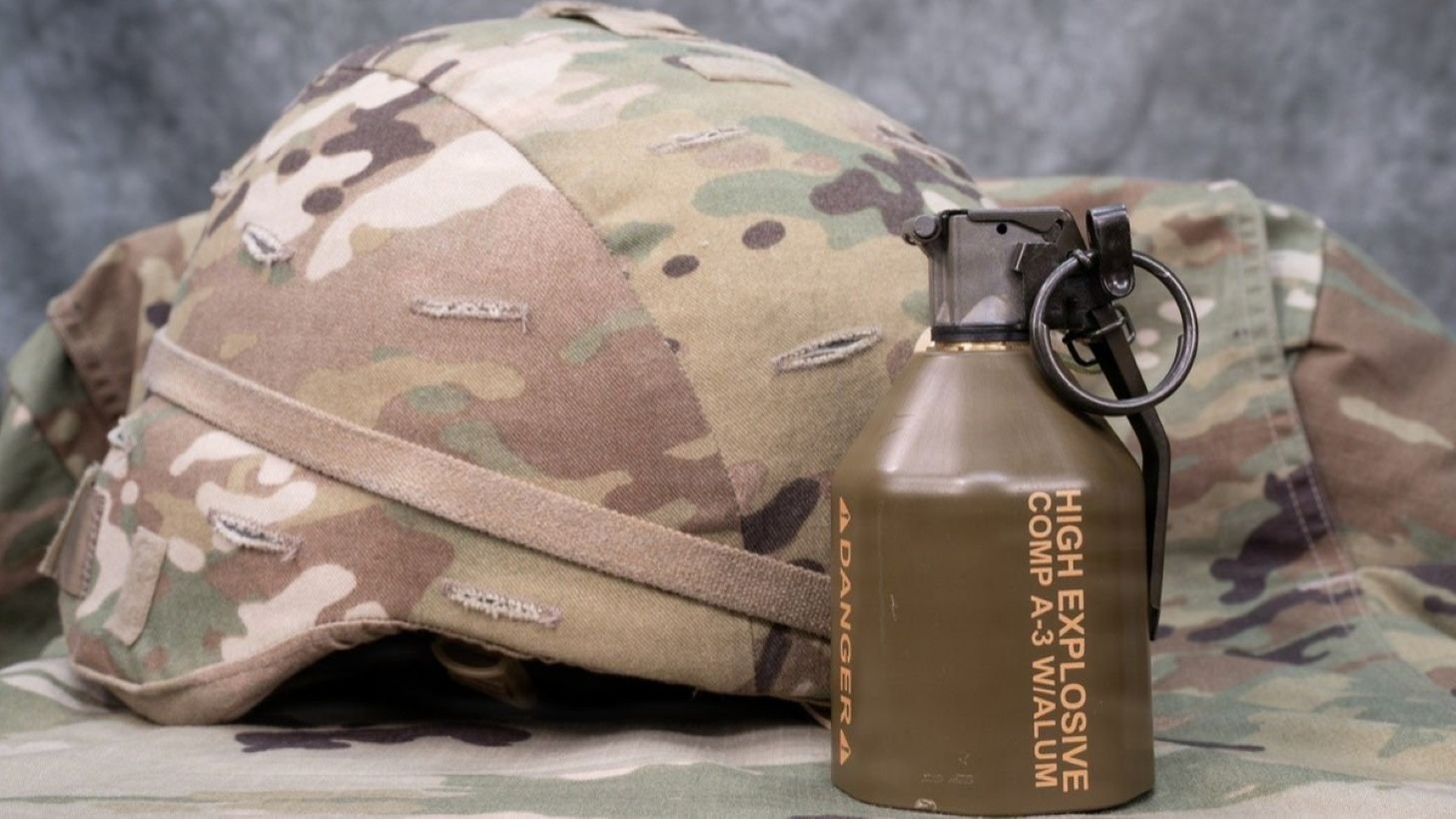 Army Clears M111 Offensive Grenade for Service The U.S. Army has approved the M111 Offensive Hand Grenade for Full Material Release, marking the first new lethal hand grenade cleared for service since the Mk3A2 entered use in 1968. The M111 was developed by the Capabilities Program Executive Office for Ammunition and Energetics in partnership with the U.S. Army Combat Capabilities Development Command (DEVCOM) Armaments Center at Picatinny Arsenal. It is intended to replace the Mk3A2 series, which has faced restrictions due to its asbestos-containing body. Unlike its predecessor, the M111 features a plastic body that is fully consumed during detonation, eliminating asbestos-related concerns and modernizing the Army’s offensive grenade capability. Designed for Close-Quarters Combat The M111 is engineered specifically for confined and enclosed environments. Rather than relying on fragmentation, it incapacitates targets through blast overpressure (BOP). This makes it particularly suited for urban combat scenarios such as rooms, bunkers, trenches, and tunnels, where fragmentation effects may be deflected by walls or structures and pose a risk to friendly forces. Army officials cited lessons from urban fighting in Iraq, noting that fragmentation grenades such as the M67 were not always appropriate for room-clearing due to the risk of fratricide through walls or confined spaces. In contrast, the M111’s blast overpressure effect is less influenced by obstacles and is intended to deliver consistent lethality within enclosed areas. In open terrain, soldiers will continue to employ the M67 fragmentation grenade to maximize fragment dispersion. The introduction of the M111 provides an additional option tailored to restricted terrain. Technical Specifications and Standardization The M111 measures 4.41 inches in length, 2.37 inches in diameter, and weighs approximately 12.6 ounces. Its octagonal shape is designed to improve grip and prevent rolling after deployment. The grenade uses a 4- to 5.5-second delay fuze and is paired with the M213 fuze assembly. Standardization was a key design objective. The M111 and its training variant, the M112, use the same five-step arming process as the M67 and its training counterpart, the M69. Both also share common fuze components. This alignment allows soldiers to train with procedures identical to operational use while enabling the Army to leverage existing fuze production lines, reducing procurement costs. The Army retains government-owned intellectual property rights for the system, allowing competitive contracting across the industrial base. Production and Fielding Initial qualification quantities of the M111 were produced by Battelle. Full-rate production will be carried out by Day & Zimmermann, Inc. The Army expects the new grenade to improve operational readiness by providing a safer and more adaptable capability for close-quarters engagements. With the M111’s approval, the Army adds a modernized offensive grenade to its inventory, expanding tactical flexibility while maintaining compatibility with existing training and logistics systems.
 -
until
SOF Week 2026 is one of the premier global gatherings focused on special operations forces (SOF), bringing together military leaders, defense industry partners, and security professionals to discuss the evolving role of special operations in modern conflict. The event is organized by the Global SOF Foundation in partnership with United States Special Operations Command. The multi-day event blends policy discussions, operational insights, and a large defense technology exposition centered on capabilities supporting special operations missions. -
until
AUVSI XPONENTIAL 2026 is one of the world’s leading conferences and expositions dedicated to autonomous and uncrewed systems across air, land, and maritime domains. Organized by the Association for Uncrewed Vehicle Systems International, the event gathers industry leaders, researchers, government officials, and technology developers focused on the rapidly expanding autonomous systems sector. The conference explores how robotics, artificial intelligence, and advanced sensing technologies are transforming industries ranging from defense and security to logistics, infrastructure inspection, agriculture, and transportation. XPONENTIAL 2026 - AUVSI -
until
Modern Day Marine is the largest military equipment, systems, and technology exposition dedicated specifically to the United States Marine Corps. The event brings together Marine Corps leadership, defense industry partners, and military professionals to explore the technologies, capabilities, and concepts shaping the future of expeditionary warfare. The exposition is co-sponsored by the Marine Corps Association & Foundation and the U.S. Marine Corps, making it a key venue for direct engagement between the Corps and the defense industry. Modern Day Marine - April 28 - April 30, 2026 Washington D.C. -
until
The Army Aviation Mission Solutions Summit is the premier professional gathering focused on U.S. Army aviation. Hosted annually by the Army Aviation Association of America, the event brings together military leadership, aviation professionals, defense contractors, and technology developers to discuss the future of Army aviation capabilities and modernization. The summit combines high-level policy discussions with a large industry exposition showcasing rotorcraft platforms, aviation electronics, training systems, and emerging technologies designed to support modern battlefield aviation. -
Service Life Extension Confirmed The U.S. Navy has officially extended the service life of the aircraft carrier USS Nimitz (CVN-68), delaying its planned decommissioning from May 2026 to March 2027. A service official confirmed the decision late Friday, citing operational requirements amid sustained deployment demands across multiple theaters. The extension allows the Navy to maintain its 11-carrier force structure while it awaits delivery of the next Ford-class carrier, USS John F. Kennedy (CVN-79), currently scheduled for commissioning in March 2027. Preserving the Nimitz through that transition helps prevent a temporary reduction in the carrier fleet during a period of heightened global tasking. Fleet Structure and Strategic Context The Navy has faced continued strain from extended deployments in the U.S. Central Command and Indo-Pacific Command areas of responsibility. Keeping USS Nimitz operational supports force availability as carrier strike groups rotate through high-demand regions. Maintaining 11 operational carriers remains a statutory requirement, and the timing of Kennedy’s delivery has made the Nimitz extension a practical measure to avoid a capability gap. The decision reflects ongoing challenges in balancing fleet modernization with operational readiness, particularly as aging Nimitz-class carriers approach retirement. Transition to Norfolk and Inactivation Plan USS Nimitz departed Naval Base Kitsap in Bremerton, Washington, on March 7 for Naval Station Norfolk, Virginia, as part of a scheduled homeport shift for the remainder of its service life. Following its final operational period, the carrier will undergo inactivation and defueling of its nuclear reactors at HII’s Newport News Shipbuilding facility. The relocation positions the vessel for the complex and multi-year deactivation process required for nuclear-powered aircraft carriers. Defueling and inactivation mark the formal beginning of retirement procedures for the Navy’s oldest active carrier. Recent Operational Record The Nimitz returned to Bremerton in December after completing a nine-month deployment spanning U.S. Central Command and U.S. Indo-Pacific Command. During that deployment, the carrier strike group also supported U.S. Africa Command operations, including strikes targeting Islamic State (ISIS) elements in Somalia. Over the course of the deployment, the crew conducted approximately 8,500 sorties totaling 17,000 flight hours. The mission profile reflected the carrier’s continued integration into multi-theater operations, underscoring its operational relevance more than four decades after commissioning. Historical Significance Commissioned in 1975, USS Nimitz has played a role in numerous major operations. Among its earliest missions was support for Operation Eagle Claw in 1980, the attempted rescue of American hostages in Iran. Though the mission ultimately failed, it marked one of the ship’s first operational deployments and established its presence in Middle Eastern contingencies. The carrier’s extended service through 2027 will conclude more than 50 years of active duty, bridging the transition from the Nimitz-class to the Ford-class era of U.S. naval aviation. View full article