Skip to content

Advertisement

Advertisement

Uncrowned Armory News

Mid-air collision during Idaho air show
Four naval aviators ejected safely after two U.S. Navy E/A-18G Growlers collided during an aerial demonstration at Mountain Home Air Force Base in Idaho.
Cmdr. Amelia Umayam, a spokesperson for Naval Air Forces, U.S. Pacific Fleet, said all four crewmembers were recovered after ejecting and were being evaluated by medical personnel. First responders were sent to the scene following the accident.
The aircraft were part of the Navy’s E/A-18G Growler Demonstration Team performing at the Gunfighter Skies Air Show. Each E/A-18G carries two aircrew: a pilot and an electronic warfare officer.
Timeline and location of the crash
According to the Navy, the collision occurred at about 12:10 p.m. involving two E/A-18Gs assigned to Electronic Attack Squadron 129, or VAQ-129, based at Naval Air Station Whidbey Island, Washington.
A spokesperson for Mountain Home Air Force Base told Task & Purpose the crash occurred roughly two miles northwest of the installation during the demonstration. Witness images and local media footage showed smoke rising near the crash area after impact.
The Idaho Statesman reported that an air show announcer told the crowd, “We had four good parachutes. The crews were able to eject.”
Footage shows rapid ejection sequence
A video circulated on social media appeared to show the two Growlers flying in close formation before making contact. In the footage, the aircraft seem to remain entangled briefly, pitching upward before both crews eject.
The ejections appear to take place within seconds of the initial collision. The unmanned aircraft then descend together and crash, followed by a fireball on impact. Separate photos and videos showed four parachutes descending near the crash site.
Task & Purpose reported that images posted by KBTV and footage shared on the Amn/nco/snco Facebook page captured the sequence from collision through impact.
Aircraft and unit background
The E/A-18G Growler is the Navy’s carrier-capable electronic attack aircraft, derived from the F/A-18 family. It is equipped for missions that include detecting, disrupting, and targeting enemy radar and other electronic systems.
VAQ-129, the squadron involved in the incident, serves as the fleet replacement squadron for the Growler community. Like most Navy Growler units, it is based at NAS Whidbey Island, which also hosts initial training for pilots and naval flight officers assigned to the platform.
A separate Whidbey Island-based E/A-18G crashed during a training flight near Mount Rainier in 2024.
Air show context
The aircraft were participating in the two-day Gunfighter Skies Air Show, which featured military demonstration teams and vintage aircraft. According to reporting cited by Task & Purpose, this year’s event marked the first Gunfighter Skies show held in eight years.
KTVB also published an interview with Navy Lt. Kevin Lynch, identified as a member of the demonstration team, that appeared to have been recorded before the accident.
The base has previously seen a fatal air show accident: a hang glider performer died during a 2018 crash. No fatalities were reported in the Growler collision, and all four naval aviators survived the incident.
  • Text Only
Drone strike hits edge of Barakah site
A drone strike sparked a fire Sunday on the edge of the United Arab Emirates’ Barakah nuclear power plant, the country’s only nuclear facility, in what UAE authorities described as an “unprovoked terrorist attack.” No group immediately claimed responsibility, and officials did not assign blame.
The UAE Defense Ministry said three drones crossed the country’s western border with Saudi Arabia. Two were intercepted, while the third struck near the plant. Saudi Arabia separately condemned the attack and later said it had intercepted three drones that entered from Iraqi airspace.
Per the AP report, there were no reported injuries and no radiological release.
Safety systems remained operational
The UAE’s nuclear regulator said the fire did not affect plant safety and that “all units are operating as normal.” The International Atomic Energy Agency said the strike caused a fire in an electrical generator and that one reactor was being powered by emergency diesel generators.
Barakah is a four-reactor facility built with South Korean assistance at a reported cost of $20 billion. It began operating in 2020 and is the only nuclear power plant in the Arab world. The station can supply roughly one-quarter of the UAE’s electricity needs.
The attack marked the first known wartime strike on Barakah itself. Yemen’s Iran-backed Houthi movement claimed in 2017 that it had targeted the plant while it was still under construction, a claim Abu Dhabi denied at the time.
Regional tensions frame the incident
The strike came amid rising tension around the Strait of Hormuz and a fragile ceasefire in the wider conflict involving Iran, Israel and the United States. The UAE has hosted Israeli air defenses and personnel and has recently accused Iran of launching drone and missile attacks.
Anwar Gargash, a diplomatic adviser to the UAE president, said the attack, “whether carried out by the principal actor or through one of its proxies, represents a dangerous escalation.” Iran and allied Shiite militias in Iraq have previously launched drone attacks against Gulf Arab states during the war.
Shortly after speaking with Israeli Prime Minister Benjamin Netanyahu, U.S. President Donald Trump posted that Iran should move “FAST.” In Tehran, Mohsen Rezaei, a military adviser to Iran’s supreme leader, said on state television that Iran’s armed forces were ready while diplomacy continued.
Different nuclear programs, different safeguards
The UAE’s nuclear program operates under a strict U.S. “123 agreement,” under which Abu Dhabi agreed not to enrich uranium domestically or reprocess spent fuel. Its uranium is imported, a structure intended to reduce proliferation concerns.
That framework differs sharply from Iran’s nuclear program, which remains at the center of long-running disputes with Washington and Israel. Iran says its program is peaceful, but it has enriched uranium near weapons-grade levels and has faced scrutiny over past military dimensions and limits on U.N. inspections. Israel is widely believed to be the region’s only nuclear-armed state, though it has neither confirmed nor denied possessing such weapons.
Ceasefire shows further signs of strain
The latest strike underscored the vulnerability of nuclear infrastructure in conflict zones, a risk also seen during Russia’s invasion of Ukraine and in reported attacks near Iran’s Bushehr plant.
Two people familiar with the matter, including an Israeli military officer, told the AP that Israel is coordinating with the United States on a possible resumption of attacks. Speaking to his Cabinet, Netanyahu said Israel was “prepared for any scenario.”
On Iranian state television, presenters on at least two channels appeared armed during live broadcasts, including one segment in which a host received basic firearms instruction from a masked Revolutionary Guard member. The broadcasts added to signs that, despite the ceasefire, the confrontation remains unstable.
  • Text Only
Army Evaluates Drone for Casualty Evacuation
The U.S. Army has tested an unmanned aircraft designed to transport wounded troops, expanding a drone portfolio that already includes systems used for reconnaissance, strike missions, and delivery of medical supplies to frontline forces. The demonstration centered on Flowcopter’s FC-100, a heavy-lift drone capable of carrying up to 1,400 pounds.
During the trial, operators strapped a test dummy onto the aircraft and prepared it for flight in front of observing troops. The event highlighted a possible future role for unmanned systems in casualty evacuation from contested areas where traditional medical evacuation helicopters may face high risk or be unable to operate safely.
Exercise Context and Units Involved
The test took place during Saber Strike, a large Army exercise involving more than 15,000 U.S. and NATO personnel training on air defense, counter-drone operations, and battlefield coordination across Eastern Europe.
Among those observing were soldiers from the Vilseck, Germany-based 2nd Cavalry Regiment. The regiment has been involved in Army efforts to test emerging autonomous technologies through initiatives including Transforming in Contact and Project Flytrap.
The Army has increasingly used large exercises to expose operational units to new systems under realistic conditions, particularly technologies intended for large-scale combat environments where logistics and medical support may be disrupted.
Medical Role Under Review
Army officials said the effort is tied to broader work on improving battlefield medical support and decision-making. Capt. James Yu of the 75th Innovation Command said in an Army video that the service is examining technologies that can strengthen both combat effectiveness and care for soldiers in future large-scale operations.
The Army has already spent years experimenting with drones that can deliver blood bags and other lifesaving supplies to the front. The FC-100 test extended that concept by examining whether an unmanned aircraft could also remove casualties from danger without sending additional soldiers or medics into threatened areas.
That approach could be particularly relevant in situations where airspace is heavily contested, landing zones are exposed, or crewed aircraft cannot be committed without significant risk.
FC-100 Design and Performance
Unlike smaller electric commercial-style drones, the FC-100 uses a hydraulic-powered engine. The aircraft operates through a combination of preplanned flight paths, autonomous navigation, and remote piloting that allows operators to supervise the mission and make adjustments in flight.
According to Flowcopter, the drone can remain airborne for up to 11 hours while carrying 110 pounds. With a 330-pound payload, endurance drops to about five hours. At a 220-pound load, the company says the aircraft can travel more than 60 miles.
Those specifications suggest the platform could support multiple roles beyond evacuation, including supply, delivery, and recovery missions in areas with limited access.
Remaining Limits and Next Steps
The concept also presents clear medical limitations. Unlike conventional medevac helicopters, which carry trained medical personnel and equipment, an unmanned aircraft cannot provide treatment during transport. That means its usefulness would depend on the casualty’s condition, distance to care, and the availability of follow-on medical support.
The Army has not announced whether Flowcopter will advance to additional prototyping or broader trials. Even so, the demonstration provided a practical look at how autonomous evacuation and resupply systems could become a more common feature of future battlefield operations.
  • Text Only
Footage Released After Deep-Strike Claims
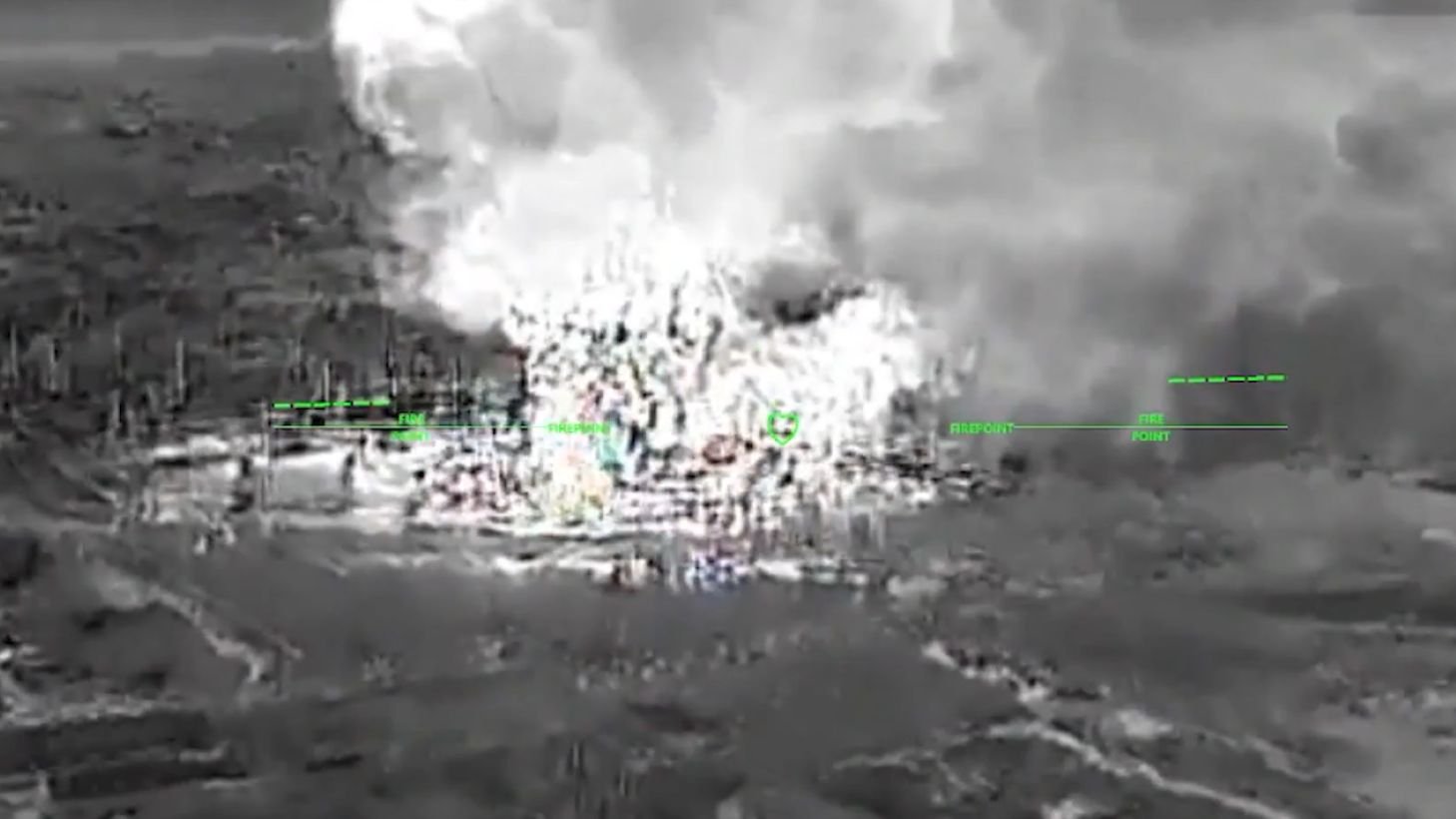
Ukrainian President Volodymyr Zelensky on May 16 published video footage he said showed Ukrainian strikes on Russian military targets located far behind the front line. The attacks were presented as part of Kyiv’s expanding long-range strike campaign against military infrastructure, air-defense assets, logistics nodes, and other support systems used by Russian forces.
Zelensky said the strikes reached targets at distances of nearly 1,000 kilometers from the line of contact. He also stated that Ukrainian attacks this week hit facilities tied to Russia’s oil sector and maritime assets. Describing the operations as a response to Russian actions, he said they were “entirely justified.”
Aircraft and Air-Defense Systems Reportedly Hit
Among the targets identified by Zelensky was a Beriev Be-200 amphibious aircraft. Ukraine’s Unmanned Systems Forces later said the aircraft was struck on May 15 in Russia’s Krasnodar Krai. The Be-200 is a twin-engine amphibious platform capable of operating from both runways and water, and is commonly associated with firefighting, search-and-rescue, and maritime patrol roles.
The same set of reported strikes also included a Kamov Ka-27 helicopter, a Pantsir-S1 self-propelled anti-aircraft missile and gun system, and a Tor-series air-defense system identified by Ukrainian forces as a Tor-M2. Zelensky additionally listed a Redut-2US communications system and drones among the targets.
Locations and Units Named by Ukrainian Forces
In a statement, Ukraine’s Unmanned Systems Forces said the attacks were conducted in coordination with its Center for Depth Damage and involved multiple units. According to the statement, operators from the 1st Separate Center struck the Be-200 and Ka-27 in Yeisk, a city in Russia’s south. The same unit was also credited with hitting a Pantsir-S1 system in occupied Crimea and a dry cargo vessel carrying ammunition in Berdyansk.
The 427th Separate Brigade “Rarog” was said to have struck a Tor-M2 air-defense system in the Luhansk region. Separately, the 414th Brigade “Birds of Magyar,” working with the 20th K-2 Brigade, reportedly targeted a Russian training center and a temporary deployment site in the same region.
Maritime and Logistical Targets
A dry cargo ship loaded with ammunition was among the most significant logistical targets listed by Ukrainian officials. If confirmed, such a strike would fit a broader Ukrainian pattern of trying to disrupt Russian ammunition movement and reduce the survivability of rear-area supply networks.
The reported destruction or damage of communications equipment, including the Redut-2US system, would also align with efforts to degrade command, control, and coordination for Russian units operating near the front.
Broader Operational Context
Ukraine has increasingly used drones and other long-range strike systems to reach targets well beyond immediate combat zones. These operations have focused on air bases, air-defense systems, fuel and energy sites, shipping, and ammunition storage, reflecting an emphasis on weakening the infrastructure that supports Russian combat operations.
No independent verification of each strike claim was immediately available. Russian authorities were not cited in the released material, and Zelensky did not provide exact timing for all of the attacks. Still, the footage and accompanying statements offered one of the clearer official summaries this week of Ukraine’s continuing campaign against military targets in Russian-held territory and inside Russia itself.
  • Text Only
Joint operation in Lake Chad Basin
U.S. and Nigerian forces killed Abu-Bilal al-Minuki in a Friday evening operation in the Lake Chad Basin, according to statements from U.S. Africa Command and the Nigerian presidency. President Donald Trump announced the mission on social media, describing al-Minuki as the Islamic State’s “second in command” globally.
AFRICOM said al-Minuki served as ISIS’s director of global operations. Nigerian President Bola Tinubu said the strike also killed “several of his lieutenants,” while AFRICOM reported that other senior ISIS leaders were among the dead.
What AFRICOM said about the target
AFRICOM identified al-Minuki as a senior ISIS figure with links to the group’s Nigerian network. The command said he was also known as Abubakar Maniok and described him as a central figure in planning attacks and managing financial operations.
The United States had sanctioned al-Minuki in 2023 over ties to ISIS in Nigeria. In its latest statement, AFRICOM called him “the most active terrorist in the world,” underscoring his role in the organization’s international activities.
Operational details remain limited
The strike appears to be the largest U.S. operation in Nigeria since Christmas, when U.S. forces launched multiple missiles at militant targets in Sokoto state in the country’s northwest. AFRICOM has not disclosed how many American or Nigerian personnel took part in the latest mission, and the total number of ISIS fighters killed has not been made public.
Video released by AFRICOM showed apparent ground combat followed by several airstrikes. The footage provided visual confirmation of a combined operation but did not clarify the scale of the force used or the full sequence of events.
Expanded U.S. involvement in Nigeria
The operation follows a notable increase in U.S. military activity in Nigeria over the past six months. In February, the United States deployed about 100 troops to the country to train Nigerian forces. U.S. officials said the mission was intended to help local forces identify and neutralize extremist groups.
That deployment came after the Christmas strikes in Sokoto, which AFRICOM said targeted ISIS camps. The recent expansion has taken place alongside repeated political pressure from Trump, who has accused the Nigerian government of failing to stop widespread violence against Christians and has previously threatened military action.
Part of a wider campaign in Africa
The strike in the Lake Chad Basin fits into a broader U.S. campaign against ISIS affiliates across Africa. American forces have also carried out repeated operations against ISIS’s Somalia branch in recent months, part of an escalating air campaign in that country.
Together, the operations in Nigeria and Somalia indicate a sustained U.S. focus on ISIS networks on the continent, with an emphasis on high-value targets, training partnerships, and air-supported missions. While the killing of al-Minuki removes a senior operative, key questions remain about the remaining leadership structure of ISIS-linked groups in West Africa and the likely pace of future joint operations.
  • Text Only
Presidential Unit Citation Presented in Norfolk
The Ford Carrier Strike Group has been awarded the Presidential Unit Citation, the U.S. military’s highest collective unit honor, for actions during combat operations against Iran. Defense Secretary Pete Hegseth presented the award in Norfolk, Virginia, as USS Gerald R. Ford returned to home port following a 326-day deployment.
The citation, signed by Acting Navy Secretary Hung Cao, recognizes “outstanding performance in action against enemy forces from 28 February to 1 May 2026 in Support of Operation Epic Fury.” It states that Carrier Strike Group Twelve distinguished itself through “outstanding warfighting prosecution while engaged in sustained combat operations against a determined enemy.”

Chief of Naval Operations Adm. Daryl Caudle joined the homecoming ceremony.
Scope of the Awarded Operations
According to the citation, units in the strike group coordinated attacks on Iranian warships and land targets and flew more than 1,700 air sorties during the cited period. The document says those operations were conducted while the force remained under “persistent threat from enemy missiles and one-way attack drones.”
The award is the highest decoration publicly reported so far for forces involved in the ongoing conflict with Iran. A temporary ceasefire remains in place, while multiple U.S. naval forces, including two other aircraft carriers, continue operating in waters around the Middle East.
Composition of Carrier Strike Group Twelve
Alongside USS Gerald R. Ford, the strike group included the Arleigh Burke-class guided-missile destroyers USS Winston S. Churchill, USS Bainbridge, and USS Mahan, with other ships rotating in and out during the deployment. Carrier Air Wing Eight, which returned earlier in the week, consists of nine squadrons.
The Ford and the Abraham Lincoln carrier strike group both took part in Operation Epic Fury beginning Feb. 28, when U.S. and Israeli forces launched attacks on Iran. USS George H.W. Bush later joined the regional carrier presence.
A 326-Day Global Deployment
Ford departed in June 2025 and first crossed the Atlantic to the Mediterranean. It later moved through the Strait of Gibraltar to northern Europe for NATO exercises before returning south. In late 2025, the strike group was redirected to the Caribbean in support of Task Force Southern Spear.
That mission, officially focused on alleged drug-smuggling interdiction, expanded to operations aimed at pressuring Venezuela. In January, Ford participated in Operation Absolute Resolve, the U.S. attack on Venezuela that included the special operations raid that captured President Nicolás Maduro. The carrier was also later used as a platform for boarding teams that seized sanctioned oil tankers.
By February, after already exceeding the Navy’s typical seven-month deployment length, the strike group was ordered back across the Atlantic for the Middle East buildup.
Rarity of the Citation and Deployment Strain
The Presidential Unit Citation is rarely awarded and is generally associated with major combat actions. Historic recipients include the 1st Marine Division for the Battle of Chosin Reservoir in 1950 and the 2nd Ranger Battalion for D-Day in 1944.
At 326 days, Ford’s deployment ranks among the Navy’s longest in the past 50 years, trailing only USS Nimitz’s 341-day deployment during the COVID-19 period in 2020-2021.
The deployment also included non-combat setbacks. Ford reportedly experienced repeated plumbing failures, including overflowing toilets and compartment flooding. In March, a fire in the ship’s laundry room caused damage and forced the carrier to leave Operation Epic Fury temporarily for repairs at a European port.
  • Text Only
Deployment Reversed for Fort Drum Missile Battalion
The Pentagon has canceled a planned deployment of the Army’s 3rd Battalion, 12th Field Artillery Regiment to Germany, reversing a move that had been in development for roughly two years. A defense official confirmed the decision after earlier reporting by CNN, which cited a May 1 memo that also halted the rotational deployment of about 4,000 soldiers from the 2nd Armored Brigade Combat Team, 1st Cavalry Division, to Poland.
The 3rd Battalion, 12th Field Artillery Regiment, based at Fort Drum, New York, had been scheduled to deploy later this year. The battalion includes more than 500 soldiers, and the cancellation leaves the unit’s near-term mission unresolved.
Role in Long-Range Fires Plan
The battalion had been expected to support the Army’s expanding long-range fires presence in Europe under the 2nd Multi-Domain Task Force, which is based in Germany. Under plans announced by the United States and Germany in July 2024, the U.S. military was set to begin episodic deployments of long-range fires capabilities to Germany in 2026 as part of a broader effort that could eventually lead to permanent stationing.
According to those plans, the unit would have operated advanced strike capabilities, including Tomahawk and SM-6 missile systems, alongside hypersonic weapons associated with the Army’s long-range modernization efforts. The deployment was intended to strengthen the Army’s ability to project long-range precision fires in support of NATO.
Part of Broader Force Review in Europe
The cancellation comes amid a wider reassessment of U.S. military posture in Europe. Since 2022, following Russia’s full-scale invasion of Ukraine, the United States has increased its presence in central and eastern Europe through rotational deployments under Operation Atlantic Resolve.
On May 1, the Pentagon said it would withdraw 5,000 troops from Germany over the following six to 12 months as part of a broader review of American forces on the continent. The same memo that affected the artillery battalion also canceled the Poland rotation for the 2nd Armored Brigade Combat Team, even as hundreds of soldiers from that unit had already arrived for a transfer of authority with the outgoing force.
German Response and Diplomatic Context
Before the cancellation was confirmed, German officials had signaled that the long-range fires deployment remained uncertain but not yet terminated. Earlier this month, Germany’s defense ministry said there had been no “definitive cancellation” of the missile unit’s move to Europe.
The shift also comes during a period of diplomatic friction between the Trump administration and German leadership. Tensions rose after Germany’s chancellor criticized the U.S. and Israeli military campaign against Iran, though the Pentagon has publicly tied the troop reductions to its ongoing force posture review.
Battalion Activation and Future Questions
The 3rd Battalion, 12th Field Artillery Regiment was formally activated in October 2025 as part of the 2nd Multi-Domain Task Force and the Army Transformation Initiative, which aims to expand long-range precision strike capabilities. At the activation ceremony, the battalion’s commander described the unit as a formative element in turning an emerging concept into a combat-ready force.
Army plans had called for the battalion to eventually be stationed in Germany. With the deployment now canceled, the timeline and location for that long-term basing plan are unclear, as is the immediate next step for the soldiers assigned to the unit.
  • Text Only
Marines Seen Training With Rifle-Mounted Counter-Drone Optics
Recent U.S. military photos show Marines assigned to the 11th Marine Expeditionary Unit training with smart scopes designed to engage small drones. The images, published April 4 on the Defense Visual Information Distribution Service, show Marines aboard a ship in the Pacific using the optics on M4 carbines while preparing for operations linked to the Middle East.
The 11th MEU, a roughly 2,500-Marine force, embarked with the Boxer Amphibious Ready Group, deployed in March. Smart Shooter Inc. confirmed the optic in the photos is its SMASH 2000L advanced fire control system. The Marine Corps has previously said it would begin fielding the system with priority for units already deployed or scheduled to deploy soon.
How the SMASH System Functions
According to a report by Task and Purpose, the SMASH 2000L and related SMASH 2000LE models are designed to detect, track, and help engage both aerial and ground targets. The company says the fire control system performs ballistic calculations, compensates for shooter movement, and only releases the shot at the optimal moment for a higher probability of hit. It can also be unlocked for conventional firing if needed.
Company officials said the system uses computer vision, artificial intelligence, and other targeting algorithms. Smart Shooter also says the optic is resistant to jamming and can be used day or night, including against tethered drones operated through fiber-optic links rather than radio control.
Marine Corps Focuses on Capability Over Specific Equipment
Marine Corps officials declined to discuss the specific optic seen in the photos, but said Marines in the 11th MEU are training with systems that allow dismounted personnel to detect, track, identify, destroy, or otherwise defeat small unmanned aircraft.
That effort reflects a broader Marine Corps push to expand counter-drone tools at the individual and small-unit level. Senior Marine leaders have previously described small unmanned aerial systems as a threat affecting the entire force, not only infantry units.
Army Places New Order for Smart Scopes
The Army has also moved to expand rifle-mounted counter-drone capability. In a separate Task and Purpose report, Smart Shooter announced a $10.7 million Army contract for SMASH 2000LE systems and support services, with deliveries scheduled between July and September. Neither the company nor the Army disclosed the quantity being purchased.
The order follows a March contract from a Pentagon counter-drone task force for just over 200 systems valued at $6.1 million. Army officials said the smart scope will be part of a layered defense approach in which larger systems engage threats farther from troops, while soldiers armed with rifles and smart optics address drones that penetrate closer to the formation.
Small Drones Continue to Reshape Battlefield Planning
The Marine and Army efforts come as small drones have become increasingly influential in recent conflicts, including operations involving Ukraine, Israel, and Iran. U.S. planners have treated the trend as a force-protection and tactical challenge requiring both new technology and updated training.
In parallel with smart scopes, the Army has tested ammunition designed to disperse in flight to improve hit probability against fast-moving drones and has continued Project Flytrap, a program focused on rapid experimentation for ground units. During the Flytrap 5.0 exercise in Lithuania, soldiers practiced drone detection and counter-drone tactics under conditions that emphasized constant aerial surveillance and the possibility of one-way attack drones.
  • Text Only
Ford Set to Return After 324 Days Underway
The aircraft carrier USS Gerald R. Ford is scheduled to return to Naval Station Norfolk on Saturday, concluding one of the longest U.S. carrier deployments in decades. Chief of Naval Operations Adm. Lisa Franchetti said the ship will come home after 324 days at sea, following its departure on June 24, 2025.
Aircraft assigned to Carrier Air Wing 8, which deployed aboard Ford, returned to their home naval air stations on Monday, according to the Navy. The carrier’s homecoming will formally close an extended cruise that far exceeded the Navy’s typical seven-month deployment model.
Modern Record Among U.S. Carrier Deployments
Ford’s 324 days underway surpass the 294-day deployment completed by USS Abraham Lincoln in 2019 and 2020, making it the longest U.S. aircraft carrier deployment since the Vietnam War era, according to USNI News’ carrier deployment database.
Its length approaches major Vietnam-era cruises, including USS Coral Sea’s 329-day deployment and USS Midway’s 332-day deployment. Those comparisons place Ford’s cruise among the longest sustained carrier operations in modern U.S. naval history.
Operations Spanned Multiple Theaters
During the deployment, Ford operated in the High North alongside NATO allies before shifting to the Eastern Mediterranean. The carrier later moved to the U.S. Southern Command area as part of a broader naval buildup ordered by the Trump administration ahead of Venezuelan leader Nicolás Maduro’s removal in January.
Ford subsequently repositioned again to support operations in the Middle East, including Operation Epic Fury, alongside Abraham Lincoln. Reports from the deployment indicate the carrier completed five transits of the Suez Canal while operating in and around the region.
Air Wing and Strike Group Activity
Carrier Air Wing 8 provided the embarked aviation component throughout the deployment, enabling the ship’s operations across Europe, the Mediterranean, SOUTHCOM, and the Middle East. The return of the air wing’s aircraft ahead of the carrier’s arrival is a standard indicator that final redeployment procedures are underway.
Although the Navy did not release a detailed sortie count in the latest update, the air wing’s early return highlights the end of a mission set that required sustained flight operations across several geographically separate theaters.
Maintenance Demands Expected to Rise
Navy officials have said the unusually long period underway will likely create a heavier post-deployment maintenance burden than a standard cruise. Acting Secretary of the Navy Hung Cao told lawmakers on the House Appropriations Committee that each additional 30 days of deployment adds roughly 6 percent to maintenance requirements.
Using that estimate, Cao said a deployment extended by about five months would generate approximately 30 percent more maintenance demand. That added workload is expected to shape Ford’s post-deployment schedule as the Navy assesses wear from the prolonged operations.
Strategic and Readiness Implications
Ford’s return closes a deployment defined by repeated theater shifts and sustained operational demand. The cruise demonstrated the Navy’s ability to keep a carrier strike group on station for an extended period, but it also underscored the readiness and maintenance costs associated with keeping a capital ship deployed well beyond normal timelines.
With the ship due back in Norfolk on Saturday, attention is expected to shift quickly from deployment milestones to recovery, maintenance planning, and the long-term effects of one of the service’s most demanding post-Cold War carrier cruises.
  • Text Only
Unauthorized Overflights Trigger Austrian Alert
Austria activated “Priorität A,” its highest peacetime air-defense alert, after four U.S. Air Force intelligence aircraft entered Austrian airspace without the required diplomatic clearance, according to reporting published by Welt on May 12 and statements from the Austrian Ministry of Defence. The incidents occurred on May 10 and May 11 in Upper Austria and near the Totes Gebirge.
Austrian officials said the aircraft involved were two U-28A Draco intelligence platforms and two Pilatus PC-12 aircraft operated by the U.S. Air Force. Under Austria’s neutrality rules, foreign military overflights require prior diplomatic authorization.
Two Consecutive Eurofighter Scrambles
The first interception followed the detection of two U-28A aircraft on May 10. A second scramble took place at 12:31 local time on May 11, when two Eurofighters were launched to identify two USAF PC-12s, according to Defence Ministry spokesperson Michael Bauer.
In both cases, Austrian Quick Reaction Alert fighters carried out visual identification after radar detection and contact procedures. The U.S. aircraft were then directed to reverse course toward Munich. Austrian authorities said the incidents would be handled through bilateral diplomatic channels rather than criminal proceedings.
Officials did not release callsigns, serial numbers, transponder data, routing details, or operating altitudes. Austria also stated that the aircraft showed no hostile intent, visible weapons, or electronic warfare activity, but the flights were still treated as sovereignty violations.
Why the Area Matters
The overflights occurred along major Central European transit corridors connecting Germany, northern Italy, the Balkans, and Eastern Europe. The Totes Gebirge area also presents a demanding air-surveillance environment, where mountainous terrain can complicate low-altitude radar tracking and create terrain-masking opportunities for turboprop aircraft.
Austria’s air-policing doctrine treats unauthorized military aircraft, radio contact failures, transponder irregularities, and unidentified tracks as grounds for immediate interception. Standard procedures include radar shadowing, radio calls, visual identification, nationality verification, and escort until the aircraft leaves Austrian-controlled airspace.
Austria’s Interception Capability
Austria’s air-defense posture is built around permanent QRA coverage supported by the Goldhaube radar and command network. Its combat fleet consists of 15 Eurofighter Typhoon Tranche 1 aircraft delivered between 2007 and 2009 and assigned to Überwachungsgeschwader at Fliegerhorst Hinterstoisser in Zeltweg.
The Tranche 1 aircraft are configured mainly for air-sovereignty missions rather than broader multirole operations. Austrian Typhoons use the CAPTOR-M mechanically scanned radar and can carry IRIS-T air-to-air missiles as well as the internal 27 mm Mauser BK-27 cannon. Powered by two Eurojet EJ200 engines, the aircraft can exceed Mach 2 and operate above 55,000 feet.
U-28A Draco and Diplomatic Context
The U-28A Draco is a military intelligence version of the Pilatus PC-12 turboprop used by the U.S. Air Force Special Operations Command. Derived from a civilian design and militarized by Sierra Nevada Corporation, it is valued for endurance, austere-field operation, and persistent surveillance. Some aircraft in the fleet incorporate SIGINT geolocation, synthetic aperture radar, and GPS-denied navigation upgrades under the EQ+ configuration. A typical crew includes two pilots, a Combat Systems Officer, and a Tactical Systems Operator.
The interceptions came amid closer Austrian scrutiny of foreign military transit tied to U.S. contingency planning involving Iran. Austria’s 1955 neutrality law bars participation in military alliances and requires approval for foreign military overflights. In April 2026, Austria reportedly denied several U.S. overflight requests linked to Iran-related operations. Over the same period, Switzerland confirmed nine approved U.S. Air Force overflights without unauthorized entries, suggesting the Austrian cases were tied to clearances.
  • Text Only
Partnership announced in Taiwan
Shield AI and Thunder Tiger Corp. announced a memorandum of understanding on May 12, 2026, to integrate Shield AI’s Hivemind autonomy software into Thunder Tiger’s unmanned systems portfolio in Taiwan, starting with unmanned surface vessels.
The companies said the first milestone will place Hivemind as the AI pilot on a Thunder Tiger USV, with a live demonstration planned for this summer. The event is intended to show how autonomous maritime systems can navigate, respond, and conduct operational tasks at sea.
Initial scope and testing plan
Under the agreement, integration and testing will follow a phased process. The companies said this will include simulation-based testing, hardware-in-the-loop integration, and live vehicle testing.
The stated objective is to validate coordinated operation among multiple autonomous systems across Thunder Tiger’s platforms. That includes testing whether maritime and aerial systems can function as a mixed fleet and perform as a multi-agent team in operational conditions.
Focus on maritime and cross-domain autonomy
Hivemind is Shield AI’s core autonomy software and is designed to enable systems to sense, decide, and act without continuous human control. In this agreement, the software is intended for use across Thunder Tiger’s maritime and aerial unmanned systems, beginning with USVs.
Shield AI co-founder Brandon Tseng said the partnership is aimed at supporting Taiwan’s Ministry of National Defense with asymmetric capabilities and is part of the company’s broader strategy in Taiwan. He also said Hivemind has previously been integrated on dozens of platforms in multiple domains and that the Taiwan effort will support cross-domain, multi-agent teaming in contested environments.
Thunder Tiger board director and general manager Gene Su said the company’s systems are built for operational use cases ranging from coastal defense to broader multi-domain missions. He said integrating Hivemind is intended to add autonomous decision-making and improve the ability of individual platforms to operate independently or as part of a coordinated team.
Broader Taiwan presence
Shield AI said the agreement builds on its existing contracts and agreements in Taiwan related to AI-piloted unmanned systems and teaming. The company also pointed to its in-country presence, including an office in Taipei 101, as part of its effort to support the development, fielding, and sustainment of autonomous defense capabilities in partnership with local industry.
Company background
Shield AI, founded in 2015, develops autonomy software and aircraft, including Hivemind, V-BAT, and X-BAT. The company said it operates offices and facilities across the United States, Europe, the Middle East, and the Asia-Pacific region.
Thunder Tiger Corp., listed on the Taiwan Stock Exchange as 8033, manufactures unmanned aerial vehicles, unmanned surface vessels, and related systems. Its products are used in defense, inspection, disaster response, and other mission-focused applications.
The release also noted that Thunder Tiger’s FPV platforms have been approved under the U.S. Department of Defense Blue UAS program, a designation tied to cybersecurity, supply chain integrity, and non-PRC sourcing requirements used in allied procurement.
  • Text Only
CBO Estimates Long-Term Cost and Scope
The Congressional Budget Office said May 12 that the proposed “Golden Dome for America” missile defense architecture could cost about $1.2 trillion over 20 years. CBO’s estimate, totaling $1.191 trillion, includes roughly $1.025 trillion in acquisition and average annual operation and support costs of about $8.3 billion. The office said the figure reflects a broad mission set: defense of the entire United States, including Alaska and Hawaii, against ballistic, hypersonic, cruise missile, and other aerial threats through multiple overlapping layers.
CBO’s estimate is far above the $185 billion figure previously associated with Pentagon planning, but the gap appears tied to different assumptions on time frame, architecture, and which budget accounts are included.
Space-Based Interceptors Drive the Largest Share
The largest cost element is a boost-phase interceptor layer in low Earth orbit. CBO modeled 7,800 interceptor satellites in near-polar orbits at about 300 to 500 kilometers altitude. The constellation is sized to counter a raid of 10 intercontinental ballistic missiles launched nearly simultaneously, with two intercept attempts per target.
The concept relies on destroying missiles during the first three to five minutes of flight, before they can deploy reentry vehicles or penetration aids. CBO said that because satellites in low orbit are constantly moving and subject to atmospheric drag, sustaining 7,800 on station would require roughly 30,000 interceptor satellites over 20 years, with replacement about every five years.
Ground and Surface Layers Expand Coverage
For exo-atmospheric midcourse defense, CBO included the existing Ground-Based Interceptor field at Fort Greely, Alaska, plus two new upper wide-area sites. Each new site is modeled with 60 Next-Generation Interceptors in silos, a Long-Range Discrimination Radar, a command facility, and local THAAD and Patriot PAC-3 MSE defenses to protect the site itself.
The lower wide-area layer would add four Aegis Ashore sites equipped with SPY-6 radars, Mark 41 launch cells, and 48 SM-3 Block IIA interceptors each. CBO estimated deployment at nearly $4 billion per site and annual operating costs at about $170 million. Supporting systems would include over-the-horizon radar, Sentinel radar, THAAD, Patriot MSE, and counter-drone defenses.
Regional Sectors and Tracking Network
CBO’s homeland air and missile defense grid centers on 35 regional sectors. Each would include a command center, one Aegis-based radar, 24 Sentinel MPQ-64A4 radars, eight Glide-Phase Interceptors, four SM-3 Block IB missiles, 20 SM-6 Block IB interceptors, 32 THAAD interceptors, and 84 Patriot MSE missiles. CBO estimated this regional layer at $187 billion over 20 years.
The plan also depends on a major sensor network: 108 tracking satellites in low Earth orbit and 27 in medium Earth orbit, at an estimated 20-year cost of $90 billion. The purpose is to detect launches, maintain tracking on ballistic and hypersonic threats, and provide targeting data to ground radars and interceptors.
Limits, Industry Demands, and Strategic Effect
CBO said the notional architecture would be most effective against limited attacks by regional adversaries or smaller strikes by a peer state. It emphasized that the ability to engage incoming weapons does not guarantee a successful intercept. A large-scale Russian or Chinese strike could still saturate the system through volume, decoys, maneuvering payloads, cyber and electronic attacks, or strikes on satellites and supporting infrastructure.
The U.S. Space Force has already awarded contracts worth up to $3.2 billion to 12 companies for space-based interceptor work. Major contractors, including Lockheed Martin, Northrop Grumman, RTX, Boeing, and launch providers such as SpaceX, are expected to compete for larger roles. CBO said schedules will depend not only on funding, but also on industrial capacity for satellites, interceptors, radars, software, launch services, and communications networks.
  • Text Only
Deployment Halted After Initial Movement
The Pentagon has canceled the planned deployment of the 2nd Armored Brigade Combat Team, 1st Cavalry Division, to Europe after elements of the unit had already begun moving into the theater, according to U.S. officials.
A Defense Department memo issued May 1 stopped the rotation, which was expected to send nearly 4,000 soldiers to central and eastern Europe for several months, primarily in Poland. Officials said a portion of the brigade’s advanced echelon had already arrived in Poland and has now been directed to return to the United States.
The reason for the cancellation has not been publicly explained. Military Times first reported the decision.
Rotation Was Tied to Operation Atlantic Resolve
The Texas-based brigade was scheduled to replace the 3rd Armored Brigade Combat Team, 1st Cavalry Division, as part of a routine rotational presence supporting Operation Atlantic Resolve, the U.S. mission to strengthen NATO’s posture in central and eastern Europe.
The canceled movement comes as the White House has announced plans to reduce the U.S. military footprint in Europe by about 5,000 troops. A defense official said the broader cuts include removing one of the four rotational brigades previously assigned to the region.
Operation Atlantic Resolve expanded significantly after Russia’s full-scale invasion of Ukraine in 2022, when the United States increased forces along NATO’s eastern flank. According to a defense official, that posture had risen to two division headquarters and five brigades, but has since been gradually reduced to one division headquarters and three brigades.
Advance Team Had Already Begun the Handover
Members of the brigade’s advanced echelon were already in Europe when the order was canceled. Those troops had deployed ahead of the main body to conduct the handoff with the outgoing unit and prepare for follow-on training with allied and partner forces.
The Army had announced the rotation in March. Soldiers from the 2nd Armored Brigade Combat Team had completed extensive pre-deployment preparation, including two rotations at the National Training Center at Fort Irwin, California.
The brigade had also been designated as a “transform in contact” unit, a label used for formations testing and integrating new technology and tactics during training before operational deployment.
Ceremony Proceeded the Day the Memo Was Issued
On May 1, the brigade held a color-casing ceremony, a traditional event marking a unit’s departure for deployment. During the ceremony, Maj. Gen. Tom Feltey, commander of the 1st Cavalry Division, emphasized the strategic signaling associated with sending an armored brigade combat team overseas.
The same day, the Defense Department announced the withdrawal of 5,000 U.S. troops from Germany following a review of the American military presence in Europe.
Recent Mission History and Wider Context
The 2nd Armored Brigade Combat Team last deployed to Europe in 2023. Some of its soldiers had also recently participated in the Army’s 250th birthday parade in Washington, D.C.
The cancellation reflects a broader shift in force posture after the U.S. buildup that followed Russia’s 2022 invasion of Ukraine. While U.S. officials have not detailed why this specific brigade rotation was halted, the decision indicates that the reductions now underway are affecting operational deployments already in progress.
  • Text Only
Contract and purpose
U.S. Special Operations Command is evaluating a mobile software platform designed to give operators in the field direct access to commercial satellite imagery and imagery analytics on handheld Android tactical devices. The effort is being led by Austin-based geospatial data firm SkyFi under a Phase I prototyping contract of undisclosed value.
According to the company, the award was made through the Special Operations Forces Acquisition, Technology, and Logistics Center. SkyFi said the work includes development of a prototype platform, called the Sovereign Intelligence Platform, along with an Android Tactical Assault Kit, or ATAK, plugin and exploratory field testing with SOCOM personnel.
Integration with ATAK devices
ATAK is widely used by military and law enforcement units on ruggedized smartphones and tablets for battlefield awareness, mapping, and mission coordination. The platform supports a growing ecosystem of plugins and data services that combine maps, friendly force tracking, drone video, sensor inputs, and other operational information in a single interface.
SkyFi’s objective is to add commercial Earth-observation data to that environment. The company aggregates imagery and analytics from a large network of commercial providers rather than operating satellites itself. It says its marketplace includes optical imagery, synthetic aperture radar, hyperspectral data, and related analytics from more than 150 satellite providers.
Shift toward tactical-edge access
The project reflects a broader shift in how military users consume intelligence as commercial satellite constellations expand and cloud-based delivery improves. Instead of relying only on imagery routed through centralized analysis centers, operators increasingly want direct access on mobile devices during missions, particularly in dispersed or communications-constrained environments often described as the tactical edge.
Under current processes, personnel typically submit imagery requests before operations through centralized channels, with limited ability to retrieve archived imagery or request new collections once deployed. SkyFi’s software is intended to let users preload relevant local data before a mission, pull archived imagery in the field, and request new collections when connectivity is available.
Technical limits and bandwidth constraints
Some functions still depend on cloud access, including direct satellite tasking. Bandwidth is a central constraint, particularly in denied or degraded communications environments. Rather than pushing large imagery volumes to deployed forces, the concept emphasizes delivering smaller, localized datasets tied to the user’s operational area.
SkyFi chief executive Luke Fischer, a former U.S. special operations aviator, said the company built the software for military users seeking faster access to imagery and AI-enabled analytics on mobile devices. He also said the company has tested similar direct-to-device imagery systems with military units outside the United States for more than a year.
Broader market and potential users
Although the current work is focused on SOCOM, the model has potential applications beyond defense. SkyFi said it is also marketing related capabilities to civilian agencies and emergency-response organizations that already use ATAK, including law enforcement, firefighting, and forestry services.
Fischer said ATAK has more than 500,000 users across military, public safety, and government communities. SkyFi added that engineers with prior experience at Uber helped develop the application, with the design centered on moving geospatial information more directly to frontline users.
  • Text Only
Trijicon Adds Green Dot Option to SRO Line
Trijicon has expanded its Specialized Reflex Optic lineup with a green-dot SRO configured with a 2.5 MOA aiming point. The new version is offered in two anodized finishes, Matte Black and Coyote Brown, and retains the same core format as the existing SRO models aimed at competitive and target shooters.
The SRO remains centered on a large, unobstructed field of view and parallax-free glass, features that have made the optic a common choice for pistol-mounted competition use.
Why Trijicon Is Offering Green
According to Trijicon, the move responds to customer demand for a green-dot variant. The company says the human eye is most sensitive to green wavelengths, which can make the dot appear brighter and easier to acquire in daylight, even at lower brightness settings.
Trijicon also states that green illumination can be easier to see in fog, haze, and visually busy backgrounds. The company further notes potential benefits for reduced eye strain during long shooting sessions and improved clarity for some users with astigmatism or red-green color blindness.
Controls, Brightness, and Battery System
The optic uses an LED system with eight brightness settings, including two night-vision-compatible modes and one super-bright setting, plus an automatic brightness mode. Two button-lock functions are included: Lock-Out mode secures the auto-brightness setting for applications such as carry or hunting, while Lock-In mode holds a user-selected brightness level for competition use.
Power comes from a single top-loading CR2032 battery, allowing replacement without removing the optic from the slide. Trijicon rates battery life at two years of continuous operation at setting 4 of 8.
Mounting and Shared Footprint
The green-dot SRO uses the same footprint as the Trijicon RMR, allowing installation on RMR-cut slides without additional hardware in many cases. Trijicon says pistols using Glock MOS, Springfield OSP, Walther PDP, or H&K VP9 Optics Ready systems will require the company’s SRO mounting kit, listed as AC32085.
The optic is also compatible with suppressor-height iron sights, preserving co-witness options on many handgun setups.
Construction and Adjustment Details
The housing is built from 7075-T6 forged aluminum and is rated waterproof to 10 feet, or 3 meters. Windage and elevation adjustments are tool-less, with 1 MOA per click and 150 MOA of total adjustment travel.
Other listed specifications include 1x magnification, dimensions of 2.2 by 1.3 by 1.4 inches, and a weight of 1.6 ounces.
Models and Pricing
Trijicon lists the green-dot SRO in Matte Black under model number SRO2-C-2500027 and in Coyote Brown anodized under model number SRO2-C-2500035.
MSRP is set at $853 for the black version and $898 for the coyote brown model.
  • Text Only
Budget plan expands Coast Guard specialized forces
The U.S. Coast Guard is seeking about $80 million in its fiscal 2027 budget proposal to expand its Deployable Specialized Forces and establish a new Special Missions Command, according to service officials and budget documents. The plan would add more than 650 personnel, including 130 assigned to the new command and 525 distributed across operational units.
A Coast Guard spokesperson declined to provide the current size of Deployable Specialized Forces, though prior government reports have estimated the community at about 2,000 personnel. The units include divers, port security detachments, maritime security teams, and tactical boarding elements trained in both law enforcement and military-style operations.
New command to centralize oversight
The Special Missions Command is planned for Kearneysville, West Virginia, near existing Department of Homeland Security facilities. Once established, it would assume control of Deployable Specialized Forces units that currently report through the Coast Guard’s Atlantic and Pacific Area commands, while the units themselves would remain at their present locations around the country.
Coast Guard Commandant Adm. Kevin Lunday said the reorganization is intended to improve coordination as the pace of missions increases. In a statement, Lunday described the move as an investment in readiness for homeland protection and support to the joint force.
Tactical law enforcement capacity set to grow
The personnel increase would support four additional Tactical Law Enforcement Teams, or TACLETs, according to the service. Those teams, in existence since the 1980s, specialize in maritime interdiction and include boarding officers and precision marksmen capable of disabling suspect vessels by firing on engines from helicopters.
Congressional reports have previously identified more than a dozen TACLETs based in California and Florida, with roughly 230 members in total. The budget proposal also calls for new boat crews and direct-action sections within Maritime Safety and Security Teams and Maritime Security Response Teams, each of which has been reported to have more than 300 personnel.
Demand rising across drug and migration missions
The Coast Guard said Deployable Specialized Forces have been used increasingly for cocaine interdiction under Operation Pacific Viper, as well as immigration enforcement off coastal California and along the Rio Grande River. Service officials also said the units have deployed aboard Navy ships and worked with Marine Corps elements over the past year.
Many of these teams were created after the Sept. 11, 2001, attacks as counterterrorism units. Their current use has increased sharply under President Donald Trump’s policy of treating drug cartels as terrorist organizations. The Coast Guard describes some of its boarding teams as capable of seizing self-propelled semi-submersibles used to transport cocaine and conducting fast-rope boardings onto large commercial vessels at sea.
Pentagon support and scrutiny of operations
Deployable Specialized Forces have also supported the Defense Department’s Operation Southern Spear, launched in 2025 to disrupt what the administration calls “narco-terrorist networks.” The operation has included strikes on suspected drug-trafficking boats.
Those actions have drawn criticism from advocacy groups. Nonprofit monitors say the strikes have killed nearly 200 people. Human Rights Watch has called the deaths extrajudicial killings, while the ACLU has argued the strikes are unlawful. The administration has continued to frame the effort as part of a broader campaign against cartel-linked trafficking networks.
Wider Coast Guard funding request
Beyond the specialized-forces expansion, the administration’s fiscal 2027 request seeks a broader $2.1 billion increase for the Coast Guard. Budget documents say that funding would support new aircraft, new vessels, and infrastructure improvements.
If approved, the specialized-forces initiative would mark one of the service’s most significant recent efforts to consolidate and expand units built for high-risk interdiction, port s...
  • Text Only
FY27 plan seeks limited overseas shipbuilding authority
The U.S. Navy’s Fiscal Year 2027 Shipbuilding Plan asks Congress to allow a limited use of allied shipyards for auxiliary vessels and selected components of combatant ships, framing the move as a way to supplement domestic capacity rather than replace it.
According to the plan, building and maintaining ships in the United States remains central to President Donald Trump’s shipbuilding agenda and to efforts to strengthen the U.S. industrial base. But the document says the Navy will assess overseas options if the domestic industry cannot meet the required schedules.
Foreign yards proposed for non-sensitive modules
Under the proposal, U.S. prime contractors would receive greater flexibility to subcontract certain work to foreign partners, particularly for “non-sensitive modules” such as hull structures for surface combatants. The Navy said this would let it preserve U.S.-led ship designs, including destroyer programs, while taking advantage of advanced manufacturing capacity in allied yards.
The plan separately raises the possibility of building a small number of auxiliary ships overseas. Those vessels support combat operations by carrying fuel, ammunition, and other supplies to front-line naval forces.
Debate follows earlier public comments
The new plan follows comments made at the Sea-Air-Space exposition in April by then-Navy Secretary John Phelan, who said the service was examining foreign shipyards for both auxiliary and combatant work. He cited U.S. labor shortages as a contributing factor.
At the same event, Office of Management and Budget Director Russ Vought said the government would look to alternative shipyards if traditional suppliers could not deliver ships on time and on budget. Subsequent reporting said Trump opposed the idea of building Trump-class battleships abroad, reflecting broader administration messaging that U.S. naval expansion should reinforce domestic shipyards.
Battleship program details confirmed
The shipbuilding plan also confirms that the future Trump-class battleship will be nuclear-powered. The Navy’s long-range objective is an inventory of 15 battleships by 2056, with the first ship scheduled for delivery in 2036.
That timeline is notably later than the 2028 delivery target Trump had previously sought for the class. The plan does not indicate that the lead battleship would be built overseas.
Funding and fleet expansion goals
For FY27, the Navy is requesting $65.8 billion for shipbuilding, matching the service’s budget submission released in April and aligning the proposal with Trump’s “Golden Fleet Initiative.”
Over the longer term, the plan calls for expanding the Navy’s inventory to 450 platforms by 2031. That total includes battle force ships, auxiliary vessels, and unmanned systems, indicating that future fleet growth is expected to rely on a mix of traditional manned warships, logistical support ships, and autonomous platforms.
The proposal now places Congress at the center of the next decision: whether to preserve an almost entirely domestic build model or give the Navy narrow authority to use allied shipyards to ease production constraints while keeping U.S. shipbuilding as the stated priority.
  • Text Only
Final Freedom-Class Ship Delivered
The future USS Cleveland (LCS 31) has arrived in Ohio ahead of its scheduled commissioning on May 16, 2026, concluding the U.S. Navy’s Freedom-class littoral combat ship production run. Cleveland is the 16th and final Freedom-variant ship built for the Navy by Lockheed Martin and Fincantieri Marinette Marine, and the fourth Navy vessel to bear the Cleveland name.
Its commissioning will also set a precedent: the Navy says Cleveland will be the first U.S. Navy ship commissioned in the state of Ohio. The ship’s arrival closes a program launched in the early 2000s to field fast, shallow-draft combatants for operations in coastal waters.
Program Background and Build History
The littoral combat ship program began in 2002, with the Navy pursuing two designs: the Freedom-class monohull from Lockheed Martin and the Independence-class trimaran from General Dynamics. Odd-numbered LCS hulls used the Freedom design, while even-numbered ships followed the Independence variant.
Marinette Marine received Cleveland’s construction contract on January 15, 2019. The ship was launched on April 15, 2023. During that sideways launch, Cleveland was involved in a minor collision with a tugboat. No injuries were reported, and damage was described as limited and above the waterline. The yard later indicated future launches would use a shiplift for greater control.
Capabilities and Operational Role
As delivered, Cleveland adds one more fast surface combatant optimized for patrol, maritime security, and operations in confined or shallow waters. Freedom-class ships use a combined diesel and gas-turbine propulsion system driving four waterjets, allowing speeds above 40 knots and a shallow draft suited to chokepoints and near-shore environments.
The class was equipped with a 57mm Mk 110 gun, a Rolling Airframe Missile launcher, radar, and electronic warfare systems, and aviation support for MH-60R Seahawk helicopters and MQ-8 Fire Scout unmanned aircraft. Later ships also gained over-the-horizon strike capability through the Naval Strike Missile. Their COMBATSS-21 combat management system, derived from Aegis architecture, improved integration with wider fleet and allied networks.
Criticism and Strategic Reassessment
The LCS program faced sustained criticism over cost growth, mechanical issues, survivability concerns, and limited firepower. Several early hulls are already slated for early retirement as the Navy weighs maintenance costs against changing operational demands.
Those concerns intensified as China expanded the People’s Liberation Army Navy and fielded layered anti-access systems, including long-range anti-ship missiles, submarines, drones, and modern surface combatants. In that environment, the Navy increasingly questioned the suitability of lightly armed coastal warfare ships for contested Pacific operations.
Transition to a Different Fleet Mix
Even so, the Freedom-class served as an important testbed for distributed maritime operations, validating concepts centered on dispersing sensors, missiles, unmanned systems, and reconnaissance assets across more numerous platforms.
Cleveland, therefore, arrives at a transition point in Navy force design. The Pentagon is shifting toward more heavily armed and survivable warships, particularly the Constellation-class guided missile frigate, which is expected to provide more vertical launch capacity, stronger anti-submarine warfare, improved radar performance, and greater endurance for high-intensity conflict.
Industrial and Doctrinal Legacy
The Freedom-class program sustained shipbuilding jobs and preserved industrial expertise now feeding into next-generation frigate production. That industrial continuity remains strategically important as the United States seeks to expand naval output.
USS Cleveland marks the end of a divisive acquisition program, but also a bridge between eras. While debate over the class’s value is likely to continue, its contribution to modular mission systems, unmanned integration, and networked distributed operations remains part of the Navy’s evolving approach to Indo-Pacific warfare.
  • Text Only
Marine Corps launches Campaign – Alaska
The Marine Corps has announced “Campaign – Alaska,” a new Arctic-focused initiative that expands the service’s presence and training activity in the state. The effort combines a new Marine Rotational Force – Alaska, or MRF-Alaska, with a permanent Supporting Arms Liaison Team – Alaska, or SALT-Alaska.
Marine Corps leaders described the move as part of a broader effort to prepare forces for cold-weather and High North operations. The service said the initiative aligns with the 2026 National Defense Strategy, which identifies terrain across the Western Hemisphere, from the Arctic to South America, as important to homeland defense and strategic competition.
Rotational force to support Arctic training
MRF-Alaska will operate under Marine Forces Northern Command and is intended to provide persistent, multi-domain expeditionary training and experimentation in Alaska. The rotational task force will vary in size by season, reflecting the demands of Arctic operations.
The Marine Corps did not identify the specific location in Alaska where the rotational force will be based or which units will make up the first rotation. Sen. Dan Sullivan said the new force is a task-organized Marine Air-Ground Task Force designed to operate in extreme cold weather, austere terrain, and limited-infrastructure conditions.
Officials said the formation is intended to help prepare Fleet Marine Force units for Arctic missions while improving interoperability with joint and allied partners through exercises and training events.
Permanent detachment established at Joint Base Elmendorf-Richardson
Alongside the rotational force, Marine Corps Forces Reserve is establishing SALT-Alaska as a permanent detachment in the state. The team will come from the 6th Air Naval Gunfire Liaison Company and will be based at Joint Base Elmendorf-Richardson.
The detachment is intended to work closely with other U.S. military elements in Alaska and support coordination across joint operations. According to the Marine Corps, SALT-Alaska is expected to provide a persistent Marine presence in the state by fiscal year 2027 and help position the service for rapid expansion if required.
Marine Corps Forces Reserve said the move builds on its existing history in Alaska, where it has maintained a presence dating to 1985.
Shift in Arctic focus toward Alaska
Marines have trained in Alaska before, including participation in exercises such as Red Flag and Arctic Edge. Marine Raiders also took part in Arctic Edge earlier this year, while other Marine units have been involved in Kaiju Rain drills across the Pacific theater.
However, much of the Corps’ recent Arctic preparation has taken place in Europe. Earlier in 2026, about 3,000 Marines deployed to Scandinavia for NATO’s Cold Response 26 exercise. The new Alaska initiative indicates a shift toward a more sustained training and operational presence in the U.S. Arctic.
Part of a wider U.S. military Arctic posture
The announcement comes as the Defense Department continues to expand Arctic capabilities and infrastructure. Alaska already hosts a substantial U.S. military footprint, including missile defense facilities, major air assets, and the Army’s 11th Airborne Division at Joint Base Elmendorf-Richardson, which specializes in cold-weather operations.
Air Force units in the state also support North American Aerospace Defense Command missions, including aircraft intercepts in the Alaska Air Defense Identification Zone. Marine leaders said Alaska’s strategic value is increasing and that the new campaign is intended to provide the joint force with a combat-credible capability for homeland defense and power projection in the Arctic.
  • Text Only
Contract Expansion for Guam Defense
The U.S. Missile Defense Agency on May 7 awarded Lockheed Martin a $407.16 million contract modification to continue development of the Aegis Guam System, raising the program’s cumulative value from $1.528 billion to $1.935 billion. The award extends work through December 2029 and funds engineering, software integration, certification, testing, logistics, and sustainment for Guam’s future integrated air and missile defense network.
According to the contract notice, work will be performed in Moorestown, New Jersey, and Guam. Fiscal 2026 obligations at award include $76.16 million in research, development, test, and evaluation funds and $2.60 million in procurement funds. The contract was issued on a sole-source basis because Lockheed Martin is the manufacturer of the Aegis combat system and controls its core software architecture.
Multi-Service Battle Network
The Aegis Guam System is being built as a land-based, distributed command-and-control architecture rather than a standalone interceptor site. Its role is to connect Navy, Army, and joint sensors and weapons into a single battle-management network able to assign interceptors, fuse tracking data, sequence engagements, and coordinate fire control against ballistic missiles, cruise missiles, and maneuvering hypersonic threats.
The system is intended to integrate Aegis Ballistic Missile Defense, SM-3 and SM-6 interceptors, THAAD, and Patriot PAC-3 MSE. Associated sensors and networks include SPY-1, SPY-6, TPY-6, Sentinel A4, the Missile Defense Agency’s C2BMC system, and the Army’s Integrated Battle Command System. That arrangement is designed to allow one radar or sensor to support another service’s interceptor in real time and provide persistent 360-degree coverage.
Strategic Role of Guam
Pentagon planning increasingly treats Guam as a critical operating hub and a likely target in a major Indo-Pacific conflict. Andersen Air Force Base and Naval Base Guam are central to bomber operations, submarine sustainment, logistics, and reinforcement flows west of Hawaii. Guam lies about 3,000 kilometers from China’s coastline and within reach of several Chinese missile systems, including DF-26 intermediate-range ballistic missiles, DF-21 variants, DF-17 hypersonic systems, and air- and sea-launched cruise missiles.
U.S. planning assumes the island could face coordinated saturation attacks involving ballistic and cruise missiles, hypersonic glide vehicles, decoys, and electronic warfare aimed at airfields, fuel storage, ports, and command infrastructure.
Broader Hardening and Infrastructure Effort
The missile defense program is part of a wider effort to harden and disperse U.S. bases on Guam. The Pentagon’s fiscal 2023 five-year military construction plan allocated nearly $7.3 billion for Guam-related projects, including about $1.7 billion tied to integrated air and missile defense infrastructure.
Recent work has included runway and fuel-storage upgrades at Andersen, logistics and sustainment expansion at Naval Base Guam, and development linked to Camp Blaz, which is receiving nearly 4,000 Marines relocated from Okinawa under a U.S.-Japan agreement. Civilian infrastructure is also being upgraded. The Port Authority of Guam has identified fuel pier replacement, terminal expansion, and new gantry cranes as priorities; the commercial port handles roughly 90 percent of island imports.
Limits and Long-Term Significance
The Aegis Guam System is intended to improve survivability and operational continuity, not guarantee protection against every large-scale attack. Its effectiveness will still depend on interceptor inventories, radar survivability, network resilience, battle-management speed, and resistance to electronic warfare during saturation strikes. Guam’s fixed geography also remains a constraint.
Even with those limits, the program is significant as a test case for a scalable, multi-service missile defense architecture tailored for contested bases in a potential peer conflict.
  • Text Only
Pentagon Orders Reduction in Germany
The Department of Defense said Friday that the United States will withdraw roughly 5,000 service members from Germany, with the drawdown expected to take place over the next six to 12 months.
Chief Pentagon spokesman Sean Parnell said the order was issued by Defense Secretary Pete Hegseth following what he described as a review of U.S. force posture in Europe.
“This decision follows a thorough review of the Department’s force posture in Europe and is in recognition of theater requirements and conditions on the ground,” Parnell said in a statement.
Size of the U.S. Presence
The Pentagon did not identify which units or installations would be affected. As of December 2025, about 36,000 active-duty U.S. troops were based in Germany, with some stationed there on a permanent basis. After the announced reduction, roughly 30,000 troops would remain if no additional changes are made.
The United States operates five garrisons in Germany and maintains multiple military sites across the country. U.S. European Command and U.S. Africa Command are both headquartered there, making Germany one of Washington’s most significant defense hubs in Europe.
Strategic Importance of German Bases
Germany hosts several facilities central to U.S. and NATO operations. The Bavaria garrison includes major bases and a large training area used by American, German, and other allied forces. U.S. personnel in Germany have also helped train Ukrainian troops following Russia’s invasion of Ukraine.
Ramstein Air Base serves as the headquarters for U.S. Air Forces in Europe and functions as a key transit point for American personnel and cargo moving toward the Middle East.
Landstuhl Regional Medical Center, the largest U.S. military hospital outside the United States, has long been a primary treatment center for wounded service members evacuated from overseas operations. The facility has reportedly also received troops injured in the current conflict involving Iran.
Diplomatic Tensions Before the Announcement
The decision follows a period of strain between Washington and several NATO allies, including Germany. Pressure to reduce or remove U.S. forces from German territory has surfaced periodically, including during the first Trump administration, but tensions rose this week after German Chancellor Friedrich Merz said the United States was “being humiliated by the Iranian leadership.”
President Donald Trump said Wednesday that the administration was considering reducing the number of U.S. troops in Germany. On Thursday, he also raised the possibility of withdrawing forces from Spain and Italy.
Broader disputes between the United States and allies have included tariff disagreements and friction over security issues. The latest troop announcement also comes amid instability tied to U.S.-Israel military operations involving Iran and concerns over maritime security in the Strait of Hormuz.
Unanswered Questions
The Pentagon has not said whether the move will affect U.S. troop levels in other NATO countries or alter the missions of the forces remaining in Germany. No base-specific closure or relocation plan has been released.
For now, the announcement marks a notable reduction in one of the United States’ largest overseas military footprints, while leaving open key questions about the long-term structure of American forces in Europe.
  • Text Only
Magnum Research and Iron Monkey unveil limited-edition Desert Eagle
Magnum Research has partnered with Iron Monkey Rifle Works to introduce the “Dueling Katanas” Desert Eagle, a limited-edition version of the company’s flagship large-frame pistol. The release keeps the standard Desert Eagle’s core .50 AE chambering and carbon steel construction, while shifting the emphasis toward decorative finishing, engraving, and collector appeal rather than mechanical redesign.
The pistol is positioned as a premium custom-shop offering built around one of the most recognizable handgun platforms in the U.S. market. As with other special-edition Desert Eagle variants, the focus is on presentation, exclusivity, and hand-applied detail.
Finish and Japanese-inspired styling
According to the product announcement, each component is hand-polished to a mirror-like finish before receiving a black nickel treatment on the frame and DLC coating on the slide and barrel. Magnum Research and Iron Monkey describe the two-tone contrast as an attempt to evoke the hamon line traditionally associated with Japanese katana blades.
The visual theme extends beyond the finish. The pistol features engraved Japanese-inspired iconography based on the “dueling katanas” concept, giving the firearm a presentation-oriented appearance. Iron Monkey Rifle Works, known for custom engraving and boutique builds, handled the artistic execution that defines this collaboration.
Standard Desert Eagle configuration retained
Despite the extensive cosmetic work, the handgun remains a conventional Desert Eagle in overall layout and operation. It is chambered in .50 AE, uses the platform’s gas-operated system, and retains the substantial size and weight for which the model is known.
Published specifications list a 6-inch barrel, 10.75-inch overall length, 6.25-inch height, 1.25-inch slide width, and unloaded weight of 4 pounds, 6 ounces. The pistol uses fixed combat-type sights and ships with one seven-round magazine. Grips are walnut with a gold Eagle logo, adding to the display-focused presentation.
Collector market positioning
The “Dueling Katanas” is aimed primarily at collectors and enthusiasts seeking a highly finished version of an established handgun rather than a pistol optimized for duty, concealed carry, or high-volume range use. That positioning aligns with broader trends in the custom firearms market, where elaborate engraving, specialty coatings, and limited runs can command a premium over standard production models.
In this case, the appeal is tied less to ballistic performance, which remains the familiar .50 AE Desert Eagle formula, and more to craftsmanship and rarity.
Pricing and availability
Magnum Research lists the “Dueling Katanas” Desert Eagle at an MSRP of $5,999. Limited production has been emphasized, though a total production figure was not provided in the release material.
At that price, the pistol sits firmly in the high-end custom category, competing more as a collectible or display-grade firearm than as a practical shooter. The release also underscores how the Desert Eagle platform continues to serve as a canvas for premium custom work, combining a well-known operating system and chambering with increasingly elaborate artistic treatments.
  • Text Only
Proposal submitted for FY27 defense bill
The Pentagon has asked Congress to formally rename the Department of Defense as the Department of War through a legislative proposal tied to debate over the fiscal 2027 defense policy bill. The request would change the department’s legal name, which remains fixed in statute unless Congress acts.
Department officials said the revision would reinforce what they described as the department’s core mission: fighting and winning wars. The proposal argues that the new designation would serve as a benchmark for prioritizing activities across the organization.
Pentagon says FY27 effect is limited, but FY26 costs are estimated at $51.5 million
In the proposal, the Pentagon said the name change would have “no significant impact” on the FY27 budget. It also stated, however, that implementation across the department is expected to cost about $51.5 million in FY26.
Of that total, roughly $44.6 million would be spent within defense agencies and Department of Defense field activities. The department said it has tried to limit costs by using existing resources, exhausting current stocks before replacing letterhead and similar materials, and updating signage through combined purchases. It added that actual costs incurred during the transition to the “Department of War” nomenclature are still being collected.
Executive order allowed a secondary title, not a legal renaming
The legislative push follows Executive Order 14347, signed by President Donald Trump on Sept. 5, 2025, which authorized “Department of War” as a secondary title for the Department of Defense. The order did not change the department’s legal name.
According to a Jan. 14, 2026, Congressional Budget Office letter sent to Sen. Jeff Merkley and Senate Democratic Leader Chuck Schumer, the executive order required the Pentagon to notify the president within 30 days about offices using the secondary title and to recommend within 60 days what executive and legislative actions would be needed to make the change official. CBO said those notifications had not been sent to Congress.
CBO projects a wide range of implementation costs
CBO estimated that a modest implementation focused mainly on the Office of the Secretary of Defense could cost about $10 million. If the change were applied broadly and rapidly throughout the department, CBO said costs could reach $125 million. For a full statutory renaming, the office said expenses could rise into the hundreds of millions of dollars, depending on how Congress and the Pentagon choose to carry it out.
CBO said its estimate was constrained because the Pentagon declined to provide details on the scope, speed, and cost of its implementation plan. The budget office cited one comptroller report showing $1.9 million spent by five OSD organizations over 30 days on items including flags, plaques, identification badges, and updated training materials, but said that figure likely understates total costs.
Cost drivers extend beyond headquarters
Using comparisons to earlier Army base renamings, CBO outlined several scenarios. An OSD-only change could cost about $842,000 under a per-person model or about $9.9 million under a per-organization model. Extending the change to selected defense-wide agencies would raise those totals to about $24.8 million or $43.4 million, respectively.
The office noted that a formal renaming would also require updates to regulations, directives, doctrine, websites, contract templates, and signage. It added that nonfederal costs are also possible. North Carolina, for example, spent nearly $200,000 updating highway signs when Fort Bragg was renamed Fort Liberty, and then spent a similar amount when the name was changed back.
  • Text Only
Contract Award and Scope
Rheinmetall has received a €1.04 billion ($1.2 billion) call-off order from Germany’s Federal Office of Bundeswehr Equipment, Information Technology and In-Service Support, or BAAINBw, for additional Infantry Soldier of the Future – Enhanced System, known as IdZ-ES, equipment. The order is a legally binding procurement placed under a broader framework agreement and covers both the modernization of existing systems and the delivery of 237 additional platoon systems.
According to Rheinmetall, deliveries are scheduled from November 2027 through December 2029. The company said the German Bundestag recently approved €1.3 billion for the project, indicating that further call-off orders could follow.
Expansion of Bundeswehr Soldier Systems
The latest order is expected to equip an additional 8,600 soldiers with the IdZ-ES system. Once deliveries are completed, the German Army is projected to hold 353 platoon systems in total, representing more than 12,000 individual equipment sets.
Rheinmetall said one platoon system consists primarily of 35 individual soldier systems along with platoon-level peripheral equipment. These peripheral components include advanced IT equipment, optics, optronics, military clothing, protective gear, and carrying equipment designed to support digitally connected infantry operations.
Framework Agreement and Previous Orders
The new procurement falls under a framework contract signed in February 2025 between BAAINBw and Rheinmetall for additional IdZ-ES systems with a maximum total value of €3.1 billion. The agreement runs through the end of 2030.
Before the latest call-off, the framework had already generated a firm order worth about €417 million for the modernization of 68 systems already in service and the procurement of 24 new platoon systems. Rheinmetall described the framework as the largest soldier-systems contract of its kind to date for both the company and the German procurement authority.
Rheinmetall’s Role in Program Management
Rheinmetall is acting as the general contractor for the IdZ-ES program, making it responsible for overall system delivery and integration. The company also coordinates the contributions of more than 30 subcontractors involved in the effort.
This structure reflects the complexity of the program, which combines personal soldier equipment, platoon-level hardware, digital communications, and vehicle-network interfaces into a single fielded system.
Technical Upgrades and Network Integration
Rheinmetall said the modernized configuration removes technically obsolete components and adds communication and data-exchange capabilities for use with different vehicle platforms. The company stated that revised base hardware enables the soldier system to connect through a vehicle platform to the Bundeswehr’s Digitisation of Land-based Operations, or D-LBO, information and communications network.
The company also said the modernization establishes the conditions for a direct connection to D-LBO. The upgrade is intended to support the Bundeswehr’s broader push toward digitally networked land operations, where soldier systems are integrated more closely with vehicles and command networks.
  • Text Only

Editorial Information

Advertisement

Advertisement

Important Information

We have placed cookies on your device to help make this website better. You can adjust your cookie settings, otherwise we'll assume you're okay to continue.

Account

Navigation

Search

Search

Configure browser push notifications

Chrome (Android)
  1. Tap the lock icon next to the address bar.
  2. Tap Permissions → Notifications.
  3. Adjust your preference.
Chrome (Desktop)
  1. Click the padlock icon in the address bar.
  2. Select Site settings.
  3. Find Notifications and adjust your preference.