Skip to content

Advertisement

Advertisement

Uncrowned Armory News

Air Force Sets 2032 Deployment Target
The U.S. Air Force plans to field at least 500 semi-autonomous Collaborative Combat Aircraft by 2032, pairing lower-cost uncrewed jets with conventional fighters. The service’s longer-term objective is to acquire roughly 1,000 combat-ready aircraft under the program.
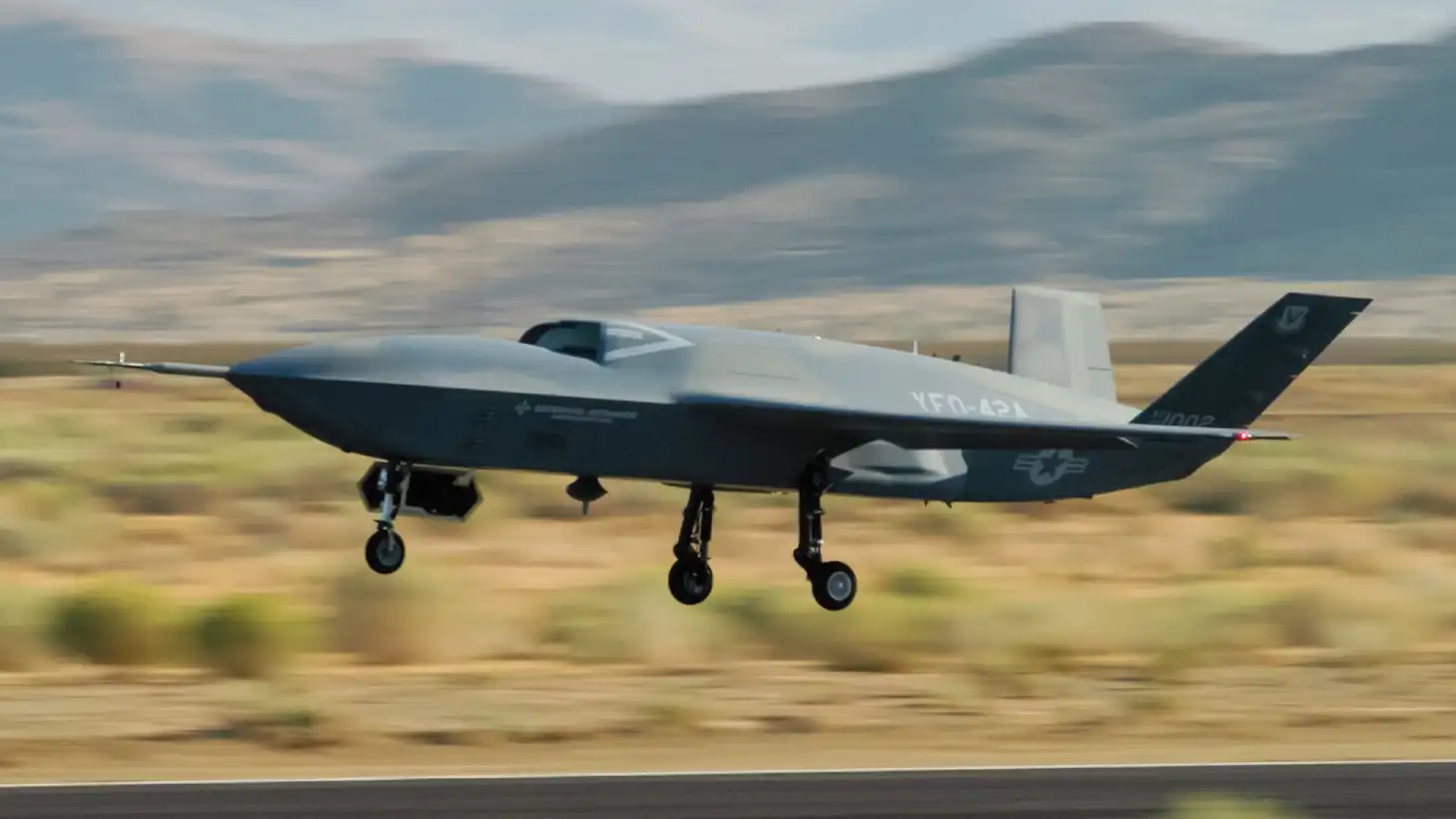
The first production designs are the General Atomics FQ-42 Vengeance and Anduril Industries FQ-44 Fury. Both were selected for Increment I of the Collaborative Combat Aircraft program, and an initial production contract calls for a combined 150 aircraft by 2030. Pricing was not disclosed.
The aircraft are intended to operate alongside the F-22 Raptor, F-35 Lightning II and planned Boeing F-47. The FQ-44 is also identified as a potential partner for the F-15EX Eagle II.
Operational Role
Collaborative Combat Aircraft are designed to serve as robotic wingmen in human-machine formations. Mission-autonomy software will allow them to conduct assigned tasks with limited pilot intervention, including extending sensor coverage, carrying additional air-to-air weapons and operating ahead of crewed fighters.
The Air Force expects the platforms to increase the number of aircraft available in contested airspace while distributing risk across crewed and uncrewed systems. Although neither design is described as expendable, their lower projected cost is intended to let commanders accept risks that may be unsuitable for crewed fighters.
“Developing semi-autonomous platforms alongside traditional fighters fundamentally expands our tactical options in modern contested airspace,” an Air Force official said at the Air & Space Forces Association’s Air, Space & Cyber Conference.
FQ-42 Development
The FQ-42 is derived from General Atomics’ XQ-67A Off-Board Sensing Station demonstrator and belongs to the company’s Gambit family of uncrewed combat aircraft. Its configuration includes a single engine, dorsal-mounted inlet, slender wings, V-tail surfaces and an internal weapons bay. Planned armament includes two AIM-120 AMRAAM missiles.
The YFQ-42A prototype first flew on Aug. 27, 2025. General Atomics named the prototype Dark Merlin in February 2026, while the Air Force assigned Vengeance to the production FQ-42 in September 2026.
One prototype was lost shortly after takeoff on April 6, 2026. The mishap was attributed to an autopilot miscalculation involving aircraft weight and center of gravity. Flight testing resumed May 21.
FQ-44 Development and Specifications
The FQ-44 began as an aggressor-aircraft concept developed by Blue Force Technologies, first called Grackle and later REDmedium and Fury. Anduril acquired Blue Force in 2023 and adapted the design for the Air Force program. The YFQ-44 completed its first flight on Oct. 31, 2025, and the Air Force formally retained the Fury name for the production aircraft in September 2026.
The single-engine aircraft is approximately half the dimensions of an F-16, with swept trapezoidal wings, a chin-mounted inlet and external weapon stations. Estimated specifications include a 20-foot length, 17-foot wingspan and 5,000-pound maximum takeoff weight.
Powered by a Williams FJ44-4M turbofan producing about 4,000 pounds of thrust, the Fury is designed for speeds up to Mach 0.95 and altitudes of 50,000 feet. It has two external weapon stations and is listed as capable of carrying as many as four AIM-120 missiles.
  • Text Only
Ukrainian Strikes Target Russian Refineries
Ukrainian forces struck two major Russian oil refineries and a facility used to launch attack drones on Sept. 13, Ukraine’s General Staff reported.
The attacks targeted the Slavyansky refinery in Sloviansk-on-Kuban, Krasnodar Krai, and the TANECO refinery in Nizhnekamsk, Tatarstan. Fires were reported at both sites. Russian regional authorities said two people were killed and 12 injured in the TANECO strike.
Ukraine’s General Staff also reported a strike on a facility in Millerovo, Rostov Oblast, used to store, prepare and launch Russian attack drones.
Refinery Capacity and Local Disruption
The Slavyansky refinery, operated by Sloviansk ECO LLC, can process about 5.2 million metric tons of crude oil annually. It produces gasoline, fuel oil, vacuum gas oil, jet fuel and other petroleum products. The General Staff said it supplies the Russian Armed Forces.
Krasnodar Krai authorities said falling drone debris damaged a gas pipeline in a residential area of Sloviansk-on-Kuban.
TANECO is operated by Tatneft and processes more than 16 million metric tons of oil annually. Tatarstan authorities said the refinery processed 16.2 million metric tons in 2022. Its products include gasoline, diesel, aviation kerosene and marine fuel.
Russia’s Defense Ministry claimed air defenses intercepted and destroyed 389 Ukrainian drones overnight. The claim could not be independently verified. Aviation authorities temporarily restricted flights at airports in Nizhnekamsk, Kazan and Bugulma over safety concerns.
Russian Missiles Hit Ukrainian Steel Plants
Separately, Russian missile strikes hit two major Ukrainian metallurgical plants overnight on Sept. 12, killing two people and injuring six, according to plant operators.
Four ballistic missiles struck the Zaporizhstal steel plant in Zaporizhzhia, injuring four employees and causing what operator Metinvest described as critical damage. Equipment in the blast-furnace and open-hearth shops was damaged, along with energy systems, internal networks and logistics infrastructure.
One injured worker was treated at the plant and declined hospitalization. Three others were hospitalized with moderate injuries. Zaporizhstal had not resumed production after earlier ballistic missile attacks on Aug. 11 and Aug. 27.
“Zaporizhstal produced pig iron and steel for civilian needs,” Metinvest Chief Operating Officer Oleksandr Myronenko said, adding that the facility did not manufacture military products or host anything that would make it a military target. Metinvest said the full extent of the latest damage had not yet been established.
Fatal Strike in Kryvyi Rih
A Russian missile also hit the ArcelorMittal Kryvyi Rih steel plant in Dnipropetrovsk Oblast. Two employees of contractor companies were killed and two plant workers were injured, the company said.
Production and auxiliary facilities were damaged, while search-and-rescue operations continued. Specialists were assessing the destruction and possible recovery timelines. The company described the site as a civilian mining and metallurgical enterprise.
The plant has been struck repeatedly during the war. An attack in December 2022 killed one employee and destroyed a rolling mill. Another in August 2026 killed two plant employees and one contractor, injured 18 people, damaged key energy and blast-furnace facilities, and partially halted production.
Broader Overnight Attacks
The strikes on Zaporizhstal and ArcelorMittal Kryvyi Rih formed part of a broader Russian missile and drone attack across Ukraine overnight on Sept. 12. At least 11 people were killed and 96 injured.
Odesa Oblast was the main target, while deadly attacks were also reported in Dnipropetrovsk, Zaporizhzhia, Sumy and Kharkiv oblasts.
  • Text Only
Canada Launches Drone Procurement Marketplace
Canada announced a national digital marketplace intended to accelerate procurement of uncrewed and counter-uncrewed systems for the Canadian Armed Forces and Canadian Coast Guard.
The Defence Drone Initiative Marketplace Supply Arrangement will connect military and government operators with nearly 400 approved Canadian suppliers. Allies and partner countries will also receive access. The system is modeled on Ukraine’s Brave1 defense technology platform.
Canada awarded initial contracts valued at up to C$50 million, which the government said will increase the number of drones deployed by the Canadian Armed Forces tenfold. The contracts follow the July launch of the Defence Drone Initiative and were issued within 50 days of the project’s start.
Canada’s longer-term objective is to establish factories, supply chains and component capacity capable of producing millions of drones over the next two years. Training, maintenance, repair, configuration and sustainment under the initial contracts must take place in Canada.
Initial Suppliers and Systems
The first procurements cover intelligence, surveillance and reconnaissance drones and uncrewed ground vehicles.
Selected suppliers include Quebec-based Beonyx, which offers a Canadian-designed and manufactured ground vehicle; AVSS, with manufacturing and assembly in Ontario; and Montreal-based Volatus Aerospace, working with partners in the United Kingdom and providing domestic logistics, training and lifecycle support.
Ontario-based Twenty20 Insight will provide Canadian services for a UK-designed and manufactured platform. Saskatchewan-based Draganfly plans Canadian licensed production of a platform based on Australian technology. Ontario-based Objexis AI will provide a Canadian-built platform using domestically owned intellectual property, software, avionics and mission systems.
Joint Production With Ukraine
General Dynamics Mission Systems-Canada and Ukrainian company Green Tech Harvest formed a partnership to develop and produce drones and related technologies. The arrangement will use Canadian manufacturing to support Ukrainian defense requirements and is expected to involve critical minerals, engineering, skilled trades and computer science.
The agreement follows a partnership between Airlogix and Sentinel Research & Development announced in May. Canada said other industry arrangements remain under negotiation.
The two governments also agreed to pursue long-term joint production of uncrewed systems, counter-drone and electronic disruption technologies, priority munitions and ammunition. The framework will combine Ukrainian operational experience with Canadian manufacturing, software and artificial intelligence capabilities, supported by research, technology transfer and predictable procurement.
Additional Defense and Security Assistance
Canada committed approximately C$350 million for air-defense interceptors through the U.S.-managed Joint Ukraine Multinational Program—Services, Training and Articles Rapid Timeline, or JUMPSTART. It also allocated nearly C$23 million to strengthen Ukrainian police, national guard, military and frontline community capabilities against hybrid threats and disinformation.
Operation UNIFIER, Canada’s military training and capacity-building mission for Ukraine, has been extended through 2029. Canada said cooperation will also expand in intelligence, cyber defense, counter-drone operations, electronic disruption and foreign information manipulation.
Since 2022, Canada’s combined military, economic, humanitarian, development, security and immigration commitments for Ukraine have exceeded C$26 billion.
Energy, Reconstruction and Long-Term Cooperation
Canada announced nearly C$435 million in loan guarantees through the European Bank for Reconstruction and Development for winter gas purchases and backup electricity generation. A further C$200 million in concessional loans through Export Development Canada will support reconstruction projects involving Canadian companies.
Additional commitments include C$10 million for the Ukraine Energy Support Fund, bringing Canada’s contribution to C$100 million, and C$2 million for an International Energy Agency program supporting energy resilience and regulatory development.
Prime Minister Mark Carney and Ukrainian President Volodymyr Zelenskyy signed declarations establishing a planned 100-year partnership and expanded defense and security cooperation. The framework covers co-development and production of defense equipment, information sharing, trade, reconstruction, critical minerals, and cooperation in artificial intelligence, cybersecurity, and space technologies.
  • Text Only
KONGSBERG Selects MESA Radar for Counter-UAS Systems
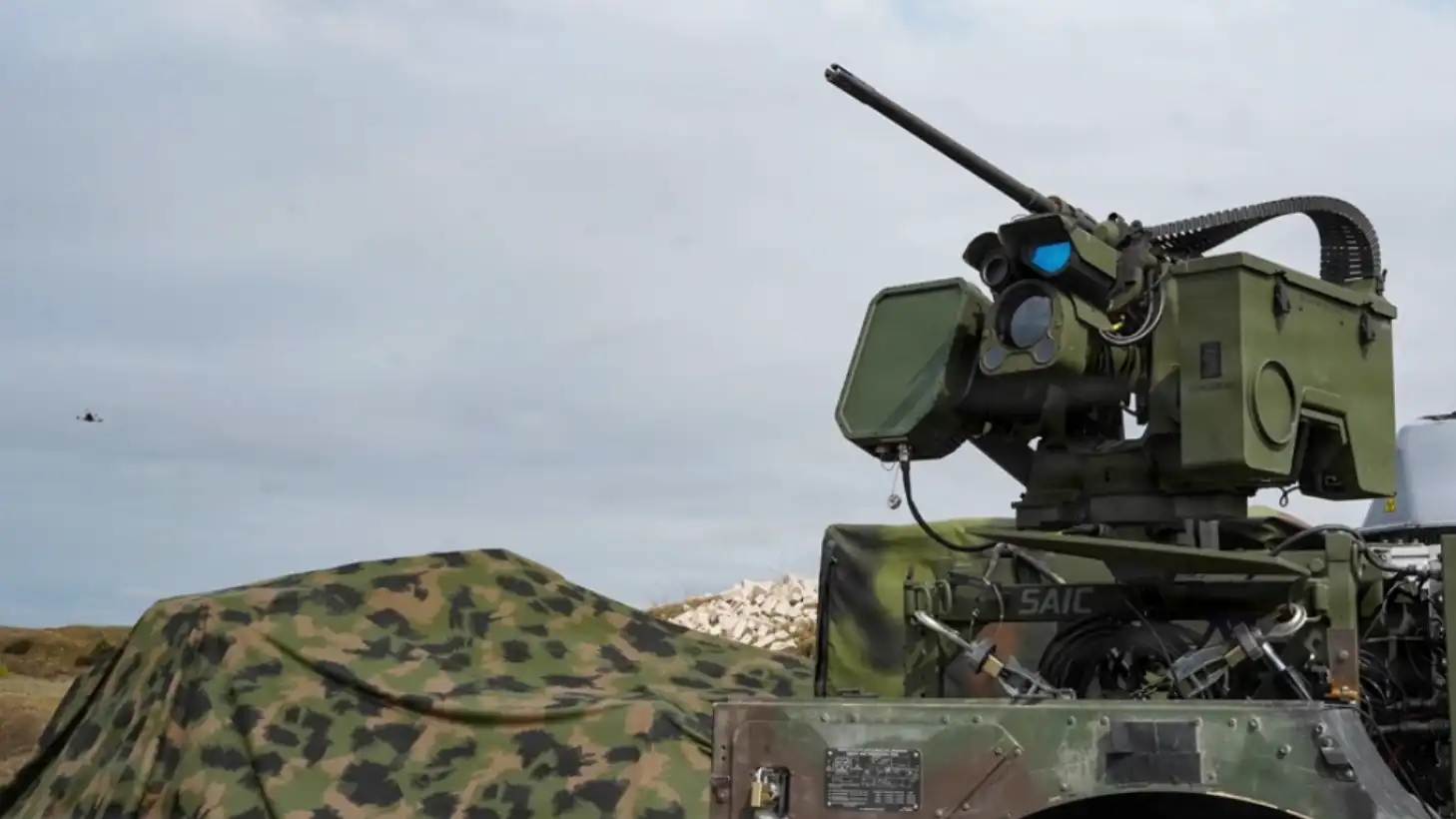
KONGSBERG has selected Echodyne’s MESA radar platform for air and surface applications, including integration with its PROTECTOR RS4 and RS6 remote weapon stations. The initial integrations are intended to provide radar tracking data for counter-unmanned aircraft system operations.
According to Echodyne’s Sept. 9, 2026, announcement, the solid-state radar can be installed on static, crewed and uncrewed platforms. The companies did not disclose procurement quantities, customers, deployment schedules, or contract value.
Detection and Fire-Control Functions
The MESA radar supplies range, range-rate, bearing and target kinematic data to the weapon station’s fire-control chain. Echodyne said the radar is designed to stabilize and cue the system’s optical sensors, maintain target tracks and reduce the time between detection and engagement.
The integration combines the radar with KONGSBERG’s weapon-station architecture and Collaborative Fire Control capabilities. It is intended to support tracking of fast-moving unmanned aircraft with low radar cross-sections while operating within the size, weight, and power limits of vehicle-mounted or stationary systems.
Echodyne CEO Eben Frankenberg said the integration is intended to provide the PROTECTOR family with persistent tracks for fire-control cueing and target lock. He also cited the radar’s compact, software-defined configuration as relevant to use across the existing PROTECTOR platform base.
Airburst and Networked Engagements
The companies identified programmable airburst munitions as one application for the radar data. Accurate range and range-rate measurements can support calculation of the point at which a munition should function along a target’s flight path.
In a networked configuration, a cooperative search radar or another sensor can pass an initial threat track to a radar-equipped remote weapon station. The local MESA radar can then refine and maintain that track for fire-control use.
This search-cue-track-engage process is designed to allow distributed systems to share an air picture, allocate targets and retarget as engagements are completed. The release did not identify specific munitions, engagement ranges or performance figures for the integrated systems.
Multi-Year Integration and Testing
Echodyne and KONGSBERG said they have conducted several years of integration, testing and demonstrations involving the radar-enabled configuration. The announcement did not specify test locations, participating military organizations, or whether the system has entered operational service.
Beyond the RS4 and RS6 integrations, the companies are evaluating additional uses for the radar across KONGSBERG air and surface mission systems. Planned joint technical work will focus on resilient sensing, networked fire control and protection against changing unmanned-system threats.
  • Text Only
Utah Facility Expands B-21 Production
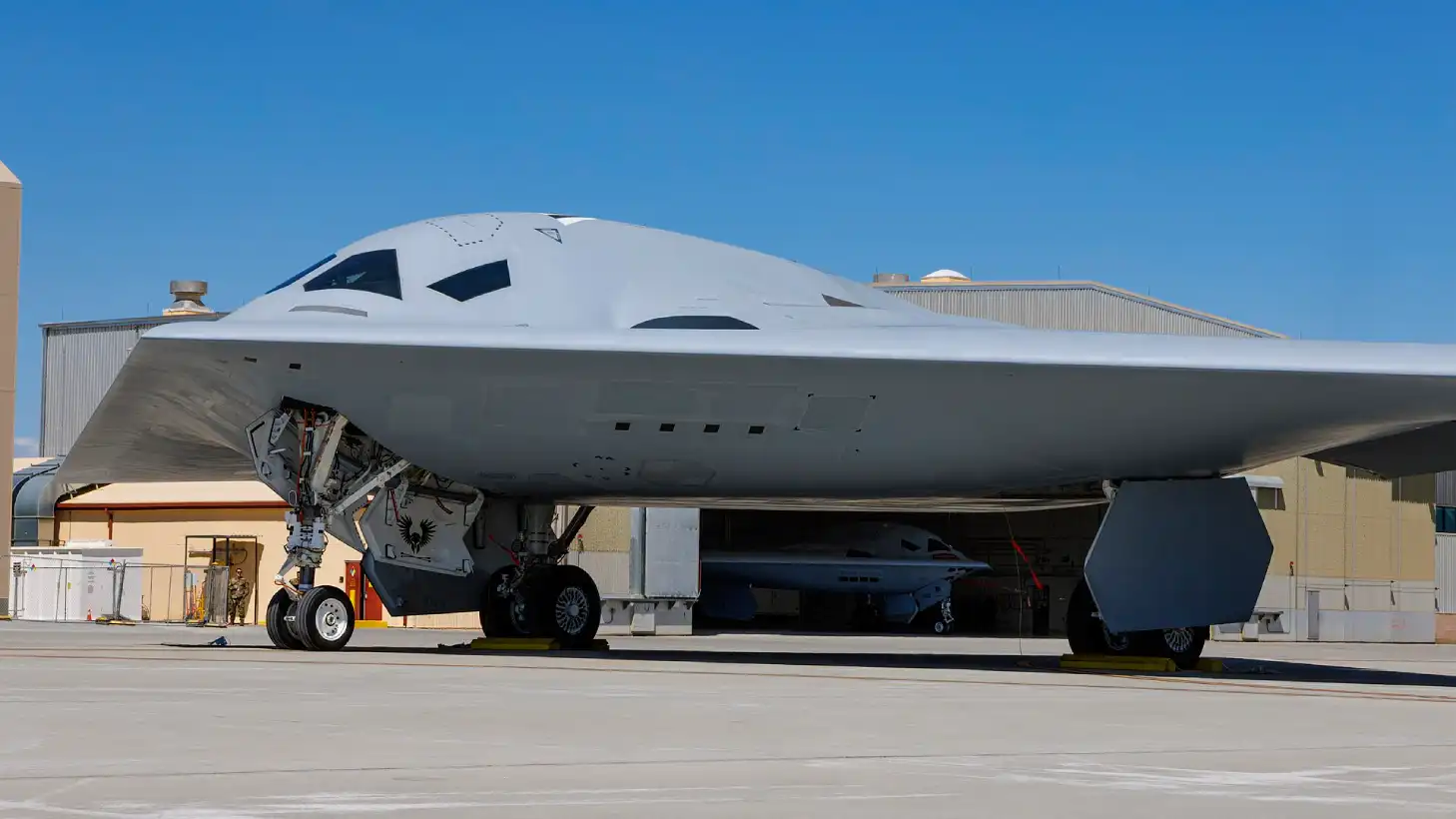
Northrop Grumman opened its East Gate 3 manufacturing facility in Layton, Utah, on September 9, 2026, expanding production infrastructure for the U.S. Air Force’s B-21 Raider stealth bomber. Per an Army Recognition report.
The East Gate campus will total 845,000 square feet and is intended to support simultaneous low-rate initial production and flight testing. It will manufacture key B-21 components and support up to 1,500 engineering and manufacturing positions by 2032.
The expansion increases Northrop Grumman’s combined Layton and Clearfield manufacturing footprint to more than two million square feet. Final assembly of the B-21 will remain at Air Force Plant 42 in Palmdale, California.
Funding and Fleet Plans
The project follows $4.5 billion provided through 2025 reconciliation legislation to increase annual B-21 production capacity by 25%. The fiscal 2027 budget request includes $6.109 billion for the program, including $3.246 billion for procurement.
Another $1.006 billion is designated for advance procurement of long-lead airframe, engine, and modernization requirements needed before later aircraft enter final assembly.
The Air Force plans to acquire at least 100 B-21s, while senior Air Force and U.S. Strategic Command officials have discussed a requirement of about 145 aircraft. The service lists an average procurement unit cost of $692 million in fiscal 2022 dollars for a minimum 100-aircraft fleet. That figure includes aircraft, support equipment, training, spares, and engineering changes rather than only the aircraft’s flyaway cost.
Testing and Operational Schedule
The first B-21 flew on November 10, 2023, and a second joined the Edwards Air Force Base test campaign on September 11, 2025. Other aircraft are in production or ground testing.
Testing was preceded by more than 1,000 flight hours using surrogate aircraft for communications, avionics, navigation, and mission software work. One developmental campaign planned for 180 days was completed in 73 days using roughly half the scheduled missions, while digital development methods reduced software certification time by about 50%.
On March 10, 2026, a B-21 completed a 5-hour, 33-minute aerial-refueling sortie, connecting with an Edwards-based NKC-135 at 23,000 feet. The Air Force has not disclosed the amount of fuel transferred, the bomber’s internal fuel capacity, or its hourly consumption.
The first operational B-21 is scheduled to arrive at Ellsworth Air Force Base, South Dakota, in 2027. Dyess Air Force Base in Texas and Whiteman Air Force Base in Missouri are also planned operating locations. Edwards leads flight testing, while Tinker Air Force Base in Oklahoma is responsible for depot planning.
Utah Industrial Network
Layton focuses on sixth-generation aircraft manufacturing, while nearby Clearfield produces composite structures for the B-21, F-35, Sentinel missile, and Airbus A350. The proximity is intended to shorten the movement of composite structures into downstream component production.
Northrop Grumman employs more than 11,000 people in Utah. Its operations involve over 600 suppliers, support more than 46,000 jobs, and generate more than $12.4 billion in statewide economic activity across aircraft, missile, navigation, and propulsion programs.
The broader B-21 program includes more than 400 suppliers in at least 40 states and more than 8,000 Air Force and industry personnel. Northrop Grumman says it has invested more than $5 billion in Raider digital technologies and manufacturing infrastructure.
Aircraft Role and Armament
The nuclear-capable, subsonic B-21 is a smaller flying-wing bomber intended to replace the B-1 and B-2 by 2040 and potentially succeed the B-52 later. It retains a two-person crew and is designed for conventional and nuclear missions.
Planned weapons include the AGM-181 Long Range Stand Off nuclear cruise missile, B61-12 and B61-13 nuclear gravity bombs, and conventional weapons such as the JASSM-ER cruise missile. The current U.S. inventory contains 19 B-2 bombers, making the minimum planned B-21 fleet more than five times larger.
  • Text Only
Houthis Reportedly Seize Strategic Island
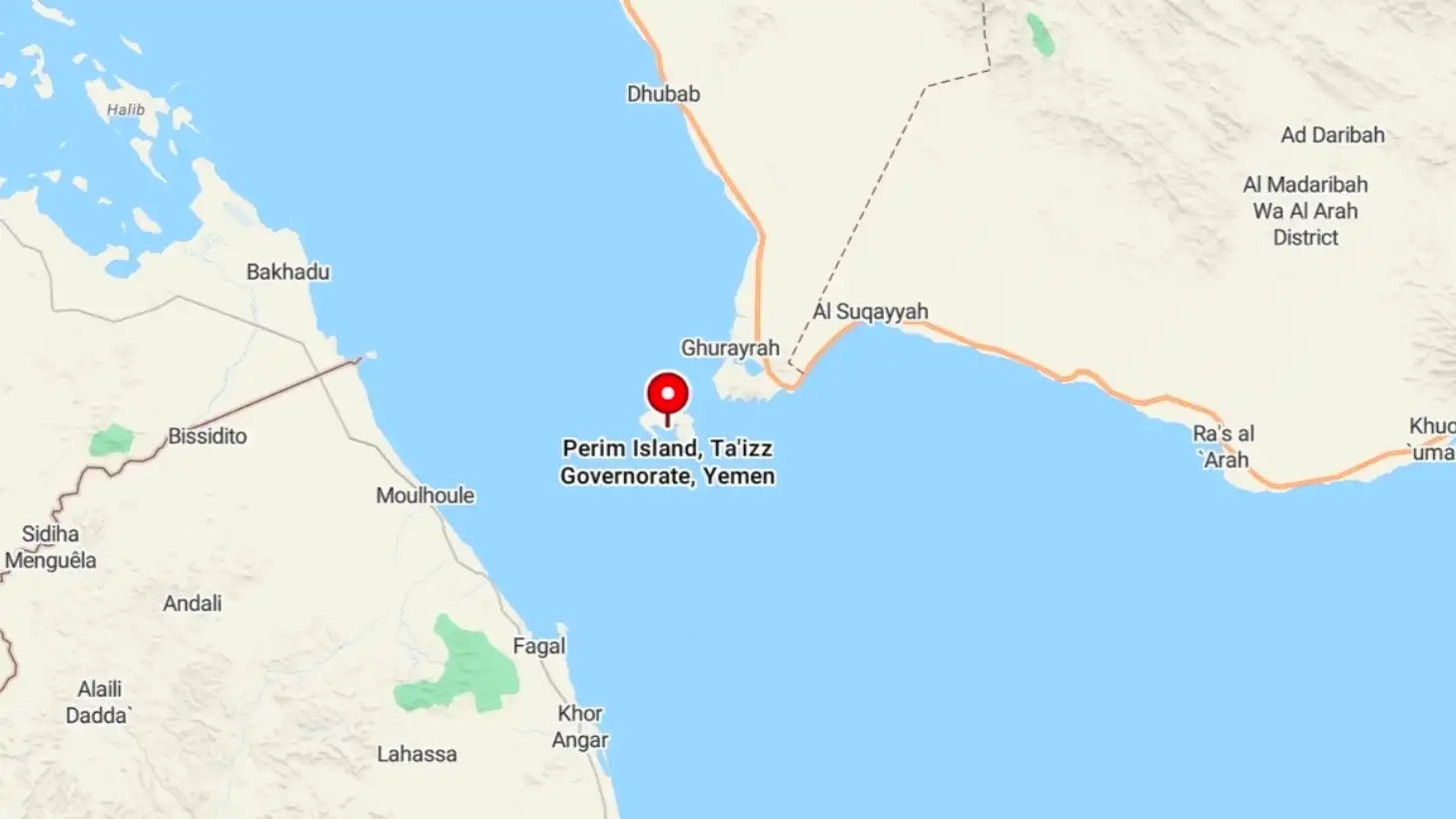
Yemen’s Iran-backed Houthi movement has reportedly taken control of Perim Island in the Bab al-Mandab Strait during a rapid advance along the country’s western coast.
The Houthis described the capture as part of a large-scale operation to expel Saudi-backed forces. An unnamed military official from Yemen’s internationally recognized government told AFP that the group had also seized two other islands in the strait and now controlled Yemen’s entire Red Sea coastline.
“Everything that was under our control on the western coast has fallen,” the official said.
Shipping Through Bab al-Mandab
Perim Island sits in the Bab al-Mandab Strait, a major maritime gateway connecting the Red Sea with the Gulf of Aden and shipping routes between Asia and Europe.
The Houthis said the strait remains safe for shipping companies other than Saudi vessels. However, their new positions could increase risks around one of the world’s most important trade corridors, particularly if fighting expands or restrictions broaden beyond Saudi-linked traffic.
The group has reiterated that it does not intend to threaten international shipping while maintaining that Saudi vessels will be targeted.
Potential Impact on Oil Markets
Oil prices remained relatively stable immediately after reports of the island’s capture and the blockade of Saudi vessels. Traders have yet to determine how significantly the situation will affect shipments.
Saudi Arabia, the world’s second-largest oil producer, has relied more heavily on the Red Sea route since the US and Israel’s war on Iran severely restricted access through the Strait of Hormuz. A broader closure of Bab al-Mandab could therefore place additional pressure on Saudi exports and global energy supplies, potentially raising crude oil and consumer fuel prices.
The effect may be more limited if restrictions remain focused only on Saudi-registered vessels. Many large oil tankers are registered elsewhere, which could allow shipments from other producers to continue. Rerouting cargo may also be possible, although alternative arrangements could increase time and costs.
Saudi Arabia Seeks US Support
Saudi Crown Prince Mohammed bin Salman reportedly asked US President Donald Trump to take military action against the Houthis following their advance. The two leaders have spoken several times in recent days, according to sources familiar with the discussions.
Trump declined to commit US forces, but Washington offered intelligence and targeting support to Saudi Arabia. Talks between the two countries remain ongoing, and Saudi officials are reportedly seeking a coalition with the US amid concerns that military action against the Houthis could prompt an Iranian response.
US Position on the Escalation
A senior US administration official did not address the reported request for military action directly, but said Washington was focused on protecting core national security interests, including freedom of navigation in the Red Sea.
The official added that the US intends to empower regional partners to take the lead in managing security challenges and remains in continuous discussions with Saudi Arabia and Yemen’s internationally recognized government.
For now, the US is not preparing to intervene directly, while the Houthis’ territorial gains have increased pressure on Saudi-backed forces and uncertainty around Red Sea shipping.
  • Text Only
Factory-equipped Bodyguard 2.0 arrives at $599
Smith & Wesson is shipping the .380 Auto Bodyguard 2.0 with a factory-installed Viridian RFX1 green-dot reflex sight. The optic is dovetail-mounted and zeroed, eliminating the need for separate installation or adapter plates.
The package has a $599 MSRP and is offered in three configurations: a model with a thumb safety, a no-thumb-safety version, and a compliant model limited to 10-round magazines. Availability remains subject to federal, state, and local laws.
For comparison, the standard Bodyguard 2.0 NTS has a $449 MSRP, while the separately sold RFX1 for the pistol is priced at $229.
Carry dimensions and configurations
The striker-fired Bodyguard 2.0 measures 5.5 inches long, 0.88 inch wide, and 4.8 inches high, with a listed weight of 12 ounces. Its stainless steel barrel is 2.75 inches long with a 1:10-inch twist and an Armornite finish. The stainless steel slide also uses an Armornite finish, while the frame and grip are polymer.
Standard-capacity versions support 10- and 12-round magazines and ship with one of each. The compliant configuration is restricted to 10 rounds. The no-thumb-safety model is identified as SKU 14786 and lists Colorado, Delaware, Illinois, and Vermont under state compliance.
Other controls include a flat-face trigger, an 18-degree grip angle, and a reversible ambidextrous magazine release. The pistol does not have a threaded barrel or integrated laser.
Viridian RFX1 optic
The RFX1 uses a 3 MOA green dot and a 16-by-15 mm objective lens. It provides unlimited eye relief, automatic brightness adjustment, and Viridian’s INSTANT-ON activation system. Power comes from a CR1632 battery, with a listed battery life of up to 30,000 hours.
The optic measures 1.63 inches long, 0.81 inch wide, and 1.02 inches high. Its housing is machined from 6061 aluminum, and it carries an IPX4 water-resistance rating. The design is also described as shockproof.
Viridian developed this version of the RFX1 around the Bodyguard 2.0’s slide geometry. It incorporates slide serrations and a tapered dovetail intended to limit lateral movement while keeping the optic aligned with the pistol’s narrow profile.
Sights, handling and intended use
The factory-mounted optic provides an alternative to relying solely on the micro pistol’s iron sights, particularly for shooters seeking a clearer aiming reference. Its automatic brightness system adjusts dot visibility for changing ambient light without manual controls.
The package retains the Bodyguard 2.0’s compact dimensions and 12-ounce listed weight while adding the green-dot system at the factory. Smith & Wesson positions the three versions to address differing preferences on manual safeties and magazine-capacity restrictions.
Included equipment and service
Each standard-capacity pistol ships with one 10-round magazine, one 12-round magazine, and tools for the optic. The compliant model’s magazine package is not detailed beyond its 10-round capacity restriction.
The Bodyguard 2.0 series is covered by Smith & Wesson’s lifetime service policy.
  • Text Only
GA-ASI Unveils Wildfire Uncrewed Aircraft
General Atomics Aeronautical Systems Inc. (GA-ASI) unveiled Wildfire, a medium-altitude, long-endurance uncrewed aircraft intended for military, civil, and commercial missions. The company described the clean-sheet design as a lower-cost, attrition-tolerant platform that can be produced and deployed in greater numbers than its existing large UAS.
Wildfire is focused primarily on intelligence, surveillance and reconnaissance, strike and related missions. GA-ASI said the aircraft also could support non-combat applications, including heavy cargo delivery, using its payload capacity and reinforced hardpoints.
Air Force Competition and Delivery Timeline
GA-ASI has proposed Wildfire for the U.S. Air Force’s Massed Modular Aircraft competition, managed through the Defense Innovation Unit. The program is seeking an alternative to the MQ-9A Reaper.
According to GA-ASI, Wildfire meets or exceeds the competition’s stated requirements and could be delivered several years before the fiscal 2031 timeline identified by DIU. The company also said its existing production facilities and supplier network would allow it to manufacture more than twice as many aircraft within the same period. The release did not provide unit cost figures, production quantities or a date for an initial flight.
Range, Payload and Mission Systems
GA-ASI lists Wildfire with a ferry range exceeding 8,000 nautical miles. The aircraft is designed to carry two Long-Range Anti-Ship Missiles simultaneously over what the company described as operationally meaningful distances. Another disclosed configuration carries four Joint Strike Missiles.
Other payload options include munitions, launched effects, sensors and mission-specific equipment. The aircraft will incorporate multispectral targeting sensors and is designed to accommodate long-range precision-strike weapons. Detailed information on endurance, payload weight, dimensions, speed and propulsion was not included in the announcement.
GA-ASI positioned Wildfire in the same general medium-altitude, long-endurance class as the MQ-9A, while stating that the new aircraft will offer greater payload capacity and range at a lower cost.
Autonomy and Collaborative Operations
Wildfire will use mission-autonomy technology derived from GA-ASI’s FQ-42A Collaborative Combat Aircraft work. Rather than relying on a conventional ground control station, human personnel are expected to operate the aircraft through U.S. government-provided autonomy software.
The intended control architecture is designed to let individual operators manage multiple aircraft and support networked operation of dozens of Wildfires. GA-ASI said the platform will also employ proliferated low-Earth-orbit satellite communications technology already demonstrated aboard other company aircraft.
Design and Intended Role
The aircraft combines selected features from GA-ASI’s existing UAS with lower-cost components and a modular architecture. The company said it deliberately limited the platform to a narrower group of missions than the MQ-9B, which is configured for roles including anti-submarine warfare, counter-UAS operations and airborne early warning.
GA-ASI President David R. Alexander characterized Wildfire as a high-volume aircraft intended to perform a smaller number of core missions. For defense users, the design is meant to permit deployment in kinetic environments where commanders may accept greater risk to individual aircraft. GA-ASI said the design draws on experience from more than 1,600 uncrewed aircraft delivered across the Predator, Reaper, SkyGuardian, Avenger, and Collaborative Combat Aircraft families.
  • Text Only
Availability and Price
Shield Arms has released the S20, a 20-round 9mm magazine for Glock 43X and Glock 48 Slimline pistols. It is available now at a price of $44.99.
The S20 is intended primarily as a higher-capacity spare magazine. Its steel body extends below the pistol’s grip and is not flush-fitting like the company’s 15-round S15 magazine. No baseplate extension is required to reach the stated 20-round capacity.
Design and Capacity
The S20 uses the same patented staggered-feed geometry as the S15 but lengthens the magazine body to accommodate five additional cartridges. Unlike an S15 fitted with a separate +5 aluminum extension, the S20 uses a continuous, one-piece steel body.
Integrated over-insertion tabs are stamped into the magazine body. These tabs are designed to prevent the magazine from being seated too deeply during rapid or forceful reloads, helping maintain feed-lip alignment.
The magazine is formed from steel and treated with a black QPQ nitrocarburizing finish for hardness, wear resistance, and corrosion protection. Shield Arms says it is manufactured in the United States to the same standards as the S-Series lineup.
Compatibility Requirements
The S20 is compatible only with 9mm Glock 43X and Glock 48 pistols. It does not fit the Glock 43 or Glock 42, which use shorter frames, and it is not designed for full-size or compact double-stack Glock models.
Use requires a Shield Arms S-Series steel magazine catch. The S20 is not compatible with the factory polymer magazine catch. Shield Arms also advises against using its steel catch with Glock’s factory plastic magazines, recommending steel magazines with steel catches and plastic magazines with plastic catches.
Owners using a first-generation Shield Arms aluminum magazine catch should confirm compatibility before installing the S20. Pistols already configured with the required steel catch need no gunsmithing or fitting to use the new magazine.
Intended Role
Because the S20 protrudes below the grip, Shield Arms positions it as a backup, range, competition, or home-defense magazine rather than a flush-fit concealed-carry option. Existing S15 users can carry the 15-round magazine in the pistol and use the S20 as a higher-capacity spare.
The S20 may be particularly relevant to Glock 43X and 48 owners already committed to the Shield Arms magazine system, since switching between the S15 and S20 does not require another magazine-catch change. Glock has also introduced its own 15-round magazines, but the S20 is specifically designed around the Shield Arms steel-catch system.
Specifications and Support
The S20 holds 20 rounds of 9mm ammunition and uses a steel body with a black nitride QPQ finish. Its over-insertion protection is built directly into the body rather than added through a separate component.
Shield Arms covers the magazine with a lifetime warranty against defects in materials and workmanship. It also includes the company’s “Spring for Life” guarantee, under which a worn magazine spring can be replaced without charge for the life of the product.
  • Text Only
Navy Selects VAMPIRE for Littoral Defense
The U.S. Navy has selected L3Harris Technologies to deliver VAMPIRE counter-unmanned systems for its integrated C-UxS defense architecture, the company announced Sept. 8, 2026. The system is intended to counter unmanned aerial systems, remotely piloted platforms and potentially other small threats in littoral environments.
L3Harris is ruggedizing the Navy configuration against maritime stresses including humidity, salt exposure and vibration. The company has not disclosed the number of systems ordered, contract value, delivery schedule, or exact configuration.
“VAMPIRE is a flexible and effective system that meets the unique requirements of the U.S. Navy for littoral C-UxS defense,” said Tony Calderon, president of Targeting & Sensor Systems at L3Harris.
Maritime Roles and Variants
VAMPIRE has developed into a family of modular systems combining sensors, precision weapons, electronic jammers and other effectors. Its maritime-focused Black Wake variant is designed for installation on crewed or uncrewed vessels and for lower-cost engagements against small drones and fast attack craft.
L3Harris has not confirmed that Black Wake is the version selected by the Navy. The announced system could be deployed as part of a wider detection and command network to protect forces, bases, logistics sites or other infrastructure near the coast.
Other VAMPIRE configurations include the land-based Stalker XR, airborne Dead Wing, containerized CASKET, BAT system for base protection, and Killcode electronic-warfare variant.
Sensors and System Architecture
The baseline VAMPIRE uses a self-contained, palletized design that can be fitted to different vehicles or platforms. According to L3Harris, two personnel can install the system in a vehicle cargo bed in about two hours using standard tools.
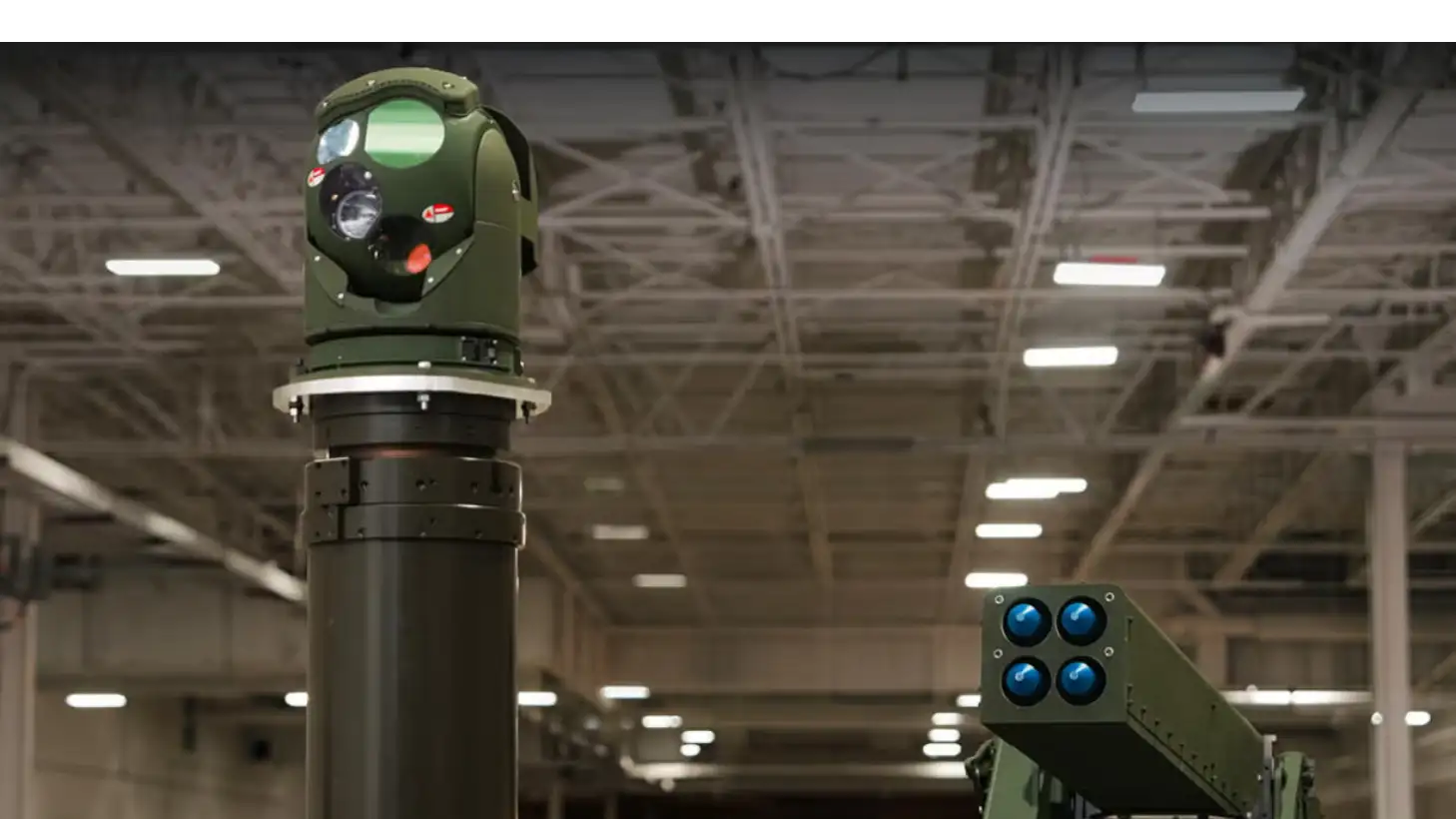
Its primary sensor is the stabilized WESCAM MX-10D RSTA electro-optical and infrared turret, mounted on a telescopic mast. The sensor supports surveillance, identification, and laser target designation.
VAMPIRE also connects to the Widow Mission Management System, which is compliant with the Forward Area Air Defense Command and Control architecture. Widow integrates sensors, effectors, radios, and navigation functions, allowing individual launchers to operate within a broader counter-unmanned network.
Weapons and Engagement Range
For kinetic engagements, VAMPIRE can use the 70 mm AGR-20A Advanced Precision Kill Weapon System laser-guided rocket. A proximity fuze improves its effectiveness against small aerial targets by allowing an engagement without a direct impact.
Company documentation lists an engagement range of up to approximately six kilometers for the current configuration. The launcher can also accommodate other laser-guided munitions, depending on the selected configuration, host platform, and target.
The system is intended to provide an intermediate defensive layer between electronic warfare, automatic weapons and more expensive surface-to-air missiles. This gives naval forces another option for responding to repeated or numerous unmanned threats without relying exclusively on higher-cost interceptors.
Related Orders and Operational Use
The Navy selection follows a separate U.S. Army VAMPIRE order announced in June 2026 and valued at up to $106 million. L3Harris reports that VAMPIRE systems have accumulated more than 350,000 operational hours in Europe since 2023.
The company has also introduced Wraith Shield software, which uses radios as sensors to help defeat small drones. L3Harris says the software can be integrated with VAMPIRE and Drone Guardian systems as part of a layered defense against unmanned threats.
  • Text Only
Ukrainian General Staff Reports 1.5 Million Russian Troop Losses
Russia has lost an estimated 1,500,870 troops since beginning its full-scale invasion of Ukraine on Feb. 24, 2022, according to a Sept. 9 report from the General Staff of the Armed Forces of Ukraine.
The total includes 1,480 Russian casualties recorded over the preceding day. Russia has not officially released comprehensive casualty figures or a casualty list.
Equipment Losses
The Ukrainian General Staff also reported that Russia has lost 12,338 tanks and 25,290 armored combat vehicles since the invasion began. Its figures include 146,008 vehicles and fuel tanks, 49,383 artillery systems, 2,105 multiple-launch rocket systems and 1,613 air-defense systems.

Reported aviation losses comprise 441 aircraft and 355 helicopters. The General Staff also listed 506,188 aerial drones, 2,534 unmanned ground systems and 5,103 cruise missiles.
At sea, Ukraine’s military estimates that Russia has lost 35 ships and boats, along with two submarines.
Estimates of Ukrainian Casualties
A January 2026 report from the Center for Strategic and International Studies estimated that Ukraine likely suffered between 500,000 and 600,000 casualties from February 2022 through December 2025. The report estimated that between 100,000 and 140,000 Ukrainian troops were killed in action during that period.
Ukrainian officials rarely disclose military casualty totals. President Volodymyr Zelensky told France TV on Feb. 4 that at least 55,000 Ukrainian soldiers had been killed in action since the start of the full-scale war. He added that many more service members remained missing in action.
Difficulties Confirming the Toll
The intensity of combat and Russian drone attacks has made it difficult for Ukraine to recover the bodies of fallen soldiers. Recovery is required before DNA testing can be used to confirm identities, complicating efforts to establish a complete count of those killed or missing.
The available Russian and Ukrainian figures come from differing official statements and estimates, with Moscow providing no comprehensive public accounting of its losses.
  • Text Only
Ukraine Plans Contracts for About 1,000 Patriot Missiles
Ukraine is preparing contracts for roughly 1,000 Patriot air-defense missiles with partner support and financing from an EU loan, Defense Minister Yevhen Khmara said at the 36th Ukraine Defense Contact Group meeting on Sept. 8, 2026.
Khmara cautioned that the contracted missiles will take time to arrive. Ukraine is therefore asking partners to transfer interceptors from existing stockpiles before winter, with those stocks later replenished by upgraded missiles delivered under the Ukrainian contracts.
The request follows continued Russian attacks on Ukrainian cities and critical infrastructure. An overnight missile and drone strike on Kyiv on Sept. 8 killed at least five people, injured 29 and caused large fires across the city.
Additional Air-Defense Requirements
Ukraine is also seeking air-to-air missiles and man-portable air-defense systems to counter cruise missiles and, as an interim measure, jet-powered Shahed attack drones.
Khmara said dozens of Ukrainian companies are working on affordable systems that can be produced at scale to intercept jet-powered drones. Some interceptors are already undergoing combat testing, he added.
Ukraine presented stronger air defenses, additional drone financing and faster partner decisions before winter as its immediate priorities at the Ramstein-format meeting.
EU Loan and Defense Funding
The European Commission is expected to approve the final €28.3 billion ($33 billion) tranche of this year’s defense loans for Ukraine on Sept. 11. The financing package would authorize Ukraine to buy U.S.-made PAC-3 interceptors, which Patriot systems use against ballistic missiles. EU member states have backed the request, though one procedural step remains before formal approval.
According to Khmara, partners pledged €70 billion in security assistance for Ukraine this year at a meeting in Ankara. Ukraine currently accounts for €62 billion, including bilateral support and the EU loan, leaving an €8 billion gap against that commitment.
Khmara separately placed Ukraine’s overall defense funding shortfall at €23 billion, or $27 billion. He said the money is needed to finance drones and maintain stable supplies during the remainder of this year and the beginning of the next. Ukraine is requesting funding decisions by November so that resources can affect operations during winter.
War Plan and Battlefield Assessment
Khmara and Armed Forces Commander-in-Chief Mykhailo Drapatyi attended the contact group meeting in their roles for the first time. The defense minister presented Ukraine’s war plan, which combines combat operations, personnel, defense-industrial production, cooperation with partners and a financial framework intended to provide predictable manufacturing volumes.
Khmara said Russia has not achieved strategic success on the battlefield and that Ukraine’s drone-based engagement zone is limiting Russian advances. He claimed it accounts for more than 30,000 Russian military personnel each month.
Ukraine estimates that Russia plans to mobilize about 300,000 additional soldiers by the end of 2026, beyond contract recruitment, and another 300,000 in 2027. Khmara said Ukraine intends to respond through technology, speed and expanded defense production rather than compete solely on manpower and resources.
Proposed Partner Cooperation
Ukraine is offering partners cooperation through joint defense projects, technology sharing, battlefield experience and new military capabilities. Khmara characterized continued assistance as an investment in shared security rather than a subsidy, while emphasizing that near-term transfers from partner inventories remain necessary until newly contracted weapons are delivered.
  • Text Only
Five Killed in Overnight Attack
Russia launched a large-scale missile and drone attack on Kyiv overnight on Sept. 8, killing five people and injuring 35. Explosions began around 3:30 a.m. local time and continued in several waves, igniting fires and sending smoke across the capital.
Residential buildings, a school, warehouses, garages and vehicles were damaged. Emergency crews reported destruction and fires in the Holosiivskyi, Solomianskyi, Darnytskyi, Podilskyi and Dniprovskyi districts.
Fourteen injured people were hospitalized, according to Mayor Vitali Klitschko, who said three were in serious condition. Rescuers evacuated two people from a damaged 16-story apartment building and freed 10 others trapped in a five-story building.
Air raid alerts and explosions continued through the day as additional jet-powered drones targeted the city.
Missiles and Drones Target Kyiv
Ukraine’s Air Force said Russia launched 32 cruise missiles, 166 Shahed-type drones and an unspecified number of ballistic missiles. More than half of the drones were described as jet-powered.
Ukrainian forces intercepted two ballistic missiles, 31 cruise missiles and 142 drones, according to the Air Force. Missile or drone impacts were recorded at 29 locations. Monitoring channels reported that at least 12 ballistic missiles targeted Kyiv within about an hour.
President Volodymyr Zelensky said the attack involved ballistic, cruise, and anti-ship missiles as well as jet-powered drones. He described the interception of nearly all cruise missiles as a positive result but said Ukraine needed additional interceptor missiles and a U.S. ballistic missile defense package.
TV Channel and Homes Damaged
A drone struck the building of the We-Ukraine television channel during a live broadcast, injuring at least five people. The broadcaster, part of Ukraine’s national telethon, said its newsroom and offices were hit.
In the Solomianskyi district, residents reported shattered windows, damaged furniture and debris entering apartments. Dariia Kolisnyk said she reached her child and husband after windows and a door broke during the blast. Her husband suffered minor cuts from glass.
Another resident, Liudmyla Akhremenko, said her home had been damaged for a second time and that no nearby shelter had yet been built.
“These attacks destroy people’s lives and livelihoods,” resident Yevhen Panchenko said. “They have nowhere to live or work.”
Kyiv Region Also Hit
Russian attacks also damaged residential areas and civilian infrastructure across Kyiv Oblast from the evening of Sept. 7 into the following morning. Three people were injured, including a 2-year-old girl who suffered a shrapnel wound to the eye and was hospitalized.
In Bila Tserkva, two apartment buildings, a house, a warehouse and a production facility were damaged. Homes, warehouses, businesses and vehicles were also affected in the Brovary, Boryspil, Fastiv and Obukhiv districts.
Air raid alarms sounded overnight in other parts of Ukraine, including Rivne Oblast, after the Air Force warned that Russia had likely launched cruise missiles from Tu-95 and Tu-160 strategic bombers.
Brief Aerial Truce Ends
The attack ended a short pause in aerial strikes on the two countries’ capitals. Russia and Ukraine had agreed to halt such attacks for three days while U.S. special envoys Steve Witkoff and Jared Kushner visited Kyiv for peace talks.
Moscow announced the pause on Sept. 6 but did not clearly specify its starting time. Kyiv was not attacked during the envoys’ visit, but Russian drones began targeting the capital again after their departure on Sept. 7.
Before the pause, Kyiv had faced nine consecutive days of sustained Russian drone attacks.
  • Text Only
Five-Day Trilateral Exercise Begins
Japan, South Korea and the United States began Freedom Edge 2026 on Sept. 7, launching five days of air, maritime, cyber, logistics and Integrated Air and Missile Defense training.
The exercise runs through Sept. 11 in international waters and airspace east and south of Jeju Island, with Japanese activities also conducted west of Kyushu in the East China Sea. Military bases and command posts in Japan and South Korea are participating.

This is the fourth Freedom Edge exercise in 27 months. It is also the second consecutive iteration without a U.S. aircraft carrier, placing greater emphasis on destroyers, land-based tactical aircraft, aerial refueling and distributed command networks.
Ships and Aircraft
The naval component comprises six surface combatants, although five had been identified when the exercise began. South Korea deployed the Sejong the Great-class destroyers ROKS Yulgok Yi I and ROKS Seoae Ryu Seong-ryong. Japan contributed the destroyers JS Atago and JS Asahi, while the United States deployed the Arleigh Burke-class destroyer USS Benfold, which arrived in Busan on Sept. 3.
Four of the five identified ships use the Aegis combat system, providing shipborne air and missile defense capability.
Japan’s aircraft include P-1 maritime patrol aircraft, SH-60K helicopters, F-15 and F-2 fighters, E-767 and E-2D airborne early warning and control aircraft, and KC-46A and KC-767 tankers. U.S. F-16 fighters and KC-135 tankers are also participating. Aircraft quantities, the identity of the sixth ship, and the combined personnel total were not specified.
Japan committed approximately 560 personnel from six organizations, including joint, maritime, air, support and cyber commands. That is 140 fewer than its reported contribution to the 2025 exercise.
Training Priorities
Freedom Edge 2026 covers integrated air and missile defense, maritime missile defense, enhanced air defense, maritime interdiction, cyber defense, logistics and medical training. A central element is real-time data sharing among Japanese, South Korean, and U.S. command systems.
The carrier-free force distributes functions across ships, shore-based aircraft and tankers. Aegis destroyers provide air and missile defense nodes; maritime patrol aircraft and helicopters support surface and undersea surveillance; fighters conduct tactical aviation missions; and airborne early warning aircraft provide radar coverage and battle management.
Tankers extend fighter endurance and operating range, while shared sensor tracks support identification, interception and missile-defense decisions across the three national networks. U.S. Forces Japan commander Lt. Gen. Stephen Jost said it was “not safe to say” the absence of a carrier had become the new normal.
Shift From Carrier-Led Operations
The first two Freedom Edge exercises lasted three days and included U.S. carriers. USS Theodore Roosevelt participated in June 2024, while USS George Washington joined the November 2024 iteration. The latter involved approximately 7,000 personnel, seven ships, and more than 20 fighters, patrol aircraft, and tankers.
Freedom Edge 2025 expanded to five days but omitted a carrier, relying in part on land-based U.S. F-35A fighters and KC-135 tankers. The 2026 exercise retains that five-day structure and distributed aviation model. Across all four iterations, the series has accumulated 16 exercise days.
North Korean Missile Context
The exercise opened one day after North Korea commissioned the approximately 5,000-ton guided-missile destroyer Kang Kon at Wonsan. The ship partially capsized during its May 2025 launch, was recovered and relaunched the following month, and later underwent repairs, sea trials and weapons testing.
Kang Kon is the sister ship of Choe Hyon, commissioned in June, and carries the same weapons suite. North Korea has tested cruise missiles from the new destroyer and associates the class with conventional and nuclear-capable missile missions. Freedom Edge’s missile-defense and sensor-sharing drills also address threats from North Korean land-based ballistic and cruise missiles, aircraft, and submarines.
  • Text Only
U.S. Warships Evade Iranian Missile Attacks
Iran’s Islamic Revolutionary Guard Corps fired multiple ballistic missiles at a U.S. aircraft carrier and guided-missile destroyer in Middle Eastern waters on Sept. 5, 2026, according to U.S. Central Command. Both ships evaded the attacks, and no U.S. personnel were wounded.
CENTCOM did not identify the vessels, the number or type of missiles launched, or the defensive measures used. The USS George Washington and USS George H.W. Bush carrier strike groups, along with several independent Arleigh Burke-class destroyers, were operating in the Arabian Sea at the time.
On Sept. 6, the IRGC claimed it had damaged the carrier and destroyer and forced them to leave the engagement area. That account conflicts with CENTCOM’s statement and has not been independently confirmed.
Three Iranian Tankers Struck
U.S. forces responded by attacking three Iranian crude-oil tankers in and around the Strait of Hormuz. CENTCOM said the M/T Downy, near Kharg Island, and the M/T Stark 1, near Jask, were permanently disabled. The unladen M/T Kylo, also known as Noxen, was destroyed in the Gulf of Oman after its crew was ordered to abandon ship.
Video released by CENTCOM showed the vessels struck by multiple munitions, including a large impact against Kylo’s hull near the waterline. The number of casualties, if any, from the tanker strikes was not clear.
CENTCOM described the tankers as part of a multibillion-dollar “shadow network” supporting the IRGC and its regional partners. “If you shoot at two of our ships, we will impose an even higher economic cost — taking out three of yours,” CENTCOM commander Adm. Brad Cooper said. He added that U.S. forces would defend American personnel and, if necessary, target Iran’s “limited and exposed oil fleet.”
Iran Claims Further Maritime Attacks
The IRGC Navy subsequently said it attacked three oil tankers traveling through what Tehran called an unauthorized route in the Strait of Hormuz, as well as three U.S.-linked vessels elsewhere. Iran also warned ships against using routes it had not approved.
Tehran separately claimed it struck an unmanned U.S. military vessel attempting to enter the strait. The United States had not immediately confirmed that attack, and the vessel’s identity, the weapon used, and any resulting damage remained unknown.
These claims broaden the confrontation beyond crewed warships to commercial shipping and unmanned systems used for surveillance, reconnaissance, and maritime awareness.
Strait of Hormuz Risks
The Strait of Hormuz carries about one-fifth of the world’s crude oil, while Kharg Island is a major Iranian oil depot. Jask and the approaches to the strait are also positioned along routes where Iranian coastal missiles, aircraft, drones and naval units can affect military and commercial traffic.
An anti-ship ballistic-missile attack requires forces to locate moving vessels, maintain an accurate track and update targeting information as ships change course and speed. Carrier protection also relies on the wider strike group: guided-missile destroyers provide radar coverage, missile defense, electronic warfare and offensive strike capacity, while carrier aircraft can extend surveillance and intercept airborne threats.
Earlier Operations in the Waterway
The tanker strikes marked an expansion of U.S. action against Iranian maritime assets. After imposing a blockade of the strait in April and reinstating it in July, U.S. forces had primarily redirected shipping and fired on vessels attempting to pass through. American forces later fired on two Iranian tankers during wider strikes on Sept. 1.
On Aug. 30, U.S. forces struck Larak Island, saying IRGC launchers were preparing to deploy mines. CENTCOM had reported clearing mines from shipping lanes two days earlier. Iran then launched missiles and one-way attack drones at U.S. bases in the Middle East.
  • Audio Available
Ukrainian Units Reportedly Ordered to Halt Fighting
Units of Ukraine’s Defense Forces were reportedly ordered to stop fighting along the front from 12:00 a.m. on Sept. 5 through 11:59 p.m. on Sept. 8, according to Ukrainska Pravda, which cited personnel from several brigades on different fronts and a senior security official.
Ukrainian officials have not publicly announced a ceasefire, and it remains unclear which units are covered by the reported order. There was also no confirmation that Russian forces would observe a corresponding halt in hostilities.
US Envoys to Visit Moscow and Kyiv
The reported pause coincides with a diplomatic trip by U.S. envoys Steve Witkoff and Jared Kushner, who are scheduled to visit Moscow and Kyiv as part of Washington’s effort to negotiate an end to Russia’s war against Ukraine.
President Volodymyr Zelensky said the envoys would travel to Kyiv on Sept. 6 after visiting Moscow. Other details indicated the visits would take place on Sept. 5 and 6. The trip will mark Witkoff and Kushner’s first visit to Ukraine in their roles as envoys.
U.S. President Donald Trump confirmed the weekend mission, saying he had sent Witkoff and Kushner to determine whether progress could be made in negotiations.
“It’s got to get settled,” Trump said. “We sent them over to see whether or not we can get something done. And there may be a good chance that we’ll do it.”
Ukraine Pledges Restraint During Visit
Zelensky said Ukraine would refrain from aerial strikes against Russia during the envoys’ visit to protect the U.S. negotiators. He urged Moscow to observe the same restraint.
The Ukrainian president described the measure as ensuring the “normal functioning of Russian airspace” during the Sept. 5-6 visits.
That temporary commitment followed a Sept. 1 warning from Zelensky to airlines, insurers and foreign governments about the risks of operating in Russian airspace amid Ukrainian drone activity.
“Today we want to warn every airline that uses Russian airspace, every insurer, everyone who still uses key Russian airports — Russian skies are becoming completely dangerous,” Zelensky said. He added that Russian airspace would be “de facto closed.”
Air Alerts Continue in Ukraine
Despite the reported front-line order, air raid sirens sounded in Kyiv as the pause was due to begin at midnight on Sept. 5. Ukraine’s Air Force warned of attack drones in the Kyiv and Kharkiv regions, and air-defense activity was heard in the capital after midnight.
The alerts underscored the absence of a publicly confirmed, nationwide ceasefire. No formal agreement between Ukraine and Russia was announced alongside the reported Ukrainian order, and the status of combat operations beyond the units said to have received it remained uncertain.
  • Text Only
Three SG-100 Waypoint Rifles Added
Springfield Armory has added three Model 2020 Waypoint bolt-action rifles featuring a Super Grip SG-100 Cerakote treatment. The new variants are chambered in .308 Win., 7mm PRC, and .300 Win. Mag., covering both short- and long-action configurations.
Each rifle carries an MSRP of $1,995. The additions combine a textured carbon-fiber stock with black-finished stainless-steel components while retaining the Model 2020 line’s stated accuracy guarantee.
Stock and Finish
The rifles use bead-blasted carbon-fiber stocks sourced from AG Composites. Springfield applies SG-100 Cerakote, a non-slip ceramic finish with a rubberized texture intended to improve handling in field conditions.
The fluted barrel and stainless-steel action receive a subdued black H-164 Cerakote finish. This gives all three chamberings the same general exterior treatment, pairing the textured stock with black metalwork.
“The Model 2020’s combination of custom-grade features at production rifle pricing has established it as a premier bolt-action hunting rifle,” said Steve Kramer, Springfield Armory’s vice president of marketing. “Building on this tradition are these newest variants, featuring a subdued black finish on the metal paired with the enhanced grip of the SG-100 coating on the stock.”
Chamberings and Barrels
The .308 Win. model has a 20-inch barrel. The 7mm PRC and .300 Win. Mag. rifles use 24-inch barrels.
All three are equipped with fluted barrels made from 416 stainless steel. The muzzles are threaded and fitted with Springfield’s SA Radial Brake. Aside from their chamberings, action lengths, and barrel lengths, the rifles share the same listed barrel construction, muzzle equipment, and finish.
Action and Bolt Design
The Model 2020 Waypoint action is machined from pre-hardened stainless steel. It incorporates an integral recoil lug and electrical discharge machined, or EDM-cut, raceways.
A fluted bolt uses dual cocking cams and supports tool-free disassembly. The design allows the bolt to be taken apart for maintenance without requiring a workbench or separate tools.
Accuracy Guarantee and Specifications
Springfield backs the SG-100 models with a .75-MOA accuracy guarantee for three-shot groups. The guarantee applies when match-grade ammunition is used by a skilled shooter.
Key specifications include:
Chamberings: .308 Win., 7mm PRC, and .300 Win. Mag.
Barrel lengths: 20 inches for .308 Win.; 24 inches for 7mm PRC and .300 Win. Mag.
Barrel: Fluted 416 stainless steel
Muzzle: Threaded with SA Radial Brake
Metal finish: Black H-164 Cerakote
Stock: Bead-blasted AG Composites carbon fiber with SG-100 Cerakote
Action: Pre-hardened stainless steel with integral recoil lug and EDM-cut raceways
Bolt: Fluted with dual cocking cams and tool-free disassembly
Accuracy guarantee: .75 MOA for three shots with match-grade ammunition
MSRP: $1,995 for each model
  • Text Only
Squad-Level Air Defense Prioritized
The Marine Corps released Ground Combat Element 2040 on Wednesday, outlining plans to expand air defenses and other advanced capabilities across its ground forces. A central priority is pushing layered ground-based air defense down to the squad level as small drones, pervasive sensors and precision weapons increase the risks facing infantry units.
The service has already begun fielding more than 80 new systems intended to help infantry squads detect and destroy small unmanned aircraft. The roadmap calls for capabilities able to detect, identify, track, and defeat small drones, helicopters, and low-flying fixed-wing aircraft at close and extended ranges.
Three-Phase Modernization Plan
The 40-page FY26 framework will guide investment and force-development decisions through 2040. From 2026 to 2030, the Corps plans to accelerate existing Force Design efforts, address the immediate drone threat, and invest in survivability, command and control, artificial intelligence, and unmanned systems.
Between 2031 and 2035, AI and autonomous systems are expected to assume larger roles in headquarters operations, logistics, reconnaissance, bridging and breaching. Drone formations would supplement rocket and cannon artillery, while active and passive counter-drone measures become increasingly important across the force.
For 2036 to 2040, the roadmap envisions dispersed formations using AI-enabled command systems, edge computing, and widespread human-machine teaming. Robotics could augment or replace personnel in some high-risk maneuver and logistics tasks.
Five Modernization Pillars
The plan organizes development around human-centered warfighting, lethality, endurance, decision advantage and modularity. Although it calls for greater use of AI, robotics, and autonomous platforms, the framework states that technology should enhance rather than replace human judgment. Units must remain effective when networks, sensors, or other technical advantages are disrupted or denied.
Lethality initiatives include improved organic direct and indirect fires, integration with Joint and allied sensors, and kinetic and non-kinetic effects across multiple domains. Endurance efforts cover resilient logistics, tactical deception, camouflage, and signature management. Modularity centers on scalable Marine Air-Ground Task Force formations tailored to particular missions and threats.
Mobility, Fires and Command Systems
The roadmap’s highest-priority capability areas are force structure, multi-domain lethality and targeting, and tactical and littoral mobility. Planned materiel priorities include long- and medium-range surface fires, anti-ship missiles, organic precision fires, small unmanned aircraft, modernized electronic warfare systems and all-weather infantry battalion and regimental fires.
Mobility investments include the Amphibious Combat Vehicle, Advanced Reconnaissance Vehicle, small patrol and coastal vessels, bridging systems and stand-off mine-clearing capabilities. The Corps also seeks resilient command posts, distributed sensing networks and compact command-and-control systems for dispersed units.
Logistics priorities include unmanned ground, air and surface distribution platforms, mobile power, forward-positioned supplies, advanced medical capabilities, expeditionary fuel and water systems, field feeding equipment and additive manufacturing.
Ground Forces in Contested Littorals
Ground Combat Element 2040 builds on changes begun under Force Design 2030, including development of the Marine Littoral Regiment. Those regiments are optimized for reconnaissance, sea denial, and integration with Joint targeting networks, but the roadmap says they do not replace formations needed to seize, hold, and defend terrain.
The future force is intended to operate in contested littoral areas while supporting sea control, amphibious operations and Joint forces. It will rely on dispersion, resilient communications and lower signatures to remain difficult to detect and target, while retaining conventional combined-arms capabilities for peer-level ground combat.
  • Text Only
USS Abraham Lincoln to Stop in Thailand
The USS Abraham Lincoln will visit Thailand next week for crew rest and recovery after an extended deployment supporting U.S. operations against Iran, according to Thai officials. The aircraft carrier is expected to return to its U.S. base after the brief stop.
“The stop in Thailand is a chance for the crew to go ashore and relax,” Thai Defense Ministry spokesperson Surasant Kongsiri said at a news conference in Bangkok.
Three-Ship Port Visit
The Royal Thai Navy said three vessels from the U.S. Navy carrier strike group are scheduled to stop in eastern Thailand. No military exercises will be conducted during the visit.
The U.S. Embassy in Bangkok did not immediately respond to a request for comment, while the U.S. Navy declined to comment.
Deployment Strain and Supply Concerns
The Lincoln’s deployment included a record-setting uninterrupted period at sea of more than 250 days. Concerns about the extended deployment have increased following reports of deteriorating mental health among crew members and shortages of food, hygiene products and other supplies.
Long carrier deployments can place added strain on personnel who remain away from home for prolonged periods, as well as on the ship and its equipment.
Continuing Regional Mission
The Lincoln supported the U.S. war against Iran. Although renewed hostilities between the two countries have eased in recent weeks, the U.S. Navy continues to enforce a reimposed blockade on Iranian ports in the Strait of Hormuz.
The Trump administration has not provided details on how it plans to wind down the conflict.
  • Text Only
U.S. Special Forces Operating in Ecuador
U.S. Army Green Berets are conducting joint operations with Ecuadorian forces against drug trafficking groups in Esmeraldas province, according to provincial governor Juan Jaramillo.
“We are with the 7th (Special Forces) Group of the U.S. Army…we are working together in the fight against narcoterrorism,” Jaramillo told reporters. He did not disclose the number of U.S. personnel involved or identify the groups being targeted.
Esmeraldas borders Colombia and has experienced violence linked to the drug trade. The 7th Special Forces Group, based at Eglin Air Force Base in Florida, is primarily responsible for operations focused on South America.
U.S. Southern Command and the Navy’s 4th Fleet declined to comment on the reported operations, citing operational security.
Additional U.S. Military Assets
Ecuadorian Defense Minister Gian Carlo Loffredo said Aug. 20 that two U.S. warships equipped with interceptor boats would patrol from the Ecuadorian port city of Manta.
The amphibious transport dock USS San Antonio recently passed through the Panama Canal into the eastern Pacific. The Arleigh Burke-class destroyer USS Gridley also entered the Pacific under Joint Task Force-Western Hemisphere.
More than 1,000 Marines from the 24th Marine Expeditionary Unit deployed to Puerto Rico this spring as Littoral Combat Force-24. Their mission is to disrupt networks used by designated terrorist organizations and groups the U.S. government describes as “narco-terrorists.” Some of those Marines are aboard the San Antonio.
Maritime and Land Strikes
In the latest confirmed maritime strike, U.S. forces fired on a vessel in the eastern Pacific that officials alleged was trafficking narcotics. Two people were killed, according to Southern Command. It was the first reported strike on an alleged drug boat since June and the first confirmed under Joint Task Force-Western Hemisphere, which replaced Joint Task Force-Southern Spear.
The broader campaign has included attacks on small vessels the Trump administration says were transporting drugs. More than 220 people have been killed since the campaign began in September 2025, although the United States has released little evidence concerning the targeted boats.
In March 2026, the U.S. carried out an airstrike against an alleged training camp in Ecuador near the Colombian border. The strike, conducted days after Southern Command announced joint operations, was the first direct U.S. military action reported inside Ecuador. No further U.S. operations in the country were publicly reported before Jaramillo’s disclosure.
Southern Command also conducted what it called a “lethal kinetic strike” in Venezuela in June, allegedly killing Tren de Aragua leader Hector Rusthenford Guerrero Flores.
Training and Bilateral Cooperation
Members of the 7th Special Forces Group were already present in Ecuador earlier in 2026. In May, they participated with Ecuadorian troops in a five-week Joint Combined Exchange Training program.
The expanded activity follows closer defense cooperation between Washington and the government of Ecuadorian President Daniel Noboa. Ecuador has agreed to permit U.S. Department of Defense personnel to enter the country without visas for up to 180 days per year.
Defense Secretary Pete Hegseth said in June that the United States was prepared to conduct additional land strikes. He later said U.S. forces in the region were focused on military capabilities against threats that “need to be deterred and defeated.”
  • Text Only
Taurus Adds .380 Auto GX4 Carry
Taurus has expanded its GX4 pistol line with a .380 Auto version of the GX4 Carry, scheduled to become available through authorized dealers on August 13, 2026. The optics-ready, striker-fired pistol has an MSRP of $340.99.
The new model retains the GX4 Carry’s 15-round magazine capacity and compact dimensions while offering a lower-recoil alternative to the existing 9mm versions. Each pistol ships with two 15-round magazines, providing a total capacity of 15+1 rounds.
Carry Features and Controls
The GX4 Carry .380 Auto measures 6.56 inches long, 5.16 inches high, and 1 inch wide. It has a 3.7-inch barrel and weighs 21 ounces unloaded. Its barrel is longer than the 3.06-inch barrel found on the standard GX4, although the overall package remains sized for concealed carry.
A flat-face, serrated trigger, reversible magazine release, and three interchangeable backstraps are standard. The grip and magazine well include cuts intended to help users manually strip a magazine if needed. Taurus also incorporates its Signature Indexing and Recoil Management Pad into the grip design.
The pistol includes an easy-takedown pin for disassembly and Teflon-coated operational control parts. Its safety equipment consists of a striker block, trigger safety, and visual loaded-chamber indicator.
Optics, Sights and Accessories
Taurus includes its T.O.R.O. optics-ready slide configuration as standard equipment, allowing compatible compact red-dot sights to be mounted. The pistol also has a Mil-Std-1913 Picatinny accessory rail for lights or other compatible equipment.
The sighting system combines a fixed steel front sight with a white dot and a fully adjustable rear sight. These features carry over the GX4 Carry format while broadening its configuration beyond earlier GX4 pistols that lacked an accessory rail.
Materials and Construction
The GX4 Carry .380 uses a stainless-steel frame with a matte stainless finish. Its alloy-steel slide receives a gas-nitride treatment and matte-black finish, while the stainless-steel barrel has a satin-black diamond-like carbon coating.
The pistol operates with a striker-fired, single-action-only system. Its listed item number is 1-GX4CRP38031, and its UPC is 725327638964.
Reduced-Recoil Alternative
The principal change from the 9mm GX4 Carry is the chambering. Taurus presents the .380 Auto model as a smoother-shooting option for users who prioritize recoil control, more comfortable practice, and quicker recovery between shots.
Its 15-round magazines give the .380 Auto model the same capacity as the 9mm GX4 Carry while preserving the platform’s slim profile, accessory compatibility, and adjustable grip fit. The result is an option for current GX4 users seeking familiar controls and ergonomics, as well as concealed-carry buyers who prefer the reduced recoil impulse of .380 Auto.
  • Text Only
U.S. Wounded Total Passes 750
The number of U.S. service members wounded in the war with Iran has reached 758 since Feb. 28, according to an updated Department of Defense casualty report.
The latest data lists 341 troops as wounded in action since fighting resumed in early July, meaning nearly half of all reported wounded were recorded during the renewed conflict. The figures were current as of Friday, Aug. 21.
Eighteen U.S. service members have also died during the war. Four of those deaths occurred after July 7.
Army Accounts for Most Recent Casualties
Of the 341 service members wounded since July 7, 310 are soldiers. The Navy accounts for 21 wounded personnel, while the Air Force accounts for 10.
Three soldiers were among the four service members killed during the same period. They died in an Iranian strike on Muwaffaq Salti Air Base in Jordan.
The casualty data does not identify the locations or dates of individual injuries, nor does it describe their severity or type.
Pentagon Uses New Reporting Category
The Pentagon lists the 341 recent wounded under “Overseas Operations,” a category created last month and separated from Operation Epic Fury, the initial U.S. military campaign launched at the end of February.
The Defense Department considers Operation Epic Fury to have ended on July 7. Combining that campaign’s casualty figures with those reported under Overseas Operations produces the total of 758 wounded since Feb. 28.
Updates to the database do not necessarily indicate that injuries occurred on the date they were added. Some conditions, including traumatic brain injuries, can take time to detect, diagnose, and enter into official records. However, the placement of these cases under Overseas Operations indicates they were associated with the period following the end of Epic Fury.
Ceasefire Failed to End Fighting
The United States and Iran reached a memorandum of understanding in Islamabad on June 17 that called for a ceasefire and established a 60-day period to negotiate a peace agreement. That window expired on Aug. 17 without a peace deal.
Fighting resumed in early July amid disputes over traffic through the Strait of Hormuz. Iran subsequently targeted U.S. positions around the Persian Gulf and in Jordan, while the United States conducted several days of airstrikes against sites in Iran and reimposed its blockade of the strait.
Attacks have stopped this month, although U.S. forces have fired on ships attempting to break the blockade. The conflict otherwise remains at an impasse.
  • Audio Available
Attacks Disrupt Carrier Supply Lines
Iranian missile and drone attacks on U.S. logistics hubs in Bahrain and the United Arab Emirates have disrupted established supply routes for Navy ships operating in the Persian Gulf, including the aircraft carrier USS Abraham Lincoln, according to a Task & Purpose report.
Damage to the U.S. base in Bahrain and the closure of regional facilities have forced supplies to come from locations outside the Gulf, including Diego Garcia and Singapore, or through the Suez Canal. Some resupply ships must travel more than 4,000 miles, increasing delivery times while combat vessels continue to move and reposition.
The disruption has also limited the military’s ability to send supply ships through the Strait of Hormuz. Retired Navy Capt. Bradley Martin, a senior policy researcher with the RAND Corporation, said the vulnerability of ports and routes inside the Gulf had long been recognized but accepted.
Food Availability Aboard the Lincoln
Reports from crew families have described problems with the quantity and quality of food aboard the Lincoln. One sailor’s mother said her son reported limited food in March, though she said conditions later improved.
Defense officials have disputed reports that the carrier’s crew went without adequate meals. Acting Navy Secretary Hung Cao said in an Aug. 14 statement that “meal plans were adjusted when fresh resupply was unavailable, without a single meal being missed.”
Adm. Brad Cooper, head of U.S. Central Command, wrote on Aug. 16 that concerns involving food, hot water and other conditions had been addressed and resolved. He did not provide details about the problems or corrective measures.
Retired Navy Capt. Brent Sadler said he believed the Lincoln’s food problems stabilized in about two weeks, roughly the time required to move supplies from Japan and Singapore to the Middle East.
Limits of Resupply at Sea
Aircraft carriers generally require resupply every three to six days, depending on operational demands. Ships typically carry substantial quantities of dry goods, frozen foods, and other durable provisions, but longer supply routes can interrupt deliveries of fresh fruit, vegetables, and other perishable items.
Aircraft can also deliver supplies, although their cargo capacity is limited. Resupply flights become less frequent as a carrier operates farther from shore, while moving closer to land in a combat zone can expose the ship and its crew to enemy weapons.
The Lincoln has remained at sea for more than 240 consecutive days, setting a new record during its deployment. The carrier has participated in operations against Iran and a blockade of Iranian ports since the war began. It is scheduled to be replaced this month by the USS George Washington.
Wider Strain on the Crew
The sailor’s mother said multiple families had reported similar conditions and argued that official statements had understated the crew’s difficulties. She emphasized that sailors continued to perform their duties despite the long deployment.
According to her account, her son said the extended period at sea had damaged morale. He also told her that one sailor had been stopped while attempting to jump overboard and that another crew member was rescued after entering the water. Those incidents were not detailed in official reports.
“The sailors aren’t the ones complaining,” she said. “They’re still doing their job. They are still proud to serve our country.” She added that although the food situation appeared to have improved after receiving national attention, the conditions reported by families were “not exaggerated.”
Logistics Lessons
Experts said the Lincoln’s experience reflects a broader strain on Navy logistics when regional ports and stockpiles become unavailable. Delays may be compounded by limited numbers of combat logistics ships and the need to support vessels dispersed across an active combat area.
Sadler said the Navy’s effort to establish alternate routes also illustrates the need for fallback supply chains in other potential conflicts, particularly in the Pacific, where distances and sudden attacks on logistics hubs could create similar constraints.
  • Audio Available
Army Awards K9MH Prototype Contract
The U.S. Army awarded Hanwha Defense USA a $100.3 million contract on August 18, 2026, to deliver six K9 Mobile Howitzer prototypes for the Mobile Tactical Cannon program. The agreement includes options for 12 additional systems and has a total ceiling of $262.9 million.
The award begins a four-year period of rapid prototyping, operational testing and soldier experimentation. It is not a final selection or serial-production order. The Army will evaluate firing performance, reliability, automated loading and operational support before choosing a system for production.
The Mobile Tactical Cannon is intended primarily as a more mobile replacement for approximately 498 to 500 M777 155 mm towed howitzers in selected Stryker, Mobile and Infantry Brigade Combat Teams.
Wheeled Platform and Firepower
The K9MH combines an automated turret derived from the K9A2 with a Tatra Force 8×8 wheeled chassis. Unlike the tracked K9 variants already used by several countries, the K9MH is designed to move between firing positions without a separate towing vehicle.
Automation reduces the crew from five personnel in earlier K9 configurations to three by limiting manual ammunition handling. The system uses separate conveyors for projectiles and propellant charges.
Its baseline weapon is the CN98 155 mm/52-caliber cannon, compliant with the Joint Ballistics Memorandum of Understanding standard. Hanwha states a range of 40 km with standard charges and more than 60 km with rocket-assisted or comparable extended-range ammunition. During an April 2026 demonstration, the K9MH fired nine rounds in 59 seconds. Firing-position preparation is stated to take less than 30 seconds.
Competition and Evaluation Schedule
The K9MH remains in competition with Elbit America’s SIGMA, BAE Systems’ Archer, an American Rheinmetall and KNDS RCH 155 proposal, and a Leonardo DRS and KNDS Caesar proposal. The candidates offer differing levels of automation, crew protection, ammunition capacity, road mobility and deployability.
The Army shifted toward evaluating mature wheeled systems after ending the Extended Range Cannon Artillery program in April 2024. Its current approach emphasizes existing platforms that can enter service with limited U.S.-funded development rather than another purpose-built American howitzer.
Soldier experimentation and integration testing are planned through fiscal 2027, with an Army senior-leader downselect scheduled for the fourth quarter of that fiscal year. The selected platform would then undergo engineering, ammunition integration, qualification and production preparation. First Unit Equipped is planned for the fourth quarter of fiscal 2030.
U.S. Production Requirements
Competitors must present a credible plan to establish U.S. production within two years of an award and reach an annual output of 24 to 48 systems. Production cost, domestic supply-chain capacity, ammunition compatibility, delivery schedules and data rights are among the evaluation criteria.
Hanwha Defense USA has leased an idle facility in Opelika, Alabama, for an initial three-year term and is investing about $2 million in K9MH integration and testing capacity. The first phase is expected to create approximately 40 jobs, but it is not a complete serial-production facility. Later manufacturing locations and production rates have not been disclosed.
Hanwha has also committed approximately $1.3 billion to a U.S. ammunition facility in Arkansas. Its broader localization concept includes domestic assembly, sustainment and potential future upgrades.
Potential Longer-Range Development
In December 2025, Hanwha Defense USA entered a cooperative research and development agreement with the Army’s DEVCOM Armaments Center to study integration of a government-designed 155 mm/58-caliber cannon into the K9 family.
That effort is separate from the prototypes entering testing. The current K9MH uses the 52-caliber CN98, while ranges around 70 km are associated with a possible future 58-caliber configuration. The Army’s prototype evaluation will therefore focus initially on the existing cannon, wheeled mobility, automation, reduced crew requirements and supportability.
  • Text Only

Editorial Information

Advertisement

Advertisement

Account

Navigation

Search

Search

Configure browser push notifications

Chrome (Android)
  1. Tap the lock icon next to the address bar.
  2. Tap Permissions → Notifications.
  3. Adjust your preference.
Chrome (Desktop)
  1. Click the padlock icon in the address bar.
  2. Select Site settings.
  3. Find Notifications and adjust your preference.